

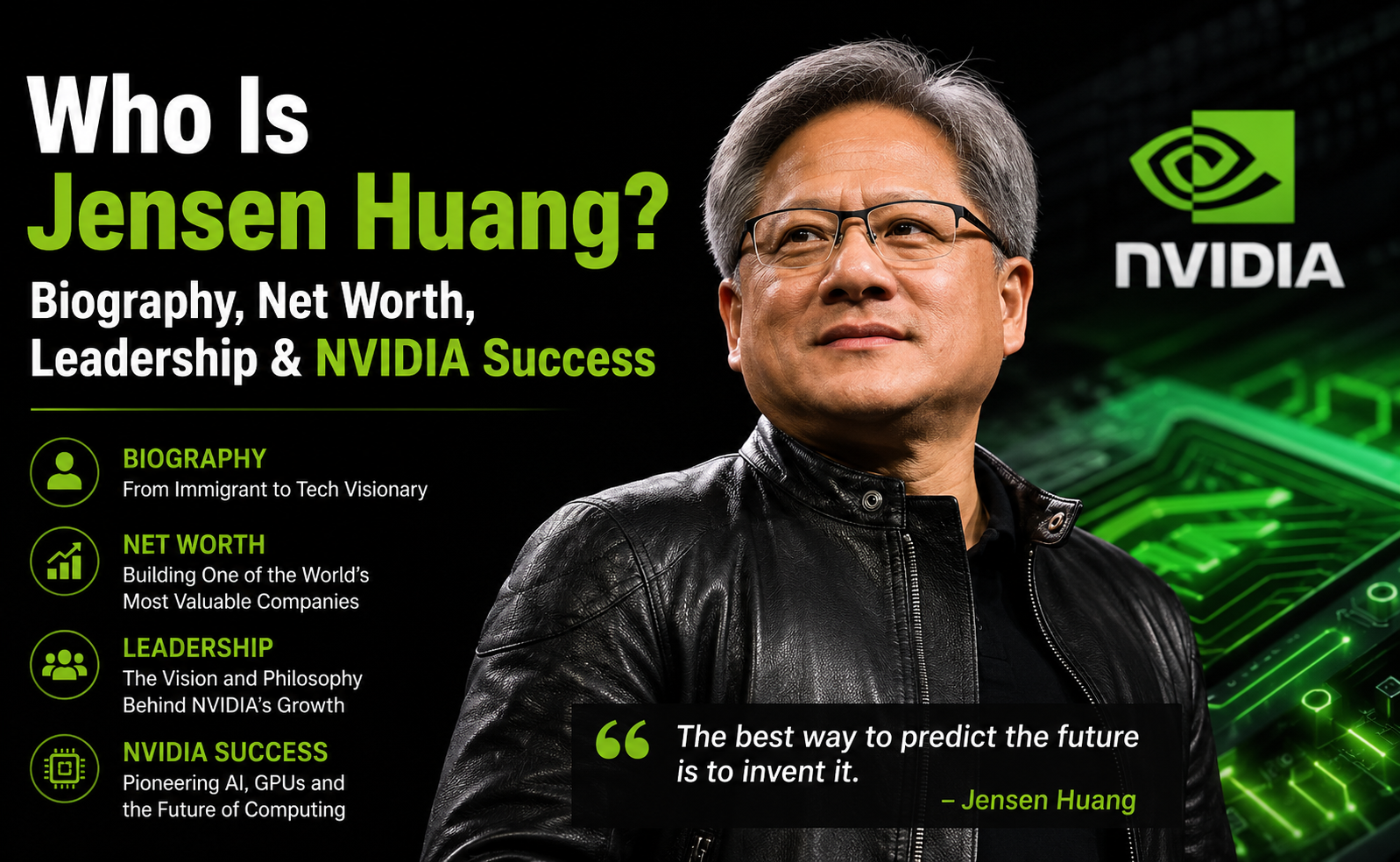
Jensen Huang is the co-founder, president, and CEO of NVIDIA, the global technology company that dominates the market for artificial intelligence chips and graphics processing units (GPUs). Under his guidance, NVIDIA transformed from a video game graphics startup into one of the most valuable companies in the world. He is highly recognizable for his signature leather jackets, his billionaire net worth, and a unique, highly accessible leadership style.
The technology landscape shifts constantly. Few figures have managed to anticipate these massive industry pivots as successfully as Jensen Huang. As the chief executive officer of NVIDIA, he has steered his company through multiple computing eras. He navigated the early days of personal computer gaming graphics, expanded into mobile computing, and ultimately positioned NVIDIA at the absolute center of the generative artificial intelligence boom.
Understanding the individual behind this massive corporate success offers valuable insights into modern corporate strategy. Business professionals and tech enthusiasts alike frequently look to top executives for clues on how to navigate complex markets. By examining the life and habits of the NVIDIA CEO, observers can learn how long-term vision and adaptability create lasting corporate value.
This comprehensive guide explores the life of Jensen Huang. We will examine his early biography, his immense net worth, his recognizable personal style, his family life, and the specific leadership habits that set him apart from other tech billionaires. Readers will gain a clear understanding of the principles that helped build a multi-trillion-dollar technology empire.
Where did Jensen Huang come from? A brief biography
Jen-Hsun “Jensen” Huang was born in Tainan, Taiwan, in 1963. His family relocated to Thailand when he was a child. Due to regional unrest, his parents sent him and his brother to the United States to live with relatives in Tacoma, Washington, before eventually settling in Aloha, Oregon. This early experience of adapting to new cultures and environments helped forge a resilient mindset.
Education played a foundational role in his trajectory. Jensen Huang attended Oregon State University, where he earned a bachelor’s degree in electrical engineering in 1984. He later pursued advanced studies, graduating with a master’s degree in electrical engineering from Stanford University in 1992. His academic background provided the deep technical knowledge required to understand complex hardware architecture.
The defining moment of his career occurred in 1993. Jensen Huang met with his friends Chris Malachowsky and Curtis Priem at a Denny’s restaurant in San Jose, California. The trio discussed the future of computing and identified a massive opportunity in creating specialized chips for rendering 3D graphics. They co-founded NVIDIA with just $40,000 in the bank. Under his continuous tenure as CEO, the company developed the Graphics Processing Unit (GPU), a technology that eventually became the engine for modern artificial intelligence systems.
What is Jensen Huang’s net worth and lifestyle?
The financial trajectory of the NVIDIA CEO mirrors the astronomical rise of his company’s stock. For decades, NVIDIA was a highly successful, yet niche, hardware manufacturer catering primarily to PC gamers and professional designers. However, the explosion of artificial intelligence technologies like ChatGPT dramatically increased the demand for NVIDIA’s high-performance hardware.
This surge in demand propelled the company’s valuation past the one-trillion, and eventually the two-trillion-dollar mark. Because Jensen Huang retains a significant percentage of NVIDIA shares, his personal fortune grew exponentially. By early 2024, his estimated net worth exceeded $70 billion, placing him firmly among the wealthiest individuals on the planet.
Despite his massive wealth, his lifestyle is heavily focused on his work. He is known to be intensely dedicated to the daily operations of NVIDIA. He invests heavily in philanthropy, specifically supporting education and technology initiatives. He donated $30 million to Stanford University to build the Jen-Hsun Huang Engineering Center, and he contributed $50 million to his alma mater, Oregon State University, for an innovation complex.
Key facts about Jensen Huang
| Attribute | Detail |
|---|---|
| Full Name | Jen-Hsun “Jensen” Huang |
| Birth Year | 1963 |
| Birthplace | Tainan, Taiwan |
| Education | Oregon State University (BS), Stanford University (MS) |
| Company | NVIDIA (Co-founded in 1993) |
| Current Title | Co-founder, President, and CEO |
| Notable Philanthropy | Stanford University ($30M), Oregon State University ($50M) |
Why does Jensen Huang always wear a leather jacket?
One of the most frequent questions asked about the NVIDIA founder revolves around his wardrobe. During keynote presentations, product launches, and earnings calls, Jensen Huang almost exclusively wears a black leather jacket. This sartorial choice has become deeply intertwined with his public persona and the NVIDIA brand identity.
The reasoning behind the black leather jacket is highly practical. Like many successful technology executives, Jensen Huang utilizes a strategy called “wardrobe fatigue reduction.” By adopting a personal uniform, he eliminates the daily mental effort required to choose an outfit. This allows him to reserve his cognitive energy for complex engineering problems and high-level corporate strategy.
Furthermore, the leather jacket projects a specific image. It stands out in a corporate world traditionally dominated by suits and ties, conveying a sense of rebellion, agility, and modern tech culture. Over the years, the jacket has evolved from a simple clothing choice into a highly recognizable trademark.
Who is Jensen Huang’s family?
While he is a highly visible public figure in the technology sector, Jensen Huang maintains a relatively private personal life. He met his wife, Lori Mills, while they were both studying engineering at Oregon State University. They were assigned as lab partners in an electrical engineering class, a partnership that eventually led to marriage.
The couple has two children together, a son named Spencer and a daughter named Madison. Both children have reportedly worked within the NVIDIA ecosystem in various capacities over the years. The Huang family prioritizes philanthropy, directing much of their charitable giving through their family foundation. They focus on funding higher education, public health initiatives, and engineering programs to support the next generation of innovators.
What are Jensen Huang’s unique leadership habits?
Jensen Huang approaches corporate leadership differently than most Fortune 500 CEOs. His methods reflect his background as an engineer and a startup founder. As NVIDIA grew from a small operation into a global powerhouse, he intentionally retained a flat organizational structure to maintain agility.
He has an unusually large span of control. Unlike traditional executives who limit their direct reports to a handful of vice presidents, Jensen Huang typically has around 50 direct reports. He believes this structure prevents information silos and ensures that the CEO remains closely connected to the actual work happening across the company. By eliminating layers of middle management, NVIDIA can make rapid decisions and pivot quickly when market conditions change.
Another defining leadership habit is his rejection of traditional status reports. He discourages formal presentations and polished slide decks. Instead, he asks employees to send him their “top five things” in a brief email. He frequently drops into meetings unexpectedly, regardless of the department or seniority level, to participate in problem-solving discussions. He emphasizes transparent communication, encouraging employees to openly admit mistakes so the organization can learn and adapt collectively.
Shaping the future of computing technology
Jensen Huang demonstrates how deep technical expertise, combined with adaptable leadership, can build a resilient and highly profitable enterprise. He identified the massive potential of accelerated computing long before the rest of the market caught on. By continuously reinvesting in research and development, he ensured NVIDIA was perfectly positioned to supply the hardware required for the artificial intelligence revolution.
Business professionals looking to emulate his success should focus on building a flat corporate structure, encouraging transparent communication, and maintaining a relentless focus on long-term innovation. Leaders who reduce bureaucratic friction and empower their teams are better equipped to navigate rapidly changing industries. To further explore the strategies of top technology executives, consider studying the growth models of other prominent Silicon Valley hardware companies.
Frequently Asked Questions About Jensen Huang
How much of NVIDIA does Jensen Huang own?
Jensen Huang owns approximately 3.5% of NVIDIA’s outstanding shares. Because NVIDIA’s total market capitalization has grown to multiple trillions of dollars, this single-digit percentage translates into tens of billions of dollars in personal wealth.
What did Jensen Huang do before founding NVIDIA?
Before co-founding NVIDIA in 1993, Jensen Huang worked as a director at LSI Logic, a semiconductor manufacturer. Prior to that role, he worked as a microprocessor designer at Advanced Micro Devices (AMD), a company that eventually became one of NVIDIA’s primary competitors in the GPU market.
Why is NVIDIA hardware so important for artificial intelligence?
NVIDIA originally designed Graphics Processing Units (GPUs) to render complex 3D video game graphics by performing thousands of small calculations simultaneously. Computer scientists later discovered that this parallel processing capability is exactly what is required to train massive machine learning models and generative artificial intelligence software efficiently.
What is Jensen Huang’s management style?
Jensen Huang employs a highly accessible and flat management style. He maintains roughly 50 direct reports, avoids scheduled one-on-one meetings, skips formal status reports, and encourages employees at all levels to communicate directly and transparently about both successes and failures.
