

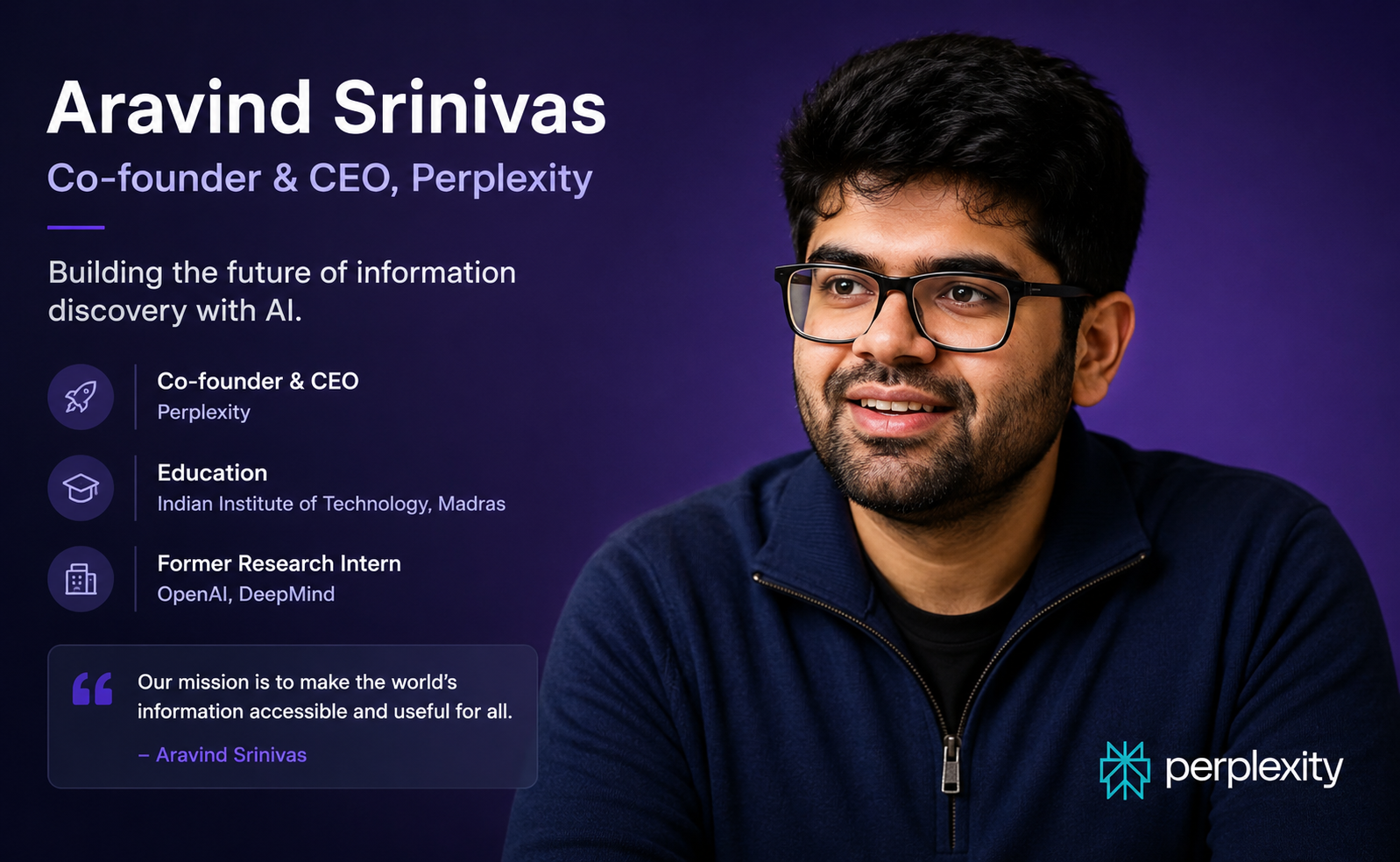
Aravind Srinivas is the CEO and co-founder of Perplexity AI, an innovative search engine powered by artificial intelligence. With a background featuring degrees from IIT Madras and a PhD from UC Berkeley, Srinivas has built a rapidly growing AI startup. His estimated net worth reflects Perplexity AI’s multi-billion-dollar valuation.
Search engines have remained largely unchanged for over two decades. Users type keywords into a simple text box, hit enter, and receive a long list of blue links. For years, navigating these links to find a specific answer felt like a necessary chore. Then, artificial intelligence started shifting the foundations of information retrieval. At the forefront of this massive technological shift is Aravind Srinivas, an AI researcher turned entrepreneur who decided to challenge the traditional search model directly.
As the CEO and co-founder of Perplexity AI, Aravind Srinivas has introduced a new way for users to find information online. Instead of providing links, Perplexity AI functions as an answer engine. It reads the internet in real-time and synthesizes direct, cited answers to complex queries. This approach has rapidly gained traction among millions of users, attracting significant attention from the biggest investors in Silicon Valley.
Understanding the trajectory of Aravind Srinivas provides valuable insights into the current artificial intelligence boom. This comprehensive blog post explores the life and career of Aravind Srinivas. You will learn about his rigorous educational background, the dramatic startup story behind Perplexity AI, and the financial milestones that have contributed to his estimated net worth. By examining his journey, aspiring founders and technology enthusiasts can uncover what it takes to build a prominent tech company today.
What is the educational background of Aravind Srinivas?
The foundation of any great artificial intelligence innovator often lies in deep, rigorous academic training. Aravind Srinivas possesses a highly distinguished educational background that equipped him with the technical expertise needed to build complex machine learning models. His academic journey spans two of the most prestigious engineering institutions in the world.
Undergraduate studies at IIT Madras
Aravind Srinivas began his higher education at the Indian Institute of Technology (IIT) Madras, one of the premier engineering schools in India. Securing a spot at IIT requires clearing the Joint Entrance Examination (JEE), known globally as one of the most difficult academic tests. At IIT Madras, Srinivas pursued a dual degree program, earning both his Bachelor of Technology and Master of Technology in Electrical Engineering. During his time in India, he developed a strong mathematical foundation, which is an essential prerequisite for advanced artificial intelligence research.
Doctoral research at UC Berkeley
After completing his studies at IIT Madras in 2017, Aravind Srinivas moved to the United States to pursue a Doctor of Philosophy (PhD) in Computer Science at the University of California, Berkeley. UC Berkeley houses one of the top artificial intelligence research labs in the world. Srinivas worked under the guidance of Pieter Abbeel, a globally recognized expert in deep reinforcement learning and robotics.
While at UC Berkeley, Aravind Srinivas focused his research on deep reinforcement learning, computer vision, and generative models. He published several influential papers that contributed to the broader machine learning community. His research aimed to make artificial intelligence systems more efficient and capable of understanding complex visual and textual data.
Key internships at leading AI labs
Academic research alone rarely provides the full picture of applied technology. To bridge the gap between theoretical research and practical application, Aravind Srinivas completed several high-profile internships during his PhD program.
He spent time working as a research scientist intern at OpenAI, the organization behind ChatGPT. He also interned at DeepMind, the London-based artificial intelligence lab acquired by Google. Furthermore, Srinivas gained experience at Google Brain. Working inside these industry-leading laboratories gave Srinivas firsthand exposure to the scale of compute power and engineering required to train large language models. He witnessed the rapid evolution of transformer architectures, which eventually became the underlying technology for Perplexity AI.
How did Aravind Srinivas build the startup Perplexity AI?
The transition from academic researcher to startup chief executive officer requires a massive shift in mindset. Aravind Srinivas made this leap in 2022 when he co-founded Perplexity AI. The startup story of Perplexity AI represents a masterclass in identifying market gaps, pivoting quickly, and executing a bold vision.
The initial idea and the pivot
Aravind Srinivas did not initially set out to build a search engine. In August 2022, Srinivas teamed up with his co-founders Denis Yarats, Johnny Ho, and Andy Konwinski. The founding team initially explored building an artificial intelligence tool that could translate natural language into SQL queries for database management. They wanted to help enterprise companies extract data easily without needing to write complex code.
However, the team quickly realized that the broader consumer market desperately needed a better way to find information online. Traditional search engines were becoming cluttered with advertisements and search-engine-optimized content that rarely answered the user’s actual question. Srinivas and his co-founders recognized that large language models could synthesize information and provide direct answers. They pivoted their startup focus to build a conversational answer engine.
Launching the conversational answer engine
In December 2022, Perplexity AI officially launched to the public. The product differentiated itself immediately by prioritizing accuracy and citations. Whenever a user asks Perplexity AI a question, the system searches the live internet, reads multiple sources, and generates a coherent paragraph. Crucially, the platform includes clickable footnote citations for every claim it makes. This design choice directly addresses the common problem of artificial intelligence “hallucinations,” allowing users to verify the information instantly.
Aravind Srinivas focused heavily on reducing latency. He understood that for Perplexity AI to compete with Google, the platform had to deliver answers in milliseconds. The engineering team optimized their infrastructure to ensure rapid response times, making the user experience seamless and highly addictive.
Securing massive venture capital funding
Building a search engine requires massive computational resources. To scale Perplexity AI, Aravind Srinivas needed to secure significant venture capital funding. Over the course of 18 months, Perplexity AI executed a series of highly successful funding rounds, attracting some of the most prominent investors in the technology sector.
The table below outlines the key funding rounds for Perplexity AI:
| Funding Round | Date | Amount Raised | Key Investors | Estimated Valuation |
|---|---|---|---|---|
| Seed Round | September 2022 | $3.1 Million | Elad Gil, Nat Friedman | $15 Million |
| Series A | March 2023 | $25.6 Million | NEA, Databricks Ventures | $150 Million |
| Series B | January 2024 | $73.6 Million | IVP, Jeff Bezos, Nvidia | $520 Million |
| Series B1 | April 2024 | $62.7 Million | Daniel Gross, Stanley Druckenmiller | $1.04 Billion |
| Series C | Mid 2024 (Reported) | $250 Million | SoftBank Vision Fund 2 | $3.0 Billion |
By securing investments from tech billionaires like Jeff Bezos and major corporations like Nvidia, Aravind Srinivas solidified Perplexity AI’s position as a serious contender in the artificial intelligence race. The rapid increase in valuation from $15 million to over $3 billion in less than two years highlights the immense market demand for a new search paradigm.
What is the estimated net worth of Aravind Srinivas?
When a startup reaches a multi-billion-dollar valuation, the financial standing of its founders naturally becomes a topic of public interest. Because Perplexity AI remains a private company, the exact net worth of Aravind Srinivas is not publicly documented in financial filings like the SEC forms required for public corporations. However, industry analysts can estimate his net worth based on standard venture capital ownership structures.
Calculating founder equity
In typical venture-backed technology startups, the founding team dilutes their ownership percentage with each successive funding round. Investors provide capital in exchange for equity. By the time a startup reaches a Series C funding round, a chief executive officer typically retains anywhere from 10 percent to 20 percent ownership of the company, depending on how equity was initially split among co-founders and the specific terms negotiated with venture capitalists.
Net worth estimations based on Perplexity AI’s valuation
As of mid-2024, private market investors valued Perplexity AI at approximately $3 billion.
If Aravind Srinivas holds a 10 percent equity stake in Perplexity AI, his shares would be worth roughly $300 million. If he managed to retain a higher equity stake of 15 percent to 20 percent, his paper net worth could range between $450 million and $600 million.
It is crucial to understand that this estimated net worth is almost entirely tied up in illiquid startup equity. Unlike publicly traded stocks, Aravind Srinivas cannot simply sell all his shares on the open market tomorrow. His actual liquid wealth is likely much lower, comprising his executive salary and any secondary stock sales he may have executed during the later funding rounds. Nonetheless, his paper wealth firmly establishes him as one of the most successful young entrepreneurs in the artificial intelligence sector today.
What can tech entrepreneurs learn from Aravind Srinivas?
The rapid ascent of Aravind Srinivas offers several actionable lessons for aspiring technology founders. First, deep technical expertise provides a massive advantage. Srinivas did not just have a good idea; his PhD from UC Berkeley and internships at OpenAI gave him the technical credibility to build a highly complex product and attract top engineering talent.
Second, founders must be willing to pivot. If the Perplexity AI team had stubbornly stuck to their original text-to-SQL idea, they would have missed out on the massive consumer search market. Identifying when a product is not achieving massive scale and pivoting toward a more pressing consumer pain point is a critical entrepreneurial skill.
Finally, building trust with users is paramount. By choosing to prioritize citations and factual accuracy, Aravind Srinivas differentiated Perplexity AI from other generative artificial intelligence chatbots. If you are building a consumer product, prioritize features that directly solve user frustrations.
To explore the technology Aravind Srinivas built, you can visit the Perplexity AI website and test the search engine for yourself. Analyzing how the platform handles complex queries will give you a firsthand look at the future of information retrieval.
Frequently Asked Questions about Aravind Srinivas
Who is Aravind Srinivas?
Aravind Srinivas is an artificial intelligence researcher and technology entrepreneur. He is best known as the co-founder and Chief Executive Officer of Perplexity AI, an AI-powered search engine that provides direct, cited answers to user queries.
What did Aravind Srinivas study at UC Berkeley?
At the University of California, Berkeley, Aravind Srinivas earned his PhD in Computer Science. His academic research focused heavily on deep reinforcement learning, generative models, and computer vision.
How does Perplexity AI make money?
Perplexity AI operates on a freemium business model. The company offers a free version of its search engine to the general public. Additionally, the company generates revenue through Perplexity Pro, a paid subscription service that gives users access to more advanced artificial intelligence models, unlimited file uploads, and enhanced search capabilities.
Did Aravind Srinivas work at OpenAI?
Yes, Aravind Srinivas worked at OpenAI as a research scientist. He also completed research internships at Google Brain and DeepMind before leaving to found Perplexity AI in 2022.
Who invested in Aravind Srinivas’s company, Perplexity AI?
Perplexity AI has secured funding from several high-profile investors and venture capital firms. Notable investors include Amazon founder Jeff Bezos, artificial intelligence chipmaker Nvidia, Institutional Venture Partners (IVP), New Enterprise Associates (NEA), and SoftBank.
