Quantum computing is one of the most exciting technological developments of the modern era. While traditional computers have transformed the way people work, communicate, and solve problems, quantum computers promise to take computing power to an entirely new level. Over the past few years, governments, research institutions, and technology companies have invested billions of dollars into quantum computing research because of its potential to solve problems that are currently impossible for conventional computers.
For beginners, quantum computing can seem confusing because it relies on concepts from quantum physics, a field known for its complexity. However, understanding the basic ideas does not require a degree in physics. At its core, quantum computing is a new way of processing information using the strange and powerful rules that govern the behavior of particles at the atomic and subatomic level. By leveraging these unique properties, quantum computers can perform certain calculations much faster than traditional computers.
How Do Traditional Computers Process Information in Everyday Computing?
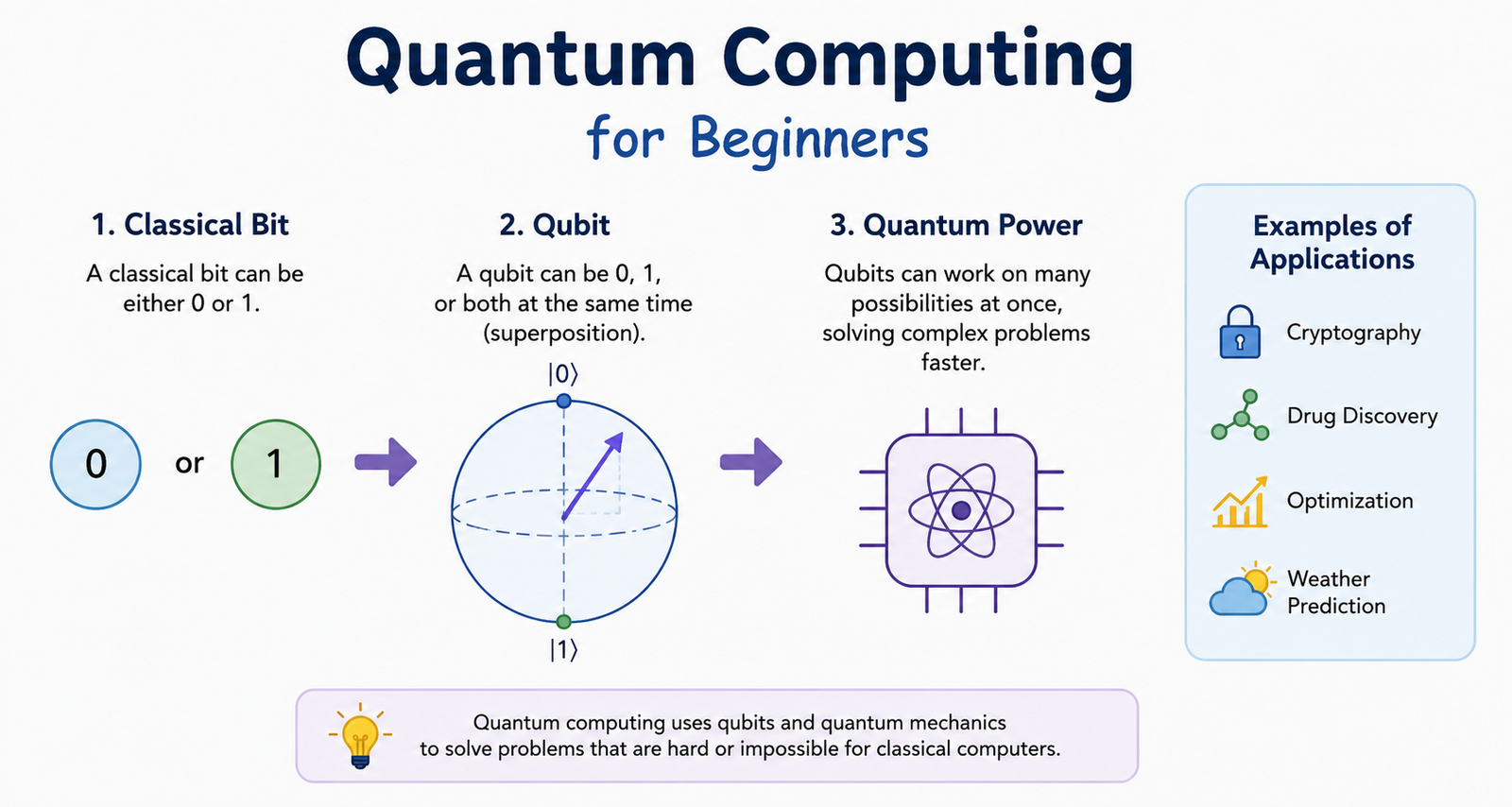
To understand quantum computing, it is important to first understand how traditional computers work. Every device you use today, including laptops, smartphones, gaming consoles, and servers, relies on bits to process information. A bit is the smallest unit of data and can only exist in one of two states: 0 or 1.
These bits are combined into larger groups to represent text, images, videos, and software instructions. Traditional computers perform calculations by manipulating these bits through logical operations. Although modern computers are incredibly powerful, they still process information using combinations of zeros and ones.
For many everyday tasks, traditional computers are more than sufficient. They can browse the internet, run applications, stream videos, and perform complex calculations. However, some scientific and mathematical problems become so complicated that even the fastest supercomputers would need thousands or millions of years to solve them. This limitation is where quantum computing begins to offer new possibilities.
What Makes Quantum Bits Different from Regular Computer Bits?
The fundamental building block of a quantum computer is called a quantum bit, or qubit. Unlike a traditional bit that must be either 0 or 1, a qubit can exist in multiple states simultaneously due to a quantum phenomenon known as superposition.
Imagine flipping a coin into the air. While it is spinning, it is not strictly heads or tails. It has the potential to be either until it lands. Similarly, a qubit can represent both 0 and 1 at the same time until it is measured. This ability allows quantum computers to explore many possible solutions simultaneously rather than checking them one by one.
Because qubits can hold more information than traditional bits, quantum computers can process certain types of calculations much more efficiently. This unique characteristic is one of the main reasons why researchers believe quantum computing could revolutionize many industries in the future.
Why Is Superposition Considered One of the Most Powerful Quantum Features?
Superposition is often described as the secret ingredient that gives quantum computers their extraordinary potential. In a classical computer, adding more bits increases computing power in a predictable way. In a quantum computer, adding more qubits dramatically expands the number of possible states that can be represented simultaneously.
For example, a system with only a few qubits can represent many combinations at once. As more qubits are added, the computational possibilities grow exponentially. This means a sufficiently powerful quantum computer could analyze enormous datasets and solve highly complex problems much faster than today’s computers.
Superposition allows quantum computers to evaluate multiple possibilities in parallel. While this does not automatically make every task faster, it provides a significant advantage for specific types of problems, such as optimization, cryptography, and molecular simulations.
How Does Quantum Entanglement Create New Computing Possibilities?
Another important concept in quantum computing is entanglement. Quantum entanglement occurs when two or more qubits become connected in such a way that the state of one qubit is directly related to the state of another, regardless of the distance between them.
This phenomenon has fascinated scientists for decades because it appears to create a unique relationship between particles. In quantum computing, entanglement enables qubits to work together in highly coordinated ways. This coordination allows quantum computers to perform calculations that would be extremely difficult or impossible for traditional machines.
Entanglement enhances the processing capabilities of quantum systems by enabling them to represent and manipulate information more efficiently. Combined with superposition, it forms the foundation of quantum computing’s remarkable computational power.
Why Could Quantum Computing Solve Problems That Challenge Supercomputers?
Traditional supercomputers are incredibly fast, but they still rely on classical bits and conventional processing methods. Certain problems involve so many variables and possibilities that checking every option individually becomes impractical.
Quantum computers approach these challenges differently. By using superposition and entanglement, they can explore vast numbers of potential solutions simultaneously. This capability could dramatically reduce the time needed to solve specific complex problems.
For example, tasks involving molecular modeling, financial optimization, supply chain management, and advanced scientific simulations may benefit significantly from quantum computing. Researchers believe that quantum computers could help discover new materials, improve energy storage technologies, and accelerate pharmaceutical development.
Although quantum computers are not expected to replace traditional computers entirely, they could become powerful tools for solving highly specialized problems.
What Real-World Applications Could Benefit from Quantum Computing in the Future?
Quantum computing has the potential to impact numerous industries. One major area is healthcare and drug discovery. Developing new medicines often requires simulating molecular interactions, a process that can be extremely complex for classical computers. Quantum computers may enable researchers to model these interactions more accurately and efficiently.
The financial sector could also benefit from quantum computing. Financial institutions constantly analyze market trends, investment opportunities, and risk factors. Quantum algorithms may improve optimization processes and help organizations make better decisions.
Logistics and transportation companies could use quantum computing to optimize delivery routes, reduce fuel consumption, and improve supply chain efficiency. Additionally, researchers are exploring how quantum computers could contribute to artificial intelligence by enhancing machine learning models and data analysis techniques.
Cybersecurity is another important area. While quantum computing may eventually threaten some existing encryption methods, it is also driving the development of new quantum-resistant security technologies.
What Challenges Are Preventing Quantum Computers from Becoming Mainstream Today?
Despite the excitement surrounding quantum computing, significant challenges remain. One of the biggest obstacles is maintaining qubit stability. Quantum states are extremely delicate and can be disrupted by heat, electromagnetic interference, or other environmental factors.
This problem, known as quantum decoherence, makes it difficult to perform reliable calculations for extended periods. Researchers must carefully isolate quantum systems and use sophisticated error-correction techniques to maintain accuracy.
Another challenge is scalability. Building a quantum computer with a large number of stable, error-corrected qubits is incredibly difficult and expensive. Current quantum computers are still in the early stages of development and are not yet capable of solving many practical real-world problems better than classical computers.
Scientists and engineers continue to work on improving hardware, software, and quantum algorithms to overcome these limitations.
How Close Are We to a Future Powered by Quantum Computers?
The quantum computing industry is advancing rapidly, but fully practical quantum computers are still a work in progress. Major technology companies, universities, and research organizations are investing heavily in this field because they believe the long-term benefits could be transformative.
Many experts compare the current state of quantum computing to the early days of classical computing several decades ago. Early computers were large, expensive, and limited in capability. Over time, technological breakthroughs made computers smaller, faster, and more accessible.
A similar evolution may occur with quantum computing. While widespread adoption could take years or even decades, ongoing research continues to bring the technology closer to practical applications.
What Should Beginners Remember About Quantum Computing Moving Forward?
For beginners, the most important thing to understand is that quantum computing represents a fundamentally different approach to processing information. Instead of relying solely on bits that exist as 0 or 1, quantum computers use qubits that can leverage superposition and entanglement to perform powerful calculations.
Although the technology remains in its early stages, its potential applications are enormous. From advancing medicine and artificial intelligence to improving cybersecurity and solving scientific mysteries, quantum computing could reshape many aspects of modern life.
As research progresses, quantum computing is likely to become one of the defining technologies of the twenty-first century. Learning the basics today provides a valuable foundation for understanding the innovations that may transform the world tomorrow. Whether you are a student, technology enthusiast, or curious learner, keeping an eye on quantum computing could help you stay ahead of one of the most fascinating technological revolutions of our time.
