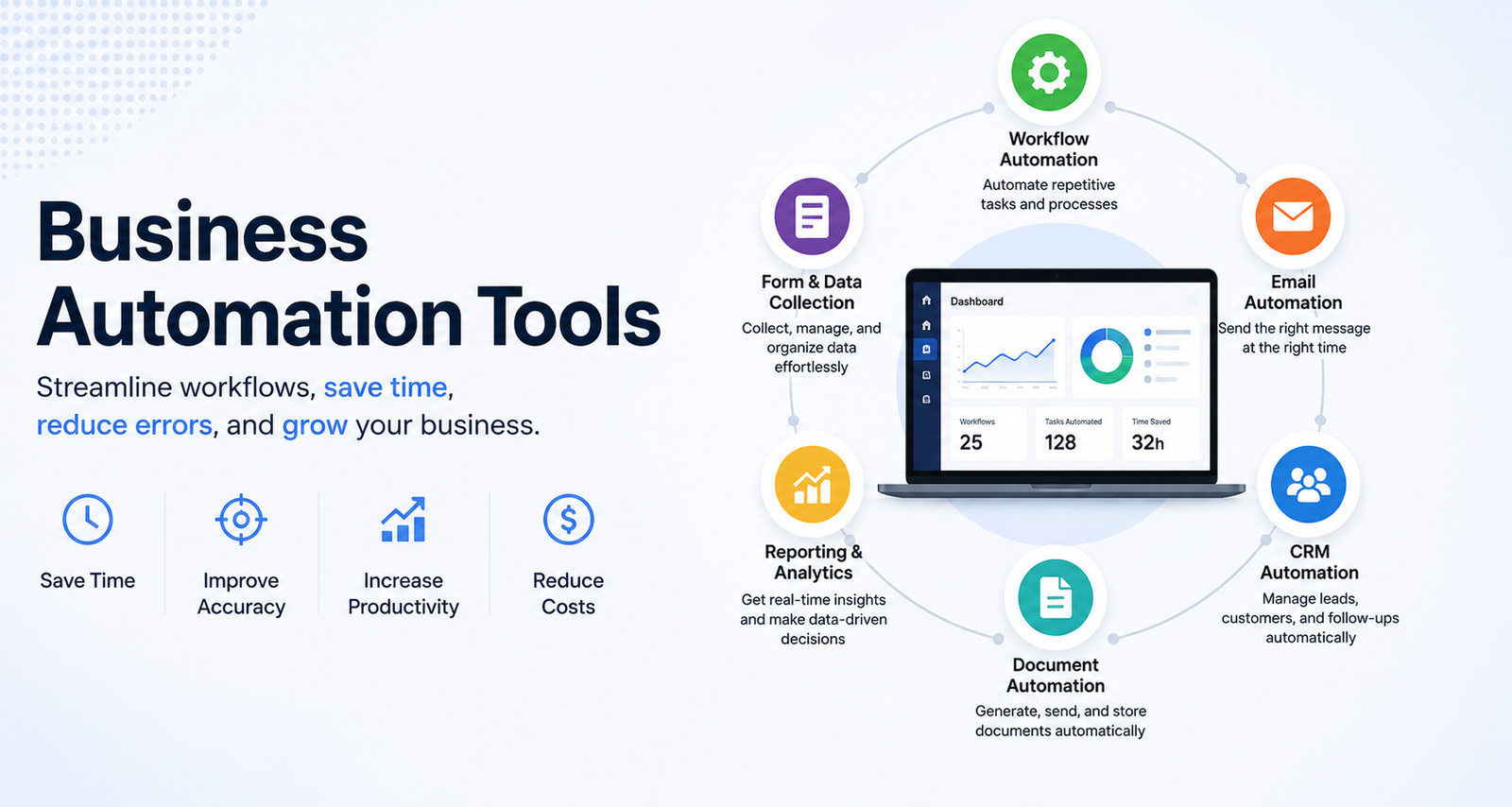
Business automation tools help companies eliminate repetitive manual tasks, reduce errors, and scale operations efficiently. In this interview, automation entrepreneur Sarah Chen shares how she built a thriving business around this need—and what founders can learn from her journey.
Spreadsheets. Sticky notes. Seventeen browser tabs open at once. For millions of small business owners, this is the daily reality of running operations without automation. The problem isn’t a lack of effort—it’s a lack of the right tools.
Sarah Chen knows this better than most. As the founder of FlowStack, a workflow automation platform built for small and mid-sized businesses, she’s spent the last four years helping companies reclaim hours lost to manual processes. Before launching FlowStack, she watched her family’s logistics business buckle under administrative overhead that no one had the time—or budget—to fix.
Her story is a compelling reminder that the best business ideas don’t always come from a whiteboard. Sometimes, they come from lived frustration. We sat down with Sarah to talk origins, obstacles, and what the future of business automation actually looks like.
What Inspired Sarah Chen to Build a Business Automation Platform?
What was the spark behind FlowStack?
“Honestly, it was watching my parents,” Sarah says. “They ran a small freight company for 20 years. Smart, hardworking people—but they were spending four to five hours a day on tasks that a decent system could have handled in minutes. Invoice follow-ups, scheduling, data entry across three separate tools. It was exhausting just to watch.”
After working in enterprise software for nearly a decade, Sarah began to see a clear gap. Large corporations had access to sophisticated automation infrastructure. Everyone else was making do with duct tape and manual effort.
“There was a specific moment,” she recalls. “I was helping my dad reconcile shipping records on a Sunday afternoon. He pulled out a printed spreadsheet from 2019 to cross-reference something. I thought—this can’t be how it still works. And for most SMBs, it was.”
What Customer Pain Point Does FlowStack Address?
The problem FlowStack targets is deceptively simple: small businesses waste enormous amounts of time on repetitive, low-value tasks that don’t require human judgment.
“The pain point is that business owners are doing $15-an-hour work when they should be doing $150-an-hour thinking,” Sarah explains. “Order confirmations, appointment reminders, data syncing between platforms—none of that needs a human. But without automation, someone has to do it manually, every single day.”
The people most affected tend to be founder-led businesses with lean teams—typically between 5 and 50 employees—where there’s no dedicated operations manager and the CEO is often doing tasks that don’t belong anywhere near their desk.
Currently, most small businesses solve this problem with a patchwork of tools: Zapier for some connections, a VA for others, and manual workarounds for everything in between. It works, barely, until growth breaks it.
How Does FlowStack’s Solution Differ From Existing Business Automation Tools?
FlowStack is a no-code workflow automation platform that connects a business’s existing tools—CRMs, email platforms, accounting software, scheduling apps—and automates the handoffs between them.
“We built FlowStack specifically for people who are not technical,” Sarah says. “You shouldn’t need an IT team to automate your invoice reminders. Our drag-and-drop workflow builder means a business owner can set something up in 20 minutes, not two weeks.”
What sets FlowStack apart from broader automation platforms is its focus on pre-built workflow templates tailored to specific industries. A physiotherapy clinic has different automation needs than a boutique law firm. FlowStack’s template library accounts for that.
“Our customers tell us the templates are what got them over the line,” Sarah notes. “They didn’t have to figure out what to automate first—we’d already mapped out the 10 workflows their type of business needs most.”
How Large Is the Market Opportunity for Business Automation Tools?
The timing for a product like FlowStack is difficult to ignore. According to McKinsey, approximately 60% of occupations have at least 30% of activities that could be automated with current technology. Yet adoption among small businesses remains far below that potential.
“The market is enormous and still largely untapped at the SMB level,” Sarah says. “Enterprise automation is mature. But the 33 million small businesses in the US alone? Most of them are still figuring out their first workflow.”
FlowStack’s primary target audience is service-based SMBs in industries like professional services, healthcare administration, and e-commerce—businesses with high transaction volumes and repetitive back-office processes.
Key trends supporting the business include the normalization of remote work (which exposed fragile manual processes), the rise of AI-assisted automation, and a generational shift toward tech-comfortable business owners who expect software to do more.
What Business Model Does FlowStack Use?
FlowStack operates on a subscription-based SaaS model, with three pricing tiers based on the number of active workflows and team members. There’s a free tier for solopreneurs, a Growth plan at $49/month, and a Business plan at $149/month that includes priority support and advanced integrations.
“We deliberately kept the entry point low,” Sarah explains. “A lot of our best customers started on the free plan, got a taste of what automation could do, and upgraded within 60 days. The product has to earn the upgrade.”
Secondary revenue comes from a partner program, where FlowStack earns referral fees from software integrations, and from a professional services arm that helps larger clients with custom workflow builds.
What Were the Biggest Challenges in Building FlowStack?
Getting the product right took longer than expected. Sarah’s first version of FlowStack was too flexible—it could do almost anything, which meant new users had no idea where to start.
“We had terrible activation rates early on,” she admits. “People would sign up, poke around, and leave. The product was powerful but not intuitive. That was a painful lesson in the difference between features and value.”
The fix came after 40 customer interviews in six weeks. The insight: people didn’t want a blank canvas. They wanted a starting point.
“We cut half the features, added 30 templates, and rewrote the onboarding flow. Activation tripled within a quarter. Sometimes building less is actually building more.”
Her advice for early-stage founders? Talk to customers before you build, not after. “I was so convinced I knew the problem that I skipped validation. Don’t do that.”
What Growth and Traction Has FlowStack Achieved?
FlowStack crossed 4,000 paying customers in its third year of operation, with a monthly recurring revenue (MRR) growth rate of 18% over the past six months. Customer churn sits below 4% monthly—a figure Sarah attributes to the stickiness of automation once it’s embedded in daily operations.
“Once someone automates their client onboarding, they’re not going back to doing it manually,” she says. “That’s the magic of the product category. It earns loyalty just by working.”
The platform has processed over 12 million automated workflow runs to date. The most popular automation? Invoice follow-up sequences, followed by appointment reminder flows.
What Are FlowStack’s Plans for the Next Three Years?
The roadmap centers on two major initiatives: an AI layer and international expansion.
“We’re building AI into the workflow builder so it can suggest automations based on what it observes in your account,” Sarah explains. “You connect your CRM, and FlowStack notices that your leads sit untouched for 48 hours after a demo. It flags that and offers to build a follow-up sequence. Proactive, not reactive.”
On expansion, FlowStack is targeting the UK and Australian markets in the next 12 to 18 months, with localized templates and compliance features for each region.
“Success, to me, is being the default automation layer for the businesses that don’t have an operations team. If we can be the tool that every 10-person company installs in their first year—that’s the vision.”
What Advice Does Sarah Chen Have for Aspiring Entrepreneurs?
Sarah’s most consistent advice centers on constraint and focus.
“Pick one problem, one customer type, and one distribution channel. Most early-stage founders try to solve too much for too many people through too many channels. You end up with noise instead of traction.”
The resources she found most valuable: “Obviously Zero to One and The Mom Test—those are the classics for good reason. But honestly, talking to 10 actual customers taught me more than any book.”
If she were starting again, she’d invest earlier in content marketing. “We grew mostly through word of mouth for the first two years, which was great but slow. Good SEO content compounds over time. I’d start that from month one.”
The Automation Opportunity Is Still Wide Open
Sarah Chen’s journey with FlowStack reflects a broader truth about business automation tools: the technology has never been more accessible, but adoption still lags far behind potential. For the millions of small business owners still managing operations manually, the cost isn’t just time—it’s growth left on the table.
The conversation with Sarah leaves one clear takeaway: automation isn’t a luxury reserved for enterprise. The right tools, designed with simplicity in mind, can transform how any business operates—regardless of size or budget.
To explore FlowStack and see which workflows you can automate today, visit flowstack.io. You can also follow Sarah’s journey and get weekly automation tips by subscribing to the FlowStack newsletter.
“The best automation is the one you actually use,” Sarah says. “Start small, prove the value, and build from there.”
Frequently Asked Questions About Business Automation Tools
What are business automation tools?
Business automation tools are software platforms that replace manual, repetitive tasks with automated workflows. They connect existing business applications—such as CRMs, email platforms, and accounting software—and trigger actions automatically based on predefined rules, saving time and reducing human error.
Which types of businesses benefit most from automation tools?
Service-based small and mid-sized businesses with high transaction volumes benefit most. This includes professional services firms, healthcare administrators, e-commerce operators, and any business where staff regularly perform the same multi-step tasks across multiple tools.
How much do business automation tools typically cost?
Costs vary widely. Entry-level tools like Zapier and Make offer free tiers with limited runs per month. Paid plans typically range from $20 to $200 per month depending on the number of workflows, users, and integrations. Enterprise-grade platforms can cost significantly more.
What is the difference between Zapier and a platform like FlowStack?
Zapier is a general-purpose integration tool that connects thousands of apps. Platforms like FlowStack are designed for specific business audiences—in FlowStack’s case, SMBs—and typically offer industry-specific templates and simpler onboarding. Choose Zapier if you need broad integration coverage; choose a specialized tool if you want faster time-to-value for a specific use case.
Do you need technical skills to use business automation tools?
Most modern business automation platforms are designed for non-technical users. No-code tools like FlowStack use drag-and-drop interfaces and pre-built templates, meaning business owners can set up workflows without any programming knowledge.
How long does it take to automate a business process?
Simple workflows—like sending a follow-up email after a form submission—can be set up in under 30 minutes using a no-code platform. More complex, multi-step automations involving several tools and conditional logic may take a few hours or require professional setup assistance.
