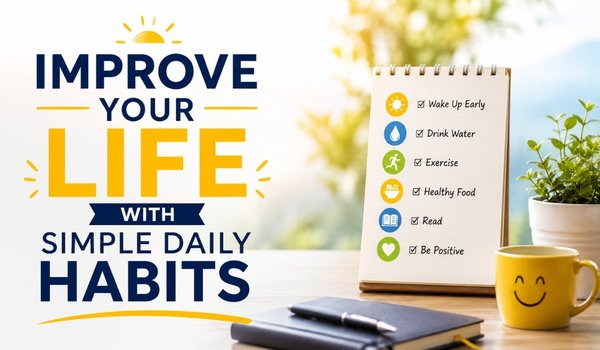
Improve Your Life with Simple Daily Habits That Create Lasting Health and Happiness
Improving your life doesn’t require dramatic overhauls. Small, consistent changes—like building a morning routine, moving your body daily, and managing your mental energy—compound over time into meaningful, lasting results. The most effective improvements are the ones you can actually stick to.
Most self-improvement advice sounds great on paper and falls apart by Wednesday. You’ve probably read the listicles, watched the videos, and maybe even bought the journal. Yet somehow, Monday rolls around and everything feels the same.
Here’s the thing: real, lasting improvement rarely comes from a single grand gesture. Research consistently shows that small, repeatable behaviors—what behavioral scientists call “habit loops”—are the primary drivers of long-term change. According to a study published in the European Journal of Social Psychology, it takes an average of 66 days for a new behavior to become automatic, not the commonly cited 21 days. That means most people quit too early, right before the habit begins to stick.
This post breaks down practical, evidence-backed ways to improve your life across the areas that matter most: your health, your mindset, your relationships, and your daily structure. No sweeping overhauls. No unrealistic expectations. Just changes that are small enough to start today and meaningful enough to matter a year from now.
Whether you’re feeling stuck, overwhelmed, or simply curious about what a better version of your daily routine could look like, this guide is for you.
How Does Building a Consistent Morning Routine Actually Improve Your Life?
The first hour of your day sets the tone for everything that follows. Neuroscientists refer to this as “proactive control”—the ability to structure your environment in advance so your brain doesn’t have to make as many reactive decisions under pressure.
A strong morning routine doesn’t need to be elaborate. It needs to be consistent. Start by anchoring three simple habits back-to-back: drink a glass of water as soon as you wake up, spend five minutes moving your body (a stretch, a short walk, or even dancing in your kitchen), and avoid checking your phone for at least the first 20 minutes. This last one is harder than it sounds, but it’s also one of the highest-impact changes you can make. Checking your phone first thing floods your brain with external demands before you’ve had a chance to set your own intentions.
Over time, a stable morning routine reduces decision fatigue—a real cognitive phenomenon where the quality of your decisions deteriorates after a long series of choices. By automating your mornings, you preserve your best mental energy for the decisions that actually matter.
What Are the Most Effective Small Daily Habits for Long-Term Well-Being?
The science of well-being points clearly toward a handful of daily habits that consistently outperform others in terms of impact. These aren’t groundbreaking discoveries. They’re simple practices that most people know about but underestimate.
Move your body every day, even if only briefly. The World Health Organization recommends at least 150 minutes of moderate-intensity physical activity per week for adults. That works out to about 22 minutes a day—a single walk around the block. Regular movement reduces the risk of depression by up to 30%, according to research published in JAMA Psychiatry (2019). You don’t need a gym membership or a structured workout plan to see benefits. Consistency matters far more than intensity.
Prioritize sleep above almost everything else. Sleep deprivation affects cognitive function, emotional regulation, metabolism, and immune health. The Centers for Disease Control and Prevention (CDC) reports that about 1 in 3 American adults don’t get enough sleep on a regular basis. Most adults need between 7 and 9 hours per night. If you’re sacrificing sleep to be more productive, you’re likely doing the opposite—sleep-deprived brains are measurably less focused, creative, and resilient.
Eat one more vegetable than you ate yesterday. Nutritional improvement doesn’t require a complete dietary overhaul. Research published in The Lancet (2019) found that a diet low in fruits, vegetables, and whole grains was one of the leading risk factors for disease globally. Small, additive changes—rather than restrictive diets—tend to produce more sustainable outcomes because they don’t trigger the psychological resistance that comes with deprivation.
How Can Changing Your Mindset Lead to Measurable Life Improvements?
Mindset isn’t just motivational rhetoric. Stanford psychologist Dr. Carol Dweck’s decades of research on “growth mindset” demonstrate that people who believe their abilities can be developed through effort and learning consistently outperform those who view their traits as fixed. This difference shows up in everything from academic achievement to career progression and relationship quality.
Adopting a growth mindset in practice means changing how you respond to failure. Rather than treating a setback as evidence of a fixed limitation, try reframing it as information. Ask: What did this reveal about what I need to learn or do differently? That single shift—from judgment to curiosity—changes the entire emotional experience of difficulty.
Journaling is one of the most accessible tools for building this kind of self-awareness. A 2018 study published in the Journal of Experimental Psychology found that expressive writing reduced intrusive thoughts about negative events and improved working memory. You don’t need to write for long. Even five minutes of free-form reflection at the end of the day can help you process experiences, spot patterns in your thinking, and gradually improve the quality of your inner dialogue.
Why Do Strong Relationships Have Such a Significant Impact on Life Quality?
According to the Harvard Study of Adult Development—one of the longest-running studies on human happiness, spanning over 80 years—close relationships are the single strongest predictor of long-term health and happiness. More than wealth, fame, or professional achievement.
Most people know relationships matter. Fewer people actively invest in them. In practice, improving your relationships often comes down to two habits: showing up consistently and listening more carefully.
Consistency means returning phone calls, remembering important dates, and checking in without a specific reason. These small gestures communicate that someone is a priority in your life, and they compound over time into a sense of security and trust that sustains relationships through difficult periods.
Listening—genuinely listening, rather than waiting for your turn to speak—is rarer than most people assume. Active listening involves asking follow-up questions, reflecting back what you’ve heard, and sitting with discomfort rather than rushing to offer solutions. It’s a skill that can be practiced and improved, and it transforms the quality of nearly every interaction.
How Does Managing Your Digital Environment Help You Live a Better Life?
The average American spends about 7 hours per day looking at screens, according to research by DataReportal (2023). A significant portion of that time is passive consumption—scrolling social media, watching videos, or reading content that was algorithmically selected to keep you engaged rather than informed or enriched.
Reclaiming even one hour of that time each day—and redirecting it toward something that genuinely matters to you—adds up to about 365 hours per year. That’s the equivalent of nine 40-hour workweeks.
Start by auditing your phone’s screen time settings honestly. Identify the apps that consume the most time and ask whether the return on that investment is worth it. For many people, social media use is associated with comparison, anxiety, and a fragmented sense of attention. Setting a daily time limit on high-consumption apps is a small change with an outsized effect on focus and mental clarity.
What Role Does a Sense of Purpose Play in Everyday Life Satisfaction?
Viktor Frankl, the psychiatrist and Holocaust survivor who founded logotherapy, argued that the primary human drive is not pleasure but the pursuit of meaning. His work suggests that people who feel their life has purpose are more resilient, more motivated, and better able to tolerate difficulty.
You don’t need to find one overarching life purpose to experience this benefit. Research from the University of Michigan (2020) found that people who reported even small, daily moments of meaning—helping a colleague, completing a creative project, spending time in nature—showed higher levels of life satisfaction than those chasing a singular, grand purpose.
One useful practice is to identify three things at the end of each day that felt meaningful, however small. This trains your attention to notice positive experiences rather than defaulting to a negativity bias, which is a well-documented feature of human cognition. Over weeks and months, this shift accumulates into a genuinely different experience of daily life.
The Most Sustainable Way to Improve Your Life Is to Start Smaller Than You Think
Grand ambitions are easy to generate and hard to sustain. The people who make the most lasting improvements to their lives tend to be those who resist the urge to overhaul everything at once. They pick one small habit, practice it until it becomes automatic, and then build on it.
Start with what’s easiest. Add a glass of water to your morning. Take a 10-minute walk after dinner. Put your phone in another room for the first 20 minutes of your day. Call one person you’ve been meaning to reach out to. Write three sentences before you go to sleep.
None of these actions are dramatic. Together, over time, they are transformative.
Frequently Asked Questions
How long does it take to see results from small daily habit changes?
Research published in the European Journal of Social Psychology found that new habits take an average of 66 days to become automatic, though this varies between individuals and behaviors. Most people begin to notice improvements in energy, mood, and focus within the first two to four weeks of consistent change.
What is the single most impactful change you can make to improve your life quickly?
Sleep quality is consistently ranked as one of the highest-leverage improvements you can make. Adequate sleep (7–9 hours for most adults) directly affects mood, cognitive performance, physical health, and emotional regulation. Improving sleep hygiene often produces noticeable benefits within days.
How do you improve your life when you feel overwhelmed and don’t know where to start?
Start with the smallest possible action. Behavioral scientists call this “habit stacking”—attaching a new behavior to an existing routine. For example, drinking a glass of water immediately after brushing your teeth requires no extra time or decision-making. Building momentum with micro-habits reduces overwhelm and creates a foundation for larger changes.
Is it better to focus on improving one area of life at a time or multiple areas simultaneously?
Focusing on one area at a time tends to produce more reliable results. According to research on habit formation, willpower and self-regulation are limited resources that deplete with use. Concentrating your effort on a single habit change preserves cognitive resources and increases the likelihood of long-term success.
How does improving your mental health contribute to improvements in other areas of your life?
Mental health improvements create a cascade effect. Better emotional regulation leads to higher-quality relationships. Reduced anxiety improves sleep. Greater clarity of thought enhances decision-making and productivity. According to the World Health Organization, mental health is foundational to overall well-being—treating it as a priority, rather than an afterthought, produces benefits across virtually every other area of life.
Every business deserves a strong online presence that drives results. Achieve your goals with LinkLuminous and its comprehensive digital services.
