

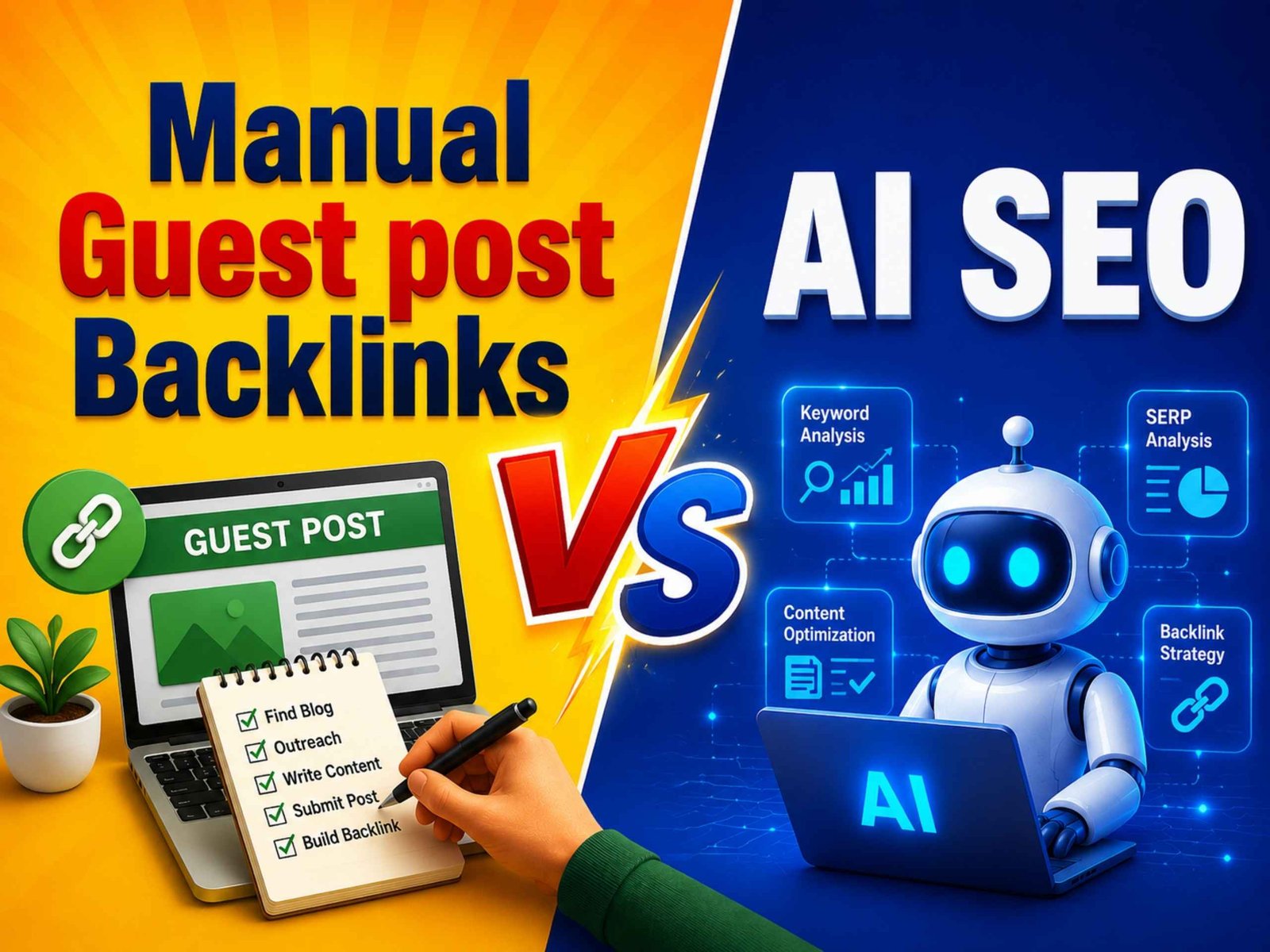
Two powerful approaches to organic visibility — and why the difference between them matters more than ever in 2026.
In-depth analysis · Link Building · Search Strategy
Search engine optimization has always been a game of authority and relevance. For years, the most dependable path to authority ran through one practice: earning high-quality backlinks from respected websites. Then artificial intelligence arrived and promised to reshape every corner of the SEO landscape — from content creation to technical audits to keyword research. Today, digital marketers must navigate a more complex decision: invest time and relationships into manual guest post backlinks, lean on AI-driven SEO tools, or find a way to make both work together. The answer is rarely simple, but the distinctions are sharper than most people realize.
This article breaks down what each approach actually does, where each one excels and falls short, and what a smart 2025 SEO strategy looks like when you put them side by side.
Table of Content
What Is Manual Guest Post Link Building?
Manual guest posting is exactly what it sounds like: a person identifies a relevant, authoritative website in their niche, pitches an original article idea to the site’s editor or owner, writes genuinely useful content, and earns a contextual backlink within that content pointing back to their own site.
Done properly, it is one of the most durable and trustworthy forms of link acquisition available. The process involves real human relationships, editorial standards, and a genuine exchange of value — your expertise in exchange for exposure to a new audience and a link signal that search engines trust.
The Core Process
A typical manual guest post campaign involves prospect research (finding sites with relevant audiences, real traffic, and solid domain authority), personalized outreach to site owners, pitch acceptance, content writing, editing, and finally publication. From first contact to live link, a single placement can take anywhere from two weeks to two months.
The slow pace is precisely why it works. The link signals that result from this effort are editorial in nature — a human editor at another website vouched for the content enough to publish it. Google’s algorithm was built to value exactly this kind of endorsement.
“A link earned through a real relationship and genuine content is not just a ranking signal — it is a mark of credibility that algorithms are increasingly sophisticated at identifying and rewarding.”
What Is AI SEO?
AI SEO refers to the use of artificial intelligence tools across the various technical and content-driven aspects of search optimization. This is not a single tactic but a broad category of capabilities: AI-powered content generation and optimization, automated keyword clustering, predictive SERP analysis, semantic topic modeling, automated internal linking, technical audit automation, and even AI-driven outreach personalization.
Tools like Surfer SEO, Clearscope, Semrush’s AI features, and dedicated platforms built on large language models can now produce content briefs, identify topical gaps, analyze competitor pages at scale, and generate optimized draft content far faster than any human team could.
What AI Does Well
AI excels at scale and speed. A task that would take an SEO analyst three days of manual spreadsheet work — clustering 2,000 keywords by intent and grouping them into a content hub architecture — can be completed in minutes with the right AI tool. Similarly, generating optimized meta descriptions for 500 product pages, identifying which pages are missing internal links to high-priority content, or producing a first-draft article brief based on top-ranking competitor pages are all tasks where AI creates enormous efficiency gains.
For content creation specifically, AI tools now assist with structuring articles for semantic completeness, ensuring that content covers the full range of related entities and subtopics that search engines associate with a given query. This kind of topical depth, when done well, genuinely improves a page’s chances of ranking.
The Core Differences: A Direct Comparison
| Dimension | Manual Guest Post Backlinks | AI SEO |
|---|---|---|
| Speed | Slow — weeks to months per placement | Fast — minutes to hours for most tasks |
| Scale | Limited — a strong team earns 10–20 quality links/month | High — can process thousands of pages or keywords at once |
| Cost | High — requires experienced outreach and writing staff | Lower per unit — significant upfront tool cost, lower marginal cost |
| Link Authority Impact | Very high — editorial backlinks are the most trusted signal | Indirect — AI optimizes content to attract links, not acquire them directly |
| Content Quality Control | High — human editorial review at the host site | Variable — requires strong human review to avoid generic or inaccurate output |
| Algorithm Risk | Moderate — Google penalizes low-quality or manipulative links; quality guest posts are safe | Moderate — AI-generated thin content risks Helpful Content penalties |
| Brand Building | High — builds real relationships and topical authority across the web | Limited — operates mostly behind the scenes |
| Longevity | Long — a published guest post can generate value for years | Ongoing — AI tools require continuous use and updating |
| Best Use Case | Authority building, competitive niches, new site growth | Content at scale, technical optimization, keyword strategy, efficiency |
Where Manual Guest Posting Wins
The most important thing to understand about manual guest post backlinks is that they address the single most influential ranking factor in search: off-page authority. Google’s algorithm is, at its foundation, a system that measures how much the rest of the internet trusts and vouches for your content. Backlinks are the primary mechanism for expressing that trust.
AI tools are extraordinarily good at many SEO tasks, but they cannot, by themselves, build a backlink profile. No matter how well an AI tool optimizes your content, a site with 50 high-quality editorial backlinks from respected publishers will outrank a technically perfect site with no links in almost every competitive market.
Manual guest posting also builds something AI cannot replicate: real relationships within your industry. The editor who publishes your guest post today may invite you to contribute again, mention your brand in future articles, or introduce you to other opportunities. These compounding relationship benefits are invisible in a domain authority metric but profoundly real in practice.
Key Insight
Google’s August 2023 and March 2024 core updates specifically targeted low-quality, AI-generated content. Sites that survived and thrived shared one trait: genuine editorial authority, much of it built through real backlinks from real publications. The fundamentals of off-page SEO have not changed — they have been reinforced.
Where AI SEO Wins
Despite the irreplaceable value of quality backlinks, AI SEO tools have created genuine competitive advantages that no serious SEO operation can afford to ignore. The most impactful of these advantages is in content strategy and on-page optimization.
Keyword research and content architecture — once requiring days of manual analysis — can now be completed in hours. AI tools can identify topical gaps in your content relative to competitors, surface long-tail keyword clusters with high conversion potential, and map out a full content hub strategy that would take weeks to develop manually. This strategic foundation is the scaffolding that makes guest post link building more effective, because you need to know what content is worth building links to before you build them.
At the technical level, AI-assisted audits can identify crawl issues, page speed problems, structured data errors, and internal linking weaknesses at a depth and speed that no human audit can match. Fixing these issues does not build links, but it ensures that the authority earned through guest posting actually translates into rankings rather than being wasted on poorly structured or technically flawed pages.
The Risks Each Approach Carries
Neither strategy is risk-free. Manual guest posting, when done poorly, can result in Google penalties. Low-quality sites with thin audiences, excessive outbound links, or a reputation for selling links rather than publishing editorial content are dangerous to associate with. The key distinction Google draws is between genuine editorial placements and paid link schemes — and the line between them has become increasingly important to understand and respect.
AI SEO carries its own hazards. The March 2024 Google core update was widely interpreted as a significant action against low-quality AI-generated content that lacks genuine expertise, experience, authoritativeness, and trustworthiness — the so-called E-E-A-T framework Google uses to evaluate content quality. Publishing AI-generated content without meaningful human review and original perspective risks being caught by these filters and seeing traffic decline rather than grow.
“The danger is not using AI — it is using AI as a replacement for human expertise rather than as an amplifier of it.”
How to Use Both Strategies Together
The false choice between manual guest posting and AI SEO has led many marketers to under-invest in one or the other. The most effective SEO programs in 2026 treat these as complementary layers of a single strategy, not competing alternatives.
Use AI to Find Where Links Matter Most
Before spending time and budget on link building, use AI tools to perform a gap analysis. Identify the pages on your site with the strongest on-page optimization but insufficient backlink authority. These are your highest-leverage link building targets — the pages most likely to jump in rankings with a modest increase in external links pointing to them.
Use AI to Make Guest Content Better
AI-assisted content briefs can make your guest post pitches more compelling and your published articles more comprehensive. Tools that analyze the semantic landscape of a topic can help you identify angles and subtopics that competing articles have missed, giving you a genuinely differentiated piece of content to pitch — not just another article on a well-covered subject.
Use Manual Outreach Where It Counts
Reserve your manual guest posting effort for genuinely high-authority placements. A single backlink from a domain with 70+ Domain Rating and real organic traffic is worth more than dozens of links from mediocre sites. Use the efficiency gains from AI elsewhere to protect the time needed for high-quality outreach.
Build Linkable Assets Informed by AI Research
Some of the most powerful link building happens passively, when a piece of content is so genuinely useful that other sites link to it without being asked. AI tools can help you identify what kinds of data-driven content, original research, or comprehensive guides are most likely to attract organic backlinks in your niche — giving your manual outreach a stronger asset to point to.
The Verdict
Manual guest post backlinks and AI SEO are not rivals — they operate in different dimensions of search optimization and are most powerful when used together.
AI handles scale, speed, and strategic precision: keyword architecture, content optimization, technical health, and efficiency. Manual guest posting handles the one thing AI cannot automate: genuine editorial authority and the trust signals that come with it.
In a search landscape increasingly shaped by AI-generated content, the competitive advantage shifts toward sites that combine the operational leverage of AI with the irreplaceable credibility of real, human-endorsed backlinks. That combination — smart AI strategy backed by authentic link equity — is what separates sites that rank from sites that simply exist.
Final Takeaways
If your site is new or struggling to break into competitive SERPs, manual guest posting should be a non-negotiable priority. Authority is the foundation — without it, even perfectly optimized content will stall on page two or three. Invest in relationships, target quality over quantity, and think of every placement as a long-term asset.
If you are managing content at scale, running technical audits, or building a keyword strategy, AI SEO tools are no longer optional. The teams that use them effectively operate with a structural efficiency advantage that compounds over time.
And if you are building a serious organic search presence for the long term, you need both — the human credibility that comes from editorial backlinks and the strategic precision that only AI-powered analysis can deliver at scale. That is not a hedge. It is the strategy. SEO Strategy Article · Manual Link Building vs. AI SEO
