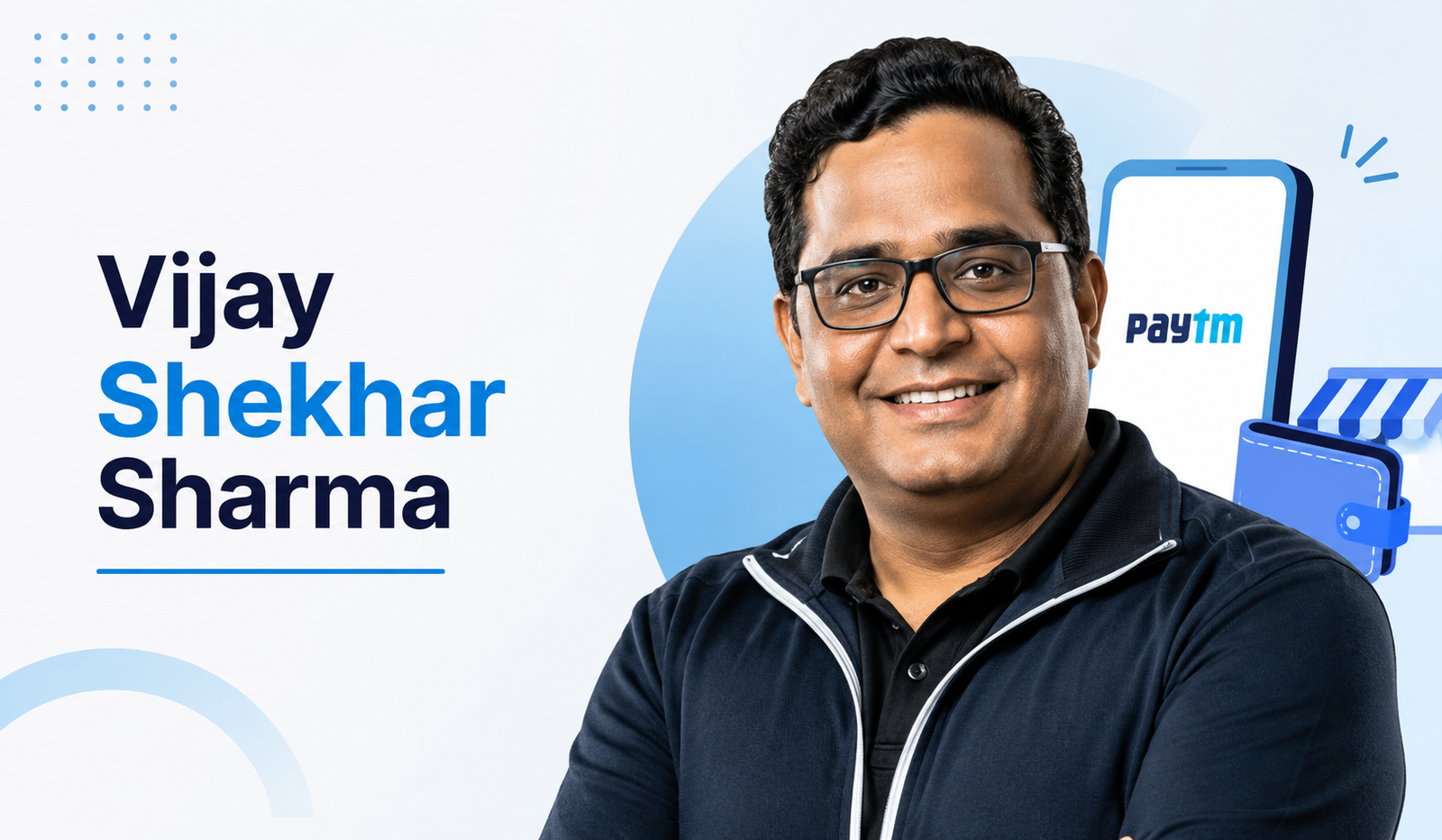
The Visionary Behind India’s Digital Payment Revolution
Vijay Shekhar Sharma is the founder and CEO of Paytm (One97 Communications), one of India’s largest digital payments and financial services companies. Born in a small-town family in Aligarh, Uttar Pradesh, Sharma built a fintech empire that helped transform how over 300 million Indians transact, save, and invest.
Few entrepreneurial stories in modern India carry the weight and resonance of Vijay Shekhar Sharma’s. A first-generation entrepreneur from a Hindi-medium school background who struggled through engineering college in a second language, Sharma went on to build Paytm into a household name—long before “digital payments” became a buzzword in India’s policy circles.
His journey is not simply about business success. It’s about stubbornness, reinvention, and an almost uncomfortable belief in the future. At a time when cash was king and smartphones were a luxury, Sharma bet everything on mobile wallets. Then demonetization happened in 2016, and overnight, his bet looked like prophecy.
But the story doesn’t end there. Paytm’s rollercoaster ride through IPOs, regulatory scrutiny, and restructuring in 2024–2026 has made Sharma one of the most scrutinized founders in India’s startup ecosystem. Understanding who he is—and what drives him—offers a rare window into the complexities of building technology companies in a rapidly evolving market.
Where Did Vijay Shekhar Sharma Come From, and What Shaped His Early Life?
Vijay Shekhar Sharma was born on July 8, 1978, in Aligarh, a city in Uttar Pradesh, India. His father was a schoolteacher, and the family lived modestly. Sharma attended a Hindi-medium school, which meant that when he enrolled at the Delhi College of Engineering (now Delhi Technological University), he faced an enormous language barrier. Most of his coursework and technical content was delivered in English—a language he was still actively learning.
Rather than retreat, Sharma leaned in. He devoured English-language books, built his vocabulary, and graduated among the top performers in his batch. This early experience of operating in unfamiliar territory, and succeeding anyway, became a recurring theme throughout his career.
At just 16, while still a student, he launched Indiasite.net, a content platform that attracted attention during the early days of India’s internet boom. That early hustle signaled something important: Sharma didn’t wait for permission or resources. He started with what he had.
How Did Vijay Shekhar Sharma Build Paytm From Scratch?
Sharma founded One97 Communications in 2000, initially as a platform offering mobile content, caller tunes, and ringtones through SMS. It was a modest beginning, but it gave him deep insight into how India’s mobile users behaved—what they clicked on, how they spent, and what frictions got in the way.
By 2010, he launched Paytm (Pay Through Mobile) as a mobile recharge and bill payment platform. The concept was simple: let people top up their phones without visiting a physical store. In a country where mobile recharge agents were everywhere but reliability was patchy, it found immediate traction.
Over the following years, Paytm expanded into e-commerce, ticketing, and eventually a full-scale digital wallet. The Paytm wallet allowed users to store money digitally and pay merchants—a concept that seemed futuristic to many Indians at the time, but one that Sharma pushed relentlessly.
The real inflection point came in August 2016, when Alibaba and its financial affiliate Ant Group invested in Paytm, valuing the company at around $5 billion. The strategic partnership brought capital, credibility, and access to China’s proven playbook for super-app development. Sharma had always admired Alibaba founder Jack Ma, and the investment cemented a relationship that would shape Paytm’s trajectory for years.
Then, on November 8, 2016, the Indian government announced demonetization—the sudden withdrawal of ₹500 and ₹1,000 notes from circulation. Overnight, cash became scarce. Paytm’s app downloads surged by 435% in the days that followed, according to reports from that period. Sharma’s face appeared on the front page of newspapers across India. Paytm ran full-page print ads that simply read: “Paytm Karo” (Use Paytm). The timing was almost impossibly perfect.
What Has Vijay Shekhar Sharma Achieved as an Entrepreneur and Business Leader?
By the time Paytm filed for its IPO in November 2021—then the largest in Indian stock market history at ₹18,300 crore (approximately $2.5 billion)—Sharma had built an ecosystem spanning payments, insurance, mutual funds, lending, gaming, and a point-of-sale device network with millions of merchants.
He has appeared multiple times on Forbes’ list of India’s richest individuals and was named among the world’s most powerful people in fintech by various financial publications. He has also been vocal about his role as an advocate for India’s startup ecosystem, frequently engaging with policymakers, speaking at global forums, and encouraging first-generation founders from non-metro India.
Sharma served as a non-executive director on the board of the Reserve Bank of India (RBI) from 2022 to 2024—an appointment that reflected both his industry standing and the government’s view of digital finance expertise.
What Challenges Has Vijay Shekhar Sharma Faced With Paytm in 2024 and 2025?
The period between 2024 and 2026 has been the most turbulent of Sharma’s career. In January 2024, the Reserve Bank of India issued sweeping restrictions on Paytm Payments Bank, citing persistent compliance failures and supervisory concerns. The RBI directed Paytm Payments Bank to stop accepting new deposits and credits after February 2024.
The fallout was immediate and severe. Paytm’s stock fell sharply. Sharma stepped down from the board of Paytm Payments Bank, though he retained his position as CEO of One97 Communications. In response to the crisis, he reorganized the business, pivoted the payments infrastructure to partner banks, and doubled down on the merchant services and financial distribution segments of the company.
Throughout 2024, Sharma communicated directly with investors, employees, and the public—an approach that, while not without controversy, reflected his characteristic directness. He acknowledged shortcomings, restructured leadership, and made the case that Paytm’s core business—helping merchants accept digital payments and helping consumers access financial services—remained sound.
By mid-2025, Paytm had stabilized its merchant base, with over 10 million active merchant devices and continued growth in its loans distribution and insurance verticals. The company’s path to profitability has remained a central focus, with analysts watching closely to see whether Sharma can execute a credible recovery.
Why Is Vijay Shekhar Sharma Considered a Pioneer of India’s Fintech Industry?
The answer lies less in timing and more in conviction. When Sharma started building mobile payment infrastructure, broadband internet was sparse, smartphone penetration was low, and the vast majority of Indians had never used a credit card. The infrastructure he believed in did not yet exist.
Sharma consistently argued that India would leapfrog traditional banking—that hundreds of millions of people would go directly from cash to mobile payments, skipping plastic cards entirely. That prediction proved accurate. According to the National Payments Corporation of India (NPCI), UPI processed over 130 billion transactions in the fiscal year 2024–25, underscoring the scale of digital payment adoption that Sharma helped catalyze.
His influence extended beyond Paytm. By demonstrating that a homegrown Indian startup could build financial infrastructure at scale, attract global investment, and list on public markets, Sharma helped make India’s fintech ecosystem credible to both domestic and international capital. Founders who came after him—building neo-banks, lending platforms, and insurance marketplaces—benefited from the market legitimacy Paytm helped establish.
What Is Vijay Shekhar Sharma’s Vision for Paytm and India’s Digital Economy in 2026?
As of 2026, Sharma’s stated focus is on three priorities: deepening Paytm’s merchant network, expanding financial services distribution, and achieving sustained profitability at the One97 Communications level.
He has spoken publicly about the opportunity in India’s semi-urban and rural markets, where digital financial services penetration remains far lower than in Tier-1 cities. Paytm’s physical device network—its QR codes and point-of-sale terminals—gives it a distribution advantage that pure-software competitors cannot easily replicate.
Sharma has also expressed interest in the intersection of AI and financial services, particularly how machine learning can improve credit underwriting for small merchants and gig economy workers—demographics that traditional banks have historically underserved. This positions Paytm not just as a payments company, but as a potential infrastructure layer for India’s emerging AI-powered financial system.
Whether that vision materializes depends on execution, regulatory goodwill, and competitive dynamics in a market that now includes well-capitalized rivals like PhonePe, Google Pay, and a resurgent HDFC Bank in the digital space.
What Can Entrepreneurs Learn From Vijay Shekhar Sharma’s Story?
Several lessons emerge clearly from Sharma’s career.
Bet on structural change, not current conditions. Sharma built for a future he could see clearly but that the market hadn’t yet validated. Founders who build for today’s infrastructure often find themselves outpaced by those who build for tomorrow’s.
Resilience after public failure matters as much as the original breakthrough. The post-2024 period tested Sharma in ways the demonetization boom never did. His willingness to restructure, communicate, and adapt—rather than retreat—offers a case study in founder durability.
First-generation disadvantages can become competitive advantages. Sharma has often spoken about how learning English as a second language, being from a non-elite background, and attending a non-IIT college forced him to develop a different kind of hunger. That hunger, he argues, is irreplaceable.
Frequently Asked Questions About Vijay Shekhar Sharma
Who is Vijay Shekhar Sharma?
Vijay Shekhar Sharma is the founder and CEO of One97 Communications, the parent company of Paytm—one of India’s largest digital payments and financial services platforms. He was born in Aligarh, Uttar Pradesh, in 1978.
What is Vijay Shekhar Sharma’s net worth in 2026?
Sharma’s net worth has fluctuated significantly due to Paytm’s stock performance. At its IPO peak, his stake was valued at several billion dollars. Following the regulatory challenges of 2024, his net worth declined considerably, though he remains one of India’s prominent tech entrepreneurs.
Why did the RBI take action against Paytm Payments Bank?
The Reserve Bank of India imposed restrictions on Paytm Payments Bank in January 2024, citing persistent non-compliance with regulatory norms and supervisory concerns around governance and data practices. Sharma subsequently stepped down from the bank’s board while continuing to lead One97 Communications.
What is Paytm’s current business model in 2026?
Paytm operates primarily as a merchant payments platform, financial services distributor (offering loans, insurance, and mutual fund products through partner institutions), and consumer payments app. Following the 2024 restructuring, the company shifted away from its banking operations and refocused on distribution and technology.
How did demonetization help Paytm grow?
India’s 2016 demonetization policy, which withdrew high-denomination currency notes from circulation, created an urgent demand for cashless payment alternatives. Paytm was one of the best-positioned platforms to absorb that demand, resulting in a dramatic surge in app downloads, wallet activations, and merchant sign-ups in late 2016.
The Unfinished Story of India’s Most Resilient Founder
Vijay Shekhar Sharma’s story is still being written. The chapters from 2000 to 2021 read like a classic startup narrative—struggle, timing, breakthrough, and triumph. The chapters from 2022 onward are messier, more instructive, and arguably more important.
What Sharma has built—and continues to rebuild—is not just a company. It’s a proof of concept for what homegrown Indian technology entrepreneurship can look like: imperfect, ambitious, tested by adversity, and unwilling to be finished.
For anyone building, investing, or simply paying attention to India’s digital economy, his trajectory remains one of the most consequential to watch.
