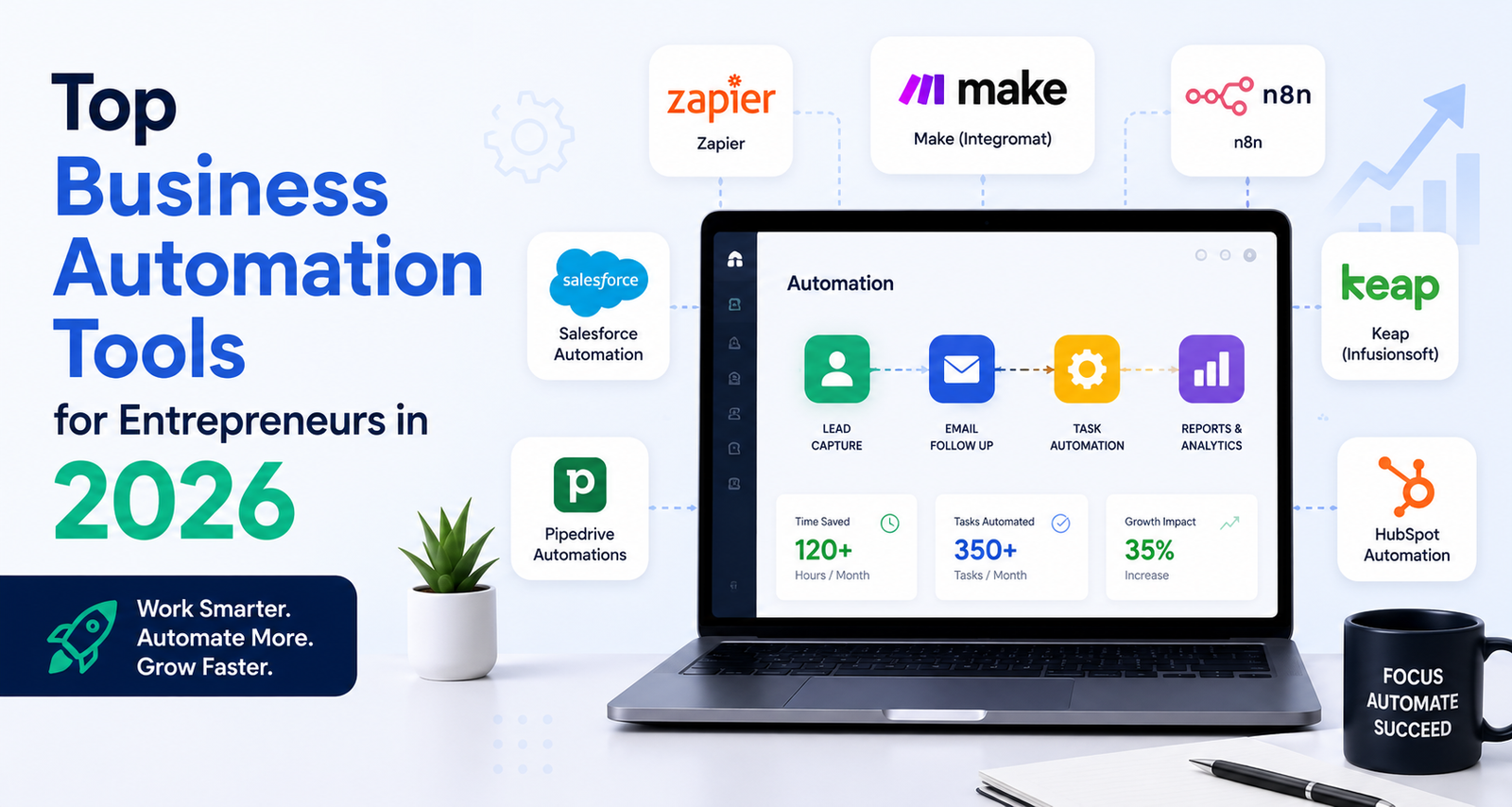
Business automation tools help entrepreneurs save time, reduce errors, and scale faster by handling repetitive tasks automatically. The top tools in 2025 span categories including project management, marketing, finance, and customer service—each offering meaningful ROI for small and growing businesses.
Running a business solo—or with a lean team—means wearing a lot of hats. You’re the strategist, the marketer, the customer support rep, and sometimes the accountant. At some point, doing everything manually stops being scrappy and starts being a liability.
That’s where business automation comes in. The right tools don’t just save you time—they remove entire categories of work from your plate, freeing you to focus on decisions that actually move the needle. According to McKinsey, roughly 45% of work activities could be automated using current technology. For entrepreneurs, that’s not a stat to skim past.
This guide covers the top business automation tools available to entrepreneurs in 2025, organized by function. Whether you’re just starting to automate or looking to fill gaps in your existing stack, you’ll find practical recommendations here—along with guidance on which tools suit which types of businesses.
Why Should Entrepreneurs Prioritize Business Automation?
Time is the resource entrepreneurs can least afford to waste. Unlike large enterprises with dedicated departments, small business owners often handle tasks that, left unautomated, can consume 20 or more hours per week.
Automation tools address this in two key ways. First, they handle repetitive, rule-based tasks—sending invoices, scheduling social posts, routing support tickets—without human input. Second, more advanced AI-powered tools can analyze patterns, generate content, and make recommendations that previously required specialized expertise.
The result: fewer bottlenecks, lower operational costs, and a business that can scale without proportionally increasing headcount.
What Are the Best Automation Tools for Entrepreneurs in 2025?
Zapier — Best for Connecting Your Entire Tech Stack
Zapier remains the gold standard for no-code workflow automation. It connects over 7,000 apps, allowing entrepreneurs to build automated “Zaps” that trigger actions across platforms. For example: a new lead fills out a form → Zapier adds them to your CRM → sends a welcome email → notifies your team in Slack.
Best for: Entrepreneurs who use multiple tools and want them to talk to each other without writing code.
Pricing: Free plan available; paid plans start at $19.99/month.
HubSpot — Best for Marketing and CRM Automation
HubSpot brings together CRM, email marketing, lead nurturing, and sales automation in one platform. Its automation workflows allow entrepreneurs to set up email sequences, score leads, and trigger follow-ups based on user behavior—all without manual input.
According to HubSpot’s own research, businesses using marketing automation see a 451% increase in qualified leads. While that figure comes from a vendor, it aligns with broader industry data showing significant improvements in lead conversion for automated pipelines.
Best for: Entrepreneurs focused on inbound marketing and sales who want a unified platform.
Pricing: Free CRM; paid Marketing Hub plans start at $15/month.
QuickBooks — Best for Financial Automation
Financial admin is one of the biggest time drains for small business owners. QuickBooks automates invoicing, expense categorization, payroll, and tax preparation—reducing both the time spent and the risk of human error.
For entrepreneurs who previously spent weekends reconciling accounts, QuickBooks can reclaim hours each month and reduce reliance on accountants for routine tasks.
Best for: Product-based businesses, freelancers, and service providers who need reliable financial tracking.
Pricing: Plans start at $17.50/month.
Jasper — Best for AI-Powered Content Creation
Jasper is an AI writing platform designed to help businesses produce high-quality content at scale. Entrepreneurs can use Jasper to draft blog posts, ad copy, email campaigns, and social media content in a fraction of the time traditional writing requires.
Jasper stands out for its brand voice training—meaning outputs align with your tone and style, rather than sounding generic. For entrepreneurs managing content marketing without a full team, Jasper removes one of the most time-consuming parts of digital marketing.
Best for: Entrepreneurs who produce regular content and want to maintain quality while reducing time investment.
Pricing: Plans start at $39/month.
Calendly — Best for Scheduling Automation
Back-and-forth emails to schedule meetings are a small inefficiency that adds up fast. Calendly eliminates them entirely. Prospects and clients book directly into your calendar based on your real-time availability, with automatic reminders and follow-ups.
For service-based entrepreneurs—consultants, coaches, agencies—Calendly can save several hours per week and reduce no-shows by up to 36%, according to internal Calendly data.
Best for: Service-based entrepreneurs and anyone who books frequent client calls.
Pricing: Free plan available; paid plans start at $10/month.
Gorgias — Best for E-commerce Customer Service Automation
Customer support is critical for e-commerce businesses, but handling every inquiry manually isn’t scalable. Gorgias centralizes support across email, chat, and social media, then uses automation rules to respond to common queries—order status, return policies, shipping times—without agent involvement.
Best for: E-commerce entrepreneurs handling high volumes of customer inquiries.
Pricing: Plans start at $10/month.
Notion + Notion AI — Best for Operations and Knowledge Management
Notion serves as an operational hub for many small teams—housing SOPs, project trackers, wikis, and client databases. With Notion AI integrated directly into the workspace, entrepreneurs can auto-generate meeting summaries, draft documents, and surface information faster.
Best for: Entrepreneurs who need a centralized, flexible system for managing their business operations.
Pricing: Free plan available; paid plans start at $10/month.
How Should Entrepreneurs Choose the Right Automation Tools?
With hundreds of tools available, the risk is building a bloated tech stack that costs more than it saves. Here’s a practical framework:
- Start with your biggest time drain. Identify the task that consumes the most hours each week. Automate that first.
- Check for native integrations. A tool that connects directly to your existing software is more valuable than one that requires workarounds.
- Calculate ROI before committing. If a tool costs $50/month and saves you 5 hours at $100/hour, the math is clear. If the savings are less obvious, start with a free tier.
- Avoid over-automating customer touchpoints. Automation is most effective for backend tasks. Customer-facing interactions often benefit from a human element, especially in early-stage businesses where trust is still being built.
Build a Leaner, Smarter Business
The entrepreneurs who scale efficiently aren’t working harder—they’re working on the right things. Business automation tools make that possible by removing the operational noise that consumes time without creating value.
Start with one tool that addresses your most pressing bottleneck. Get comfortable with it, measure the impact, then expand. Over time, a well-chosen automation stack becomes one of the most valuable assets in your business.
Frequently Asked Questions
What is business automation, and why does it matter for entrepreneurs?
Business automation uses software to perform repetitive tasks automatically—without manual input. For entrepreneurs, this matters because it reduces time spent on low-value work, minimizes errors, and allows a small team to operate with the efficiency of a much larger one.
Which business automation tool is best for a solo entrepreneur just getting started?
Zapier and Calendly are the most accessible starting points for solo entrepreneurs. Zapier connects your existing apps to eliminate manual data transfer, while Calendly removes the friction from scheduling. Both offer free plans, making them low-risk starting points.
Are business automation tools expensive for small businesses?
Most leading automation platforms offer free tiers or entry-level plans under $20/month. The more relevant question is ROI: if a tool saves you five or more hours per month, it typically pays for itself quickly.
Can automation tools replace employees?
Automation tools handle rule-based, repetitive tasks—not complex judgment calls or relationship-driven work. They’re best used to augment a small team, not replace one. The goal is to eliminate tasks that don’t require human input, so your team can focus on work that does.
How many automation tools should an entrepreneur use?
There’s no universal number, but quality matters more than quantity. A focused stack of three to five tools that integrate well and address distinct functions will outperform a dozen tools with overlapping capabilities.
