Which Is the Best Crypto to Invest in for Your Portfolio?
The best digital coins to invest in for 2026 include Bitcoin (BTC), Ethereum (ETH), Solana (SOL), and Chainlink (LINK). Each offers a distinct value proposition—from Bitcoin’s store-of-value dominance to Solana’s high-speed blockchain infrastructure. The right choice depends on your risk tolerance, investment horizon, and portfolio goals.
The cryptocurrency market has matured considerably since Bitcoin’s early days. Institutional adoption is rising, regulatory frameworks are taking shape in the US and EU, and blockchain technology continues to expand into finance, supply chains, gaming, and beyond. For investors looking to enter or expand their crypto positions in 2026, the opportunity is real—but so is the complexity.
This post breaks down the most compelling digital coins for 2026, explains what sets each one apart, and helps you figure out which might align with your investment strategy. You won’t find empty hype here—just clear analysis grounded in market fundamentals, technology, and current trends.
Before diving in, one important disclaimer: cryptocurrency investments carry significant risk. Prices are volatile, and past performance never guarantees future returns. Always do your own research and consider speaking with a licensed financial advisor before investing.
Why 2026 Is a Pivotal Year for Crypto Investment
The years following Bitcoin’s 2024 halving have historically been among the most dynamic for the broader market. Bitcoin’s fourth halving occurred in April 2024, reducing the block reward from 6.25 BTC to 3.125 BTC. Historically, halving events have preceded significant bull cycles, with major price appreciation typically materializing 12 to 18 months after the event—placing 2025 and 2026 firmly in focus.
At the same time, the approval of spot Bitcoin ETFs in the US in January 2024 opened the door for institutional capital at a scale the market had not previously seen. According to CoinDesk, spot Bitcoin ETFs attracted billions in inflows within weeks of their launch, signaling a new era of mainstream financial participation in digital assets.
Regulatory clarity in key markets is also improving. The EU’s Markets in Crypto-Assets (MiCA) regulation came into full effect in 2024, providing a comprehensive legal framework for crypto businesses operating across Europe. In the US, ongoing congressional discussions around crypto legislation suggest that a clearer regulatory environment may emerge—reducing uncertainty for long-term investors.
All of this sets the stage for a more mature, more accessible, and potentially more rewarding crypto investment landscape in 2026.
Bitcoin (BTC): The Benchmark Digital Asset Every Investor Should Understand
Bitcoin remains the foundational digital asset—the one against which all others are measured. With a fixed supply cap of 21 million coins and a decentralized network secured by proof-of-work mining, Bitcoin functions primarily as a store of value, often compared to digital gold.
The 2024 halving tightened supply further, and institutional demand—fueled by spot ETF inflows—continued to absorb that supply. According to data from CoinMarketCap, Bitcoin commands the largest market capitalization in the crypto space by a substantial margin, reflecting its unmatched liquidity and global recognition.
For investors seeking exposure to crypto with the lowest relative volatility among major assets, Bitcoin remains the benchmark. It may not offer the explosive growth potential of smaller altcoins, but it provides the deepest liquidity, widest institutional adoption, and the longest track record.
Choose Bitcoin if: you want broad crypto exposure with the highest liquidity and lowest counterparty risk, and you’re comfortable holding through multi-year cycles.
Ethereum (ETH): The Programmable Blockchain Powering Decentralized Finance
Ethereum occupies a unique position in the digital asset ecosystem. Unlike Bitcoin, Ethereum functions as a programmable blockchain—a platform on which developers build decentralized applications (dApps), smart contracts, and entire financial systems.
The transition to proof-of-stake (completed in September 2022 with “The Merge”) dramatically reduced Ethereum’s energy consumption and introduced ETH staking as a yield-generating mechanism. As of 2025, millions of ETH are staked, reducing circulating supply and introducing a deflationary dynamic to the asset.
Ethereum’s ecosystem includes the majority of decentralized finance (DeFi) protocols, NFT marketplaces, and Layer 2 scaling networks—including Arbitrum and Optimism—that extend Ethereum’s capacity while reducing transaction costs. According to DeFiLlama, Ethereum consistently leads all blockchain networks in total value locked (TVL), a key indicator of ecosystem activity.
Choose Ethereum if: you believe in the long-term growth of decentralized applications, DeFi, and Web3 infrastructure, and you want exposure to a high-utility asset with significant developer activity.
Solana (SOL): The High-Speed Blockchain Built for Scale and Speed
Solana has emerged as one of the most talked-about blockchain networks, offering transaction speeds of up to 65,000 transactions per second at costs that are fractions of a cent. This performance profile makes Solana particularly well-suited for high-throughput use cases: decentralized exchanges, payments, gaming, and consumer-facing applications.
After suffering reputational damage from its association with the collapse of FTX in 2022, Solana staged one of the most remarkable recoveries in the market. SOL’s price rebounded significantly throughout 2023 and 2024, driven by genuine ecosystem growth—including a surge in NFT volume, DeFi activity, and new dApp deployments.
The Solana ecosystem has attracted significant developer talent, and the network’s low fees and fast finality have made it a preferred platform for consumer crypto products. According to Messari’s crypto research reports, Solana’s developer activity and user growth metrics have consistently ranked among the strongest in the market.
Choose Solana if: speed, low transaction costs, and consumer-facing application use cases are priorities for you—and you’re comfortable with the higher volatility that typically accompanies faster-growing networks.
Chainlink (LINK): The Critical Infrastructure Layer Connecting Blockchains to the Real World
Chainlink is less well-known to casual investors, but it plays a critical role in the blockchain ecosystem. Chainlink provides decentralized oracle networks—infrastructure that allows smart contracts to securely access real-world data, such as price feeds, weather data, sports results, and more.
Every DeFi protocol that references an asset price, every smart contract that needs external data, and every cross-chain bridge that requires verification relies on oracle technology. Chainlink is the dominant provider in this space, with integrations across hundreds of blockchain projects and partnerships with enterprises including SWIFT and major financial institutions.
In 2024, Chainlink launched its Cross-Chain Interoperability Protocol (CCIP), designed to enable secure communication between different blockchain networks—a foundational capability as the multi-chain future of crypto takes shape.
Choose Chainlink if: you want exposure to blockchain infrastructure rather than a specific consumer-facing application, and you believe in the long-term expansion of smart contract adoption across industries.
What to Consider Before Investing in Any Digital Coin in 2026
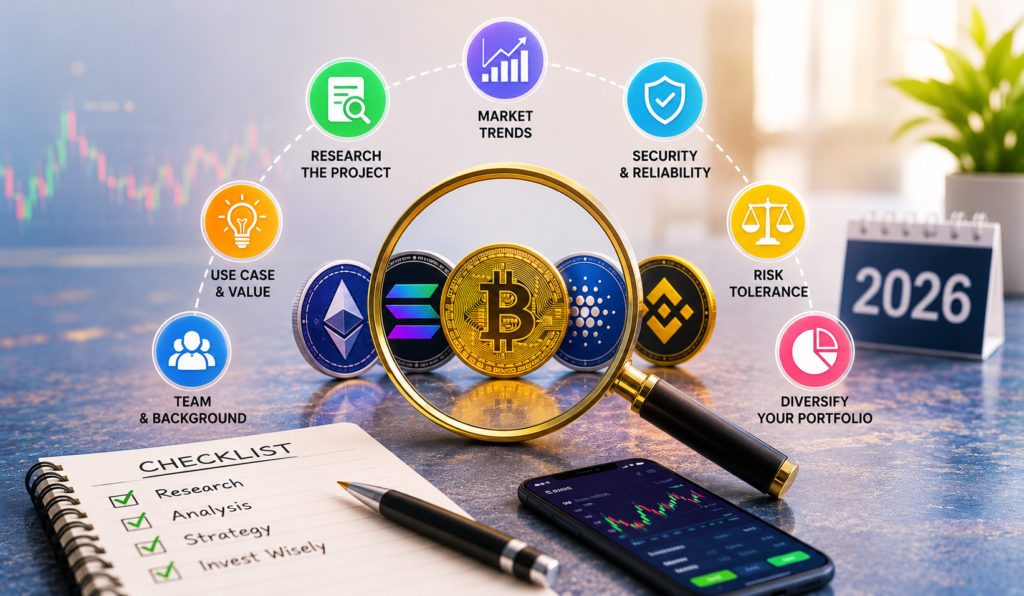
Selecting a digital coin isn’t simply a matter of picking the one with the most momentum. Several factors deserve careful consideration before committing capital.
Market capitalization and liquidity determine how easily you can enter and exit a position without significantly affecting the price. Large-cap assets like Bitcoin and Ethereum offer deep liquidity; smaller altcoins may offer higher potential returns but with significantly higher risk.
Use case and adoption reflect whether a project is solving a real problem with genuine demand. The strongest long-term investments tend to be projects where usage is growing organically—not just speculation.
Team, development activity, and community signal whether a project has the technical and organizational capacity to deliver on its roadmap. Open-source platforms allow investors to review commit activity on repositories like GitHub as a proxy for developer engagement.
Regulatory environment continues to evolve. Assets that have achieved regulatory clarity—or are likely to—carry lower legal risk, particularly for investors in jurisdictions with active enforcement. The SEC’s ongoing actions against various crypto projects in the US remain an important factor to monitor.
Finally, portfolio allocation matters as much as asset selection. Most financial advisors recommend treating crypto as a high-risk component of a diversified portfolio—typically no more than 5% to 10% of total investable assets, depending on individual circumstances.
How to Start Investing in Crypto Responsibly in 2026
Getting started requires a few practical steps. First, choose a reputable, regulated exchange. Coinbase, Kraken, and Binance are among the largest globally, each offering varying fee structures, supported assets, and regional availability. In the US, look for exchanges registered with FinCEN and compliant with applicable state money transmission laws.
Second, secure your assets. Leaving crypto on an exchange exposes it to platform risk—as the FTX collapse demonstrated. Hardware wallets from providers like Ledger or Trezor give you direct control over your private keys, which is the most secure way to hold digital assets long-term.
Third, consider a dollar-cost averaging (DCA) strategy. Rather than timing the market, DCA involves investing a fixed amount at regular intervals—weekly or monthly. This approach reduces the emotional impact of price volatility and has historically produced strong results for long-term Bitcoin and Ethereum holders.
Making a Confident, Informed Decision About Crypto in 2026
The digital asset landscape is genuinely complex, but it doesn’t have to be overwhelming. Bitcoin offers institutional-grade store-of-value characteristics. Ethereum provides exposure to the decentralized application economy. Solana captures the high-performance, consumer-facing segment. Chainlink underpins the data infrastructure that the entire smart contract ecosystem depends on.
None of these investments come without risk. Markets move unpredictably, regulations can shift, and technology evolves faster than most projections anticipate. The best investment decision you can make is an informed one—grounded in your own financial situation, risk tolerance, and long-term goals.
Start with the fundamentals, invest only what you can afford to lose, and consider consulting a licensed financial advisor before making any significant allocation.
Authoritative resources to support your research:
- CoinMarketCap — Real-time crypto price data, market cap rankings, and asset information
- Messari — In-depth crypto research, data, and sector analysis
- DeFiLlama — Total value locked (TVL) data across DeFi protocols and blockchain networks
- CoinDesk — News and analysis from a leading crypto media publication
Frequently Asked Questions
What is the best digital coin to invest in for 2026?
There is no single “best” coin for every investor. Bitcoin (BTC) is the safest entry point for most investors due to its liquidity and institutional adoption. Ethereum (ETH) suits those who want exposure to the DeFi and Web3 ecosystem. Solana (SOL) appeals to those comfortable with higher risk for higher growth potential, while Chainlink (LINK) targets investors interested in blockchain infrastructure.
Is it too late to invest in Bitcoin in 2026?
Bitcoin’s post-halving cycle and continued institutional adoption suggest it has not reached its ceiling. However, “too late” is relative to your goals. Long-term holders who adopt a dollar-cost averaging strategy have historically been rewarded, regardless of entry timing.
How much of my portfolio should I allocate to cryptocurrency?
Most financial advisors recommend limiting crypto exposure to 5%–10% of your total investable assets, depending on your risk profile and investment horizon. Crypto should be treated as a high-risk, high-potential component of a diversified portfolio.
Are cryptocurrency gains taxable?
Yes, in most jurisdictions, including the US, UK, and across the EU, cryptocurrency gains are subject to capital gains tax. The IRS treats crypto as property, meaning every sale, trade, or use of crypto may be a taxable event. Consult a tax professional familiar with digital assets for guidance specific to your situation.
What is the safest way to store digital coins?
The safest method is a hardware wallet—a physical device that stores your private keys offline, completely separate from internet-connected systems. Leading hardware wallet providers include Ledger and Trezor. For smaller amounts or active trading, reputable regulated exchanges with two-factor authentication offer a reasonable balance of security and convenience.
