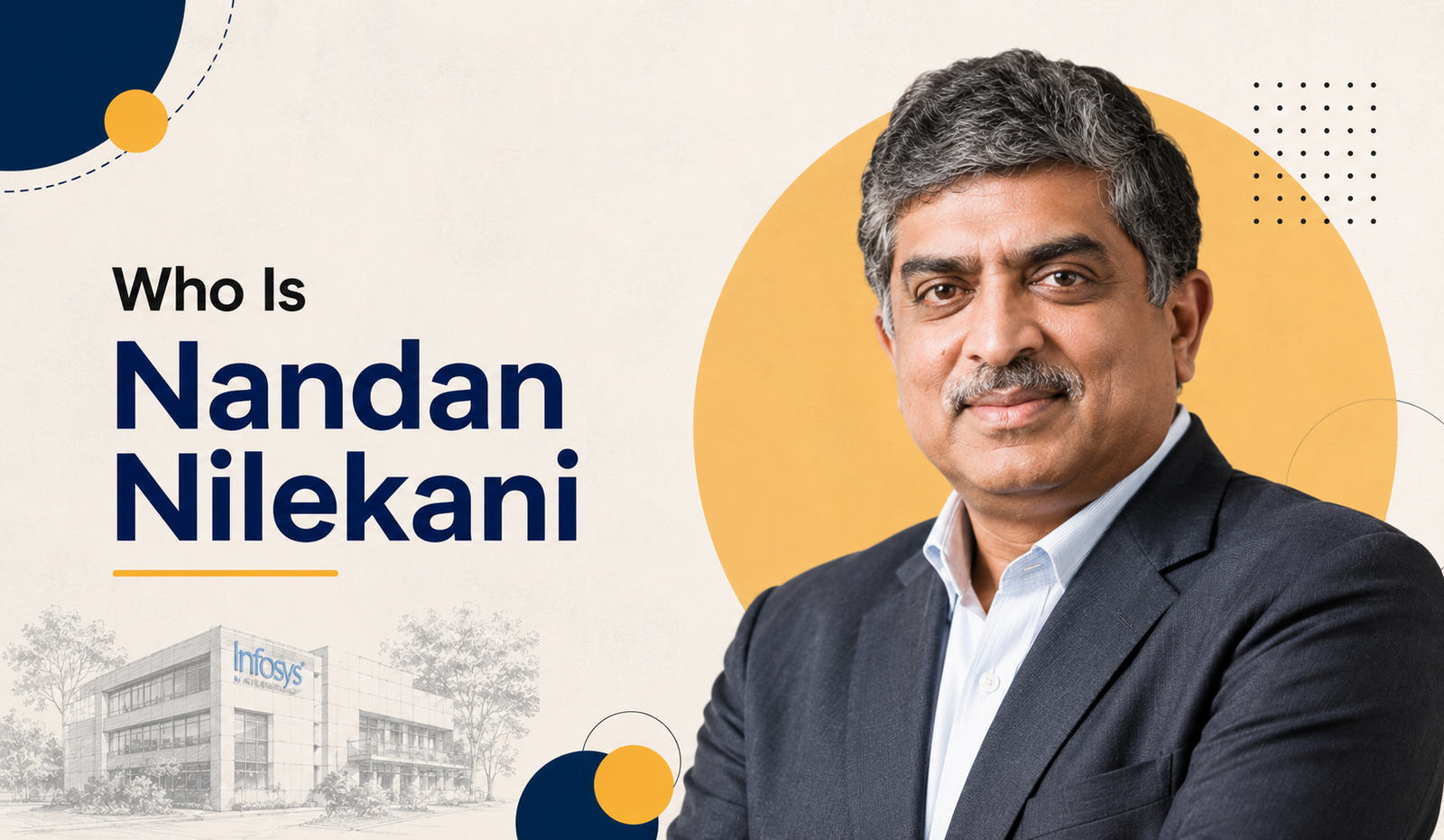
The Infosys Co-Founder Behind Aadhaar and India’s Digital Transformation
Nandan Nilekani is an Indian technology entrepreneur, co-founder of Infosys, and the architect of Aadhaar—India’s biometric identity system covering over 1.4 billion people. In 2026, Nilekani remains one of the most influential figures in global digital public infrastructure, fintech policy, and open-source governance frameworks.
Few figures in modern technology have shaped the lives of more people without most of the world knowing their name. Nandan Nilekani built one of India’s most iconic tech companies from a modest starting capital, then walked away from corporate life to design a digital identity system that became the backbone of one of the world’s largest economies. That system—Aadhaar—now underpins welfare delivery, financial inclusion, and digital payments for over a billion people.
But Nilekani’s story is not just about Aadhaar. Over four decades, he has been a co-architect of India’s software boom, a best-selling author, a government official, a venture philanthropist, and a leading voice in the global conversation about Digital Public Infrastructure (DPI). As of 2026, he chairs Infosys and continues to drive open-source fintech frameworks that other nations are now actively adopting.
This article covers who Nandan Nilekani is, what he has built, why his ideas matter globally, and what he is focused on right now.
Who Is Nandan Nilekani? A Brief Background on His Early Life and Education
Nandan Nilekani was born on June 2, 1955, in Sirsi, Karnataka, India. He completed his undergraduate degree in Electrical Engineering from the Indian Institute of Technology (IIT) Bombay in 1978—one of India’s most competitive academic institutions. Shortly after graduating, he joined Patni Computer Systems, where he met N. R. Narayana Murthy and several colleagues who would later become his co-founders at Infosys.
His early career gave him a front-row seat to the global software services industry as it was just beginning to take shape. That experience proved foundational—not only for building Infosys, but for understanding how technology could scale across massive, complex systems.
How Did Nandan Nilekani Help Build Infosys Into a Global Technology Giant?
In 1981, Nilekani co-founded Infosys Technologies alongside Narayana Murthy and five other entrepreneurs with an initial capital of just $250. What followed was one of the most remarkable growth stories in tech history. Infosys grew from a small software services firm in Pune to a global IT powerhouse with revenues exceeding $18 billion and a workforce of over 300,000 employees by the mid-2020s.
Nilekani served as the company’s Chief Executive Officer from 2002 to 2007, a period during which Infosys expanded aggressively into global markets and solidified its reputation for high-quality software delivery. Under his leadership, Infosys became synonymous with India’s emergence as a global technology hub—a story he explored in depth in his 2008 book, Imagining India, which examined how ideas were reshaping the country’s economic future.
He returned to Infosys as Non-Executive Chairman in 2017 during a period of corporate governance challenges and has held the position since. In 2026, he continues to guide the company’s strategic direction, with a focus on AI-driven services and digital transformation for enterprise clients globally.
What Is the Aadhaar System and Why Was Nandan Nilekani Chosen to Lead It?
In 2009, the Government of India established the Unique Identification Authority of India (UIDAI) and appointed Nilekani as its inaugural Chairman, granting him a Cabinet Minister-level rank. The mandate was straightforward in concept but staggering in scale: give every Indian resident a unique, verifiable identity.
The result was Aadhaar—a 12-digit biometric identification number linked to an individual’s fingerprints and iris scans. According to UIDAI, over 1.39 billion Aadhaar numbers had been issued as of early 2026, making it the largest biometric identity program ever executed. The system processes hundreds of millions of authentication requests monthly and serves as the foundation for direct benefit transfers, subsidized food distribution, tax filing, and mobile banking across India.
Nilekani was chosen because he brought something rare—deep technical credibility combined with an understanding of large-scale institutional implementation. He had already proven he could build systems that worked at national scale. The government trusted him to do it again.
The impact has been significant. According to the World Bank, Aadhaar-linked direct benefit transfers have helped reduce leakage in welfare spending substantially, channeling funds more accurately to intended recipients. India’s financial inclusion rate rose from approximately 35% in 2011 to over 80% by 2023, a shift partly attributed to Aadhaar-enabled banking programs like Jan Dhan Yojana.
What Is Digital Public Infrastructure and Why Does Nilekani Champion It?
Digital Public Infrastructure—commonly abbreviated as DPI—refers to shared, open digital systems that governments and private entities can build upon, much like roads or electricity grids. Nilekani has become one of the world’s most prominent advocates for DPI as a model for national development.
India’s DPI stack, often called the “India Stack,” includes Aadhaar (identity), UPI (payments), and DigiLocker (document storage). Together, these three systems have transformed how hundreds of millions of Indians access financial services, government benefits, and official documents. The Unified Payments Interface (UPI), which Nilekani helped champion through his involvement with iSPIRT and the Reserve Bank of India’s fintech ecosystem, processed over 17 billion transactions in a single month in early 2026—a figure that dwarfs comparable payment systems in many developed economies.
What makes Nilekani’s DPI philosophy distinctive is its open architecture. Rather than building proprietary systems controlled by a single company or government ministry, DPI frameworks are designed to be interoperable, extensible, and available for others to build upon. This is precisely why countries across Africa, Southeast Asia, and Latin America are now studying India’s model. The G20, during India’s 2023 presidency, formally recognized DPI as a framework for global digital development—an outcome Nilekani and his colleagues at the Centre for Digital Public Infrastructure (CDPI) actively worked toward.
What Is the EkStep Foundation and How Is Nilekani Investing in Education?
Beyond identity and payments, Nilekani and his wife Rohini Nilekani co-founded the EkStep Foundation in 2015—a non-profit focused on open-source learning infrastructure for children across India. EkStep developed the technology that later became DIKSHA (Digital Infrastructure for Knowledge Sharing), a national platform for teachers and students that was adopted by India’s Ministry of Education.
According to government data, DIKSHA reached over 250 million users across India’s school system. The platform delivers textbooks, training materials, and assessments in multiple Indian languages, addressing one of the country’s most persistent challenges: equitable access to quality education regardless of geography or language.
The EkStep model mirrors Nilekani’s broader philosophy—build open, scalable infrastructure and let a wider ecosystem of actors create value on top of it.
What Has Nandan Nilekani Been Working on in 2025 and 2026?
As of 2026, Nilekani’s focus spans several interconnected areas. Through the Nilekani Philanthropies, he and Rohini continue to fund work across digital public goods, civic participation, and ecological resilience.
On the technology policy front, Nilekani has been a vocal contributor to global discussions on AI governance and responsible data use. He has argued publicly that AI systems—particularly those being deployed at scale in public services—must be built on transparent, auditable infrastructure. His position is that open-source AI models, governed through public frameworks, offer a safer path than proprietary systems controlled by a small number of corporations.
He is also closely involved in the evolution of OCEN (Open Credit Enablement Network), a framework designed to make small business lending more accessible in India by creating a shared digital infrastructure for credit. OCEN, much like UPI, aims to democratize access by lowering the barriers for lenders and borrowers to connect through standardized, interoperable protocols.
At Infosys, Nilekani has been steering the company’s investments in generative AI capabilities, helping enterprise clients integrate large language models into business workflows. Infosys launched its Topaz AI suite in 2023 and has continued to expand its AI service offerings through 2025 and into 2026.
Why Is Nandan Nilekani’s Model Relevant for Other Countries in 2026?
India’s DPI story has become a reference model for governments seeking to accelerate financial inclusion and service delivery without waiting for private market infrastructure to mature organically. Countries including the Philippines, Ethiopia, Morocco, and Brazil have engaged with India’s DPI experience through bilateral partnerships and multilateral forums.
Nilekani’s contribution to this conversation is not merely theoretical. He has spent years presenting at forums like the World Economic Forum, the United Nations, and the G20, making the case that scalable digital identity and payments infrastructure can reduce poverty faster than almost any other policy lever available to developing governments.
The argument is increasingly well-supported. According to a 2023 McKinsey Global Institute report, digital financial services enabled by identity systems could add $3.7 trillion to emerging economies’ GDP by 2025. India’s trajectory is among the most cited examples of this potential in practice.
What Can Policymakers and Tech Leaders Learn From Nandan Nilekani?
Nilekani’s career offers several replicable lessons for anyone working at the intersection of technology and public policy.
Build for scale from day one. Aadhaar was not designed to serve 100 million people and then scaled up. It was architected to handle a billion from the outset, which required a fundamentally different approach to data architecture, authentication, and governance.
Open infrastructure beats closed platforms in public contexts. Every major system Nilekani has championed—Aadhaar, UPI, DIKSHA, OCEN—has been built on open, interoperable standards. This prevents vendor lock-in, encourages competition, and allows the public sector to retain meaningful oversight.
Trust is a design variable. Nilekani has consistently argued that public trust in digital systems is not automatic—it must be engineered through transparency, accountability mechanisms, and robust grievance redressal. This insight is particularly relevant as governments worldwide deploy AI in public services.
Final Thoughts: Why Nandan Nilekani’s Work Is Still Unfinished
Nandan Nilekani has already accomplished more than most technologists or policymakers could claim in multiple lifetimes. Yet by his own account, the work is far from done. Universal digital identity, equitable credit access, open-source AI governance, and climate-resilient development all sit on his agenda in 2026.
What makes Nilekani genuinely unusual is not just the scale of what he has built, but the framework he uses to build it: public benefit first, open architecture always, and trust as a non-negotiable design requirement. Those principles, applied consistently across decades, have produced outcomes that entire government ministries have failed to replicate with far larger budgets.
For anyone working on technology policy, digital development, or social innovation, studying Nilekani’s approach is time well spent.
Frequently Asked Questions About Nandan Nilekani
Who is Nandan Nilekani and what is he known for?
Nandan Nilekani is an Indian technology entrepreneur best known as co-founder of Infosys and the architect of Aadhaar, India’s national biometric identity system. He is also a leading advocate for Digital Public Infrastructure globally.
What is Nandan Nilekani’s current role at Infosys in 2026?
As of 2026, Nandan Nilekani serves as Non-Executive Chairman of Infosys, guiding the company’s strategic direction, corporate governance, and AI-related service offerings.
What is Aadhaar and how did Nandan Nilekani build it?
Aadhaar is India’s biometric digital identity system, assigning a unique 12-digit number to over 1.39 billion residents. Nilekani led its creation as Chairman of UIDAI from 2009, designing it as open, scalable infrastructure capable of handling nationwide authentication from launch.
What is Digital Public Infrastructure (DPI) and why does Nilekani support it?
Digital Public Infrastructure refers to shared, open digital systems—such as identity, payments, and data exchange frameworks—that governments and businesses can build upon. Nilekani supports DPI because open architecture prevents monopolization, reduces costs, and accelerates equitable access to services.
What book did Nandan Nilekani write?
Nandan Nilekani authored Imagining India (2008), a landmark analysis of the ideas and forces shaping India’s economic and social transformation. He also co-authored The Art of Bitfulness (2022) with Tanmoy Goswami.
How has Nandan Nilekani contributed to financial inclusion in India?
Through Aadhaar-linked banking programs and his support for UPI and OCEN, Nilekani has helped raise India’s financial inclusion rate from approximately 35% in 2011 to over 80% by the early 2020s, enabling hundreds of millions of previously unbanked individuals to access formal financial services.
