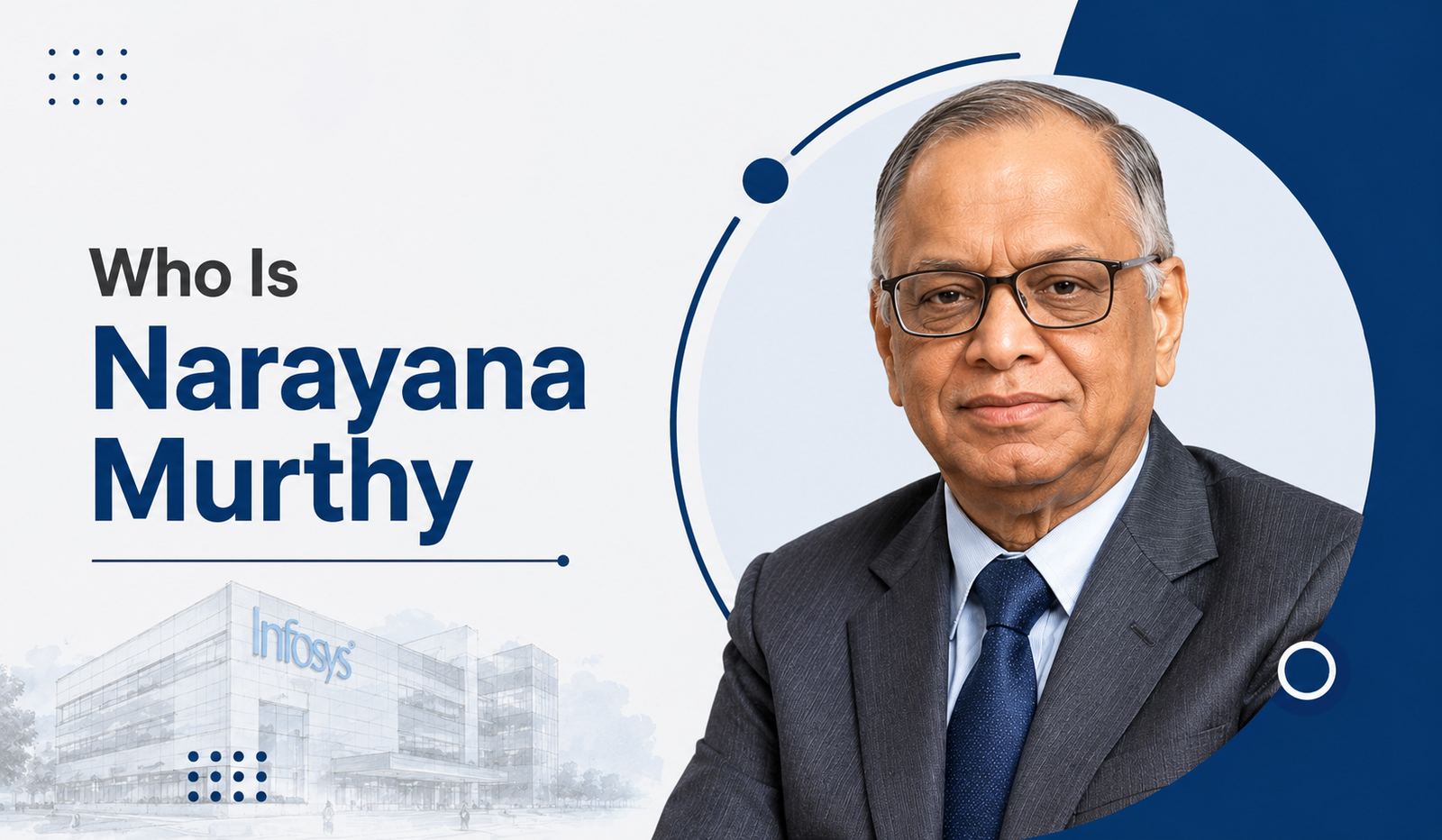
Who Is Narayana Murthy? The Visionary Entrepreneur Who Built Infosys and Transformed India’s IT Industry
Narayana Murthy is the co-founder of Infosys, one of the world’s largest IT services companies. Born in 1946, Murthy built Infosys from a $250 starting capital into a multi-billion-dollar global enterprise, pioneering India’s software outsourcing industry and inspiring generations of entrepreneurs across the developing world.
There are business leaders who build companies. Then there are those who build industries. Narayana Murthy belongs firmly in the second category.
Few names carry as much weight in Indian business history as N. R. Narayana Murthy. The co-founder of Infosys didn’t just create one of India’s most iconic corporations—Murthy helped architect the economic transformation of an entire nation. Starting with a $250 loan from his wife in 1981, Murthy and six co-founders turned a modest software startup into a $18+ billion (revenue) global IT powerhouse with over 300,000 employees worldwide.
But beyond the numbers, Narayana Murthy’s story is about values. Transparency, meritocracy, and ethical leadership were never marketing slogans at Infosys—they were operating principles, codified into the company’s culture from day one. At a time when crony capitalism was commonplace in India’s corporate sector, Murthy built a company that made money honestly and said so publicly.
As of 2026, Murthy remains one of the most discussed and occasionally controversial figures in Indian public life—whether it’s his outspoken views on work culture, wealth creation, or the responsibilities of the next generation of Indian entrepreneurs. This article explores who Narayana Murthy is, what he built, what he believes, and why his legacy continues to shape conversations in business, technology, and society.
Who Is Narayana Murthy? Early Life and the Foundations of a Business Philosophy
Nagavara Ramarao Narayana Murthy was born on August 20, 1946, in Sidlaghatta, a small town in Karnataka, India. Raised in a middle-class family, Murthy excelled academically and went on to earn a degree in electrical engineering from the National Institute of Engineering, Mysore, and a postgraduate degree from the Indian Institute of Technology (IIT) Kanpur.
What shaped Murthy’s worldview wasn’t any single classroom—it was a transformative experience traveling through Europe as a young man. Stranded at a train station in Bulgaria without money or food, Murthy was detained by authorities who suspected him of being a spy. The experience, which Murthy has recounted publicly several times, left a lasting impression on him. It gave him an intimate understanding of what it means to have nothing—and an enduring respect for the dignity of honest work.
That experience, combined with his early exposure to socialist ideals, pushed Murthy toward a philosophy he would later describe as “compassionate capitalism”—the belief that wealth creation and social responsibility are not opposites but partners.
How Did Narayana Murthy Build Infosys from $250 to a Global IT Giant?
In 1981, Narayana Murthy and six co-founders—Nandan Nilekani, S. Gopalakrishnan, S. D. Shibulal, K. Dinesh, N. S. Raghavan, and Ashok Arora—founded Infosys in Pune, India. Murthy’s wife, Sudha Murthy, provided the initial $250 in seed capital. The company later relocated to Bangalore, which would become the epicenter of India’s technology boom.
The early years were extraordinarily difficult. Murthy has described how the team worked without salaries for extended periods, operating out of minimal infrastructure with a singular focus on delivering quality software services to clients abroad. The business model was straightforward but powerful: provide skilled Indian software engineers to global companies at a fraction of the cost of local talent, without sacrificing quality.
What made Infosys different from comparable startups of the era was Murthy’s insistence on corporate governance. At a time when many Indian businesses operated in the shadows of bureaucracy and under-the-table dealings, Infosys was meticulous about financial transparency. Murthy famously refused to pay bribes—even when it cost the company contracts.
When Infosys went public on the Indian stock market in 1993, it was one of the first Indian companies to offer Employee Stock Option Plans (ESOPs) to its workforce. This decision created dozens of millionaires among early employees and established a new standard for how Indian technology companies could treat their people. According to Infosys’s own corporate history, the ESOP model was a deliberate attempt to share the company’s success broadly.
By the time Murthy stepped down as CEO in 2002, Infosys had grown into a $750 million company. By 2024, Infosys reported annual revenues exceeding $18 billion, cementing its position as one of the world’s leading IT services firms.
What Does Narayana Murthy Believe About Work, Wealth, and the Next Generation?
Narayana Murthy has never been shy about sharing his opinions—and in 2026, those opinions remain a reliable source of public debate in India and beyond.
In late 2023, Murthy sparked a firestorm when he suggested that young Indians should consider working 70 hours a week to help accelerate the country’s economic development. Speaking on a popular Indian podcast, Murthy argued that India’s GDP growth ambitions require a cultural shift toward harder work, citing post-war Japan and Germany as examples of nations rebuilt on labor intensity. The comment drew both strong support and sharp criticism. Critics pointed to mental health concerns and the risk of burnout; supporters saw it as a necessary challenge to what they viewed as a culture of complacency.
The debate was revealing precisely because of who said it. Murthy built his career on meritocracy, not nepotism—and he’s spoken candidly about ensuring his own children, including son Rohan Murthy, earned their achievements independently. His credibility on the topic of hard work comes from a lived experience most listeners recognize as genuine.
Beyond work culture, Murthy has consistently advocated for wealth redistribution through taxation, quality public education, and the development of rural India. These aren’t the typical talking points of a billionaire entrepreneur—and that inconsistency, or perhaps integrity, is part of what makes Narayana Murthy such a compelling figure.
What Has Narayana Murthy’s Family Contributed to Business and Society?
Narayana Murthy’s family has played an unusually prominent role in Indian public and entrepreneurial life. His wife, Sudha Murthy, is a celebrated author, philanthropist, and former chairperson of the Infosys Foundation. Her work in education, healthcare, and rural development across India has earned her the Padma Bhushan award—one of India’s highest civilian honors. In 2024, Sudha Murthy was nominated to the Rajya Sabha (the upper house of the Indian Parliament), marking yet another chapter in a remarkable public life.
Their daughter, Akshata Murty, is married to Rishi Sunak, who served as Prime Minister of the United Kingdom from 2022 to 2024—making the Murthy family a connecting thread between Indian enterprise and British political history.
Son Rohan Murthy, who holds a PhD in computer science from Harvard University, briefly served as his father’s executive assistant at Infosys in 2013, a decision that drew some criticism given the optics of nepotism. Narayana Murthy addressed the criticism directly, stating that Rohan received no salary for the role. Rohan has since pursued independent academic and entrepreneurial endeavors.
What Awards and Recognition Has Narayana Murthy Received?
Narayana Murthy’s contributions to business, technology, and Indian society have been recognized by institutions around the world. Key awards and honors include:
- Padma Vibhushan (2008) — India’s second-highest civilian honor, awarded for exceptional and distinguished service to the nation.
- Legion of Honour (2008) — France’s highest order of merit, awarded by the French government in recognition of Murthy’s contributions to global business.
- Ernst & Young’s World Entrepreneur of the Year Award (2003) — A global recognition of entrepreneurial achievement.
- Honorary doctorates from institutions including the University of Waterloo, the Indian Institutes of Technology, and several European universities.
In 2012, Time magazine listed Narayana Murthy among the 12 greatest entrepreneurs of our era, alongside figures like Steve Jobs, Jeff Bezos, and Bill Gates.
What Is Narayana Murthy’s Role and Impact in 2026?
As of 2026, Narayana Murthy no longer holds an executive role at Infosys. However, Murthy’s influence on Indian business culture remains enormous and continues to grow through several channels.
Murthy is an active voice in Indian policy debates around education reform, technology investment, and economic development. Through the Infosys Prize—a prestigious annual award for scientific and research excellence funded by the Infosys Science Foundation—Murthy continues to support the advancement of knowledge in India. The prize, awarded across six categories including engineering, humanities, and physical sciences, has become one of the most respected honors in Indian academia.
Murthy also remains a sought-after speaker and commentator on topics ranging from artificial intelligence’s impact on India’s IT sector to the responsibilities of first-generation wealth creators. His perspectives on AI are particularly relevant given Infosys’s significant investments in AI-powered services and automation tools, which Infosys has described as central to its growth strategy through 2027.
At the personal investment level, Murthy has backed a number of Indian startups through Catamaran Ventures, his family investment office. The portfolio includes companies in technology, retail, and healthcare—reflecting a continued commitment to building value in the Indian ecosystem.
What Lessons Can Entrepreneurs Learn from Narayana Murthy’s Journey?
Narayana Murthy’s career distills into several lessons that are as applicable in 2026 as they were in 1981.
Integrity compounds over time. Murthy’s decision to refuse bribes in the early days of Infosys cost the company short-term contracts but built long-term credibility with international clients who needed to trust their outsourcing partners. That trust became a competitive advantage worth far more than any individual deal.
Transparency builds institutions. Infosys pioneered corporate governance standards in Indian business—detailed quarterly disclosures, ESOP programs, and independent board structures—at a time when none of these were legally required. Murthy understood that institutions outlast individuals, and building one requires more than a good product.
Frugality is a feature, not a limitation. Murthy has spoken frequently about the principle of living simply, even as Infosys grew dramatically. This ethos shaped the company’s cost discipline and its ability to offer competitive pricing without sacrificing employee quality.
Speak plainly, even when it’s uncomfortable. The 70-hour work week comment generated controversy—but it also generated serious national debate. Murthy’s willingness to say unpopular things has made him a more credible voice than many of his peers who stay silent to avoid backlash.
The Enduring Significance of Narayana Murthy
Narayana Murthy didn’t set out to become a symbol. He set out to build an honest company in a country where that was genuinely difficult. The fact that Infosys became a global enterprise is extraordinary. The fact that it did so with its values largely intact may be even more so.
In 2026, as India continues its trajectory as one of the world’s fastest-growing major economies—and as the global technology industry grapples with questions of ethics, labor, and AI displacement—Murthy’s career offers a framework worth studying. Not because every decision he made was right, but because the principles behind those decisions were consistent and publicly accountable.
For entrepreneurs building companies today, the Narayana Murthy story is a reminder that the means of building matter as much as the ends. Wealth, at scale, tends to reflect the character of those who created it.
Frequently Asked Questions About Narayana Murthy
Who is Narayana Murthy and what is he famous for?
Narayana Murthy is the co-founder of Infosys, one of India’s largest and most globally recognized IT services companies. He is famous for building Infosys from a $250 startup into an $18+ billion enterprise, and for championing transparent, ethical corporate governance in Indian business.
What did Narayana Murthy say about working 70 hours a week?
In late 2023, Narayana Murthy suggested in a public interview that young Indians should consider working 70 hours a week to accelerate India’s economic development. The comment sparked wide debate in India and internationally, with supporters praising his ambition for the country and critics raising concerns about work-life balance and mental health.
What is Narayana Murthy’s net worth in 2026?
As of 2026, Narayana Murthy’s net worth is estimated to be in the range of several billion US dollars, with holdings primarily through his family investment office, Catamaran Ventures, and residual Infosys shares. Exact figures vary by source and market conditions.
What is Catamaran Ventures and what companies has it invested in?
Catamaran Ventures is Narayana Murthy’s personal investment office, established to invest in Indian startups and growth-stage companies. The portfolio spans sectors including technology, retail, and healthcare, reflecting Murthy’s continued commitment to the Indian entrepreneurial ecosystem.
How is Narayana Murthy related to UK politics?
Narayana Murthy’s daughter, Akshata Murty, is married to Rishi Sunak, who served as Prime Minister of the United Kingdom from 2022 to 2024. This connection placed the Murthy family at the intersection of Indian business and British political life.
What is the Infosys Prize and why does it matter?
The Infosys Prize is an annual award given by the Infosys Science Foundation to recognize outstanding contributions to science and research across six categories, including engineering, humanities, and physical sciences. It is considered one of the most prestigious scientific honors in India.
For another inspiring entrepreneurial story, explore our feature on Who Is Azim Premji and see how he transformed Wipro into a global technology powerhouse.
