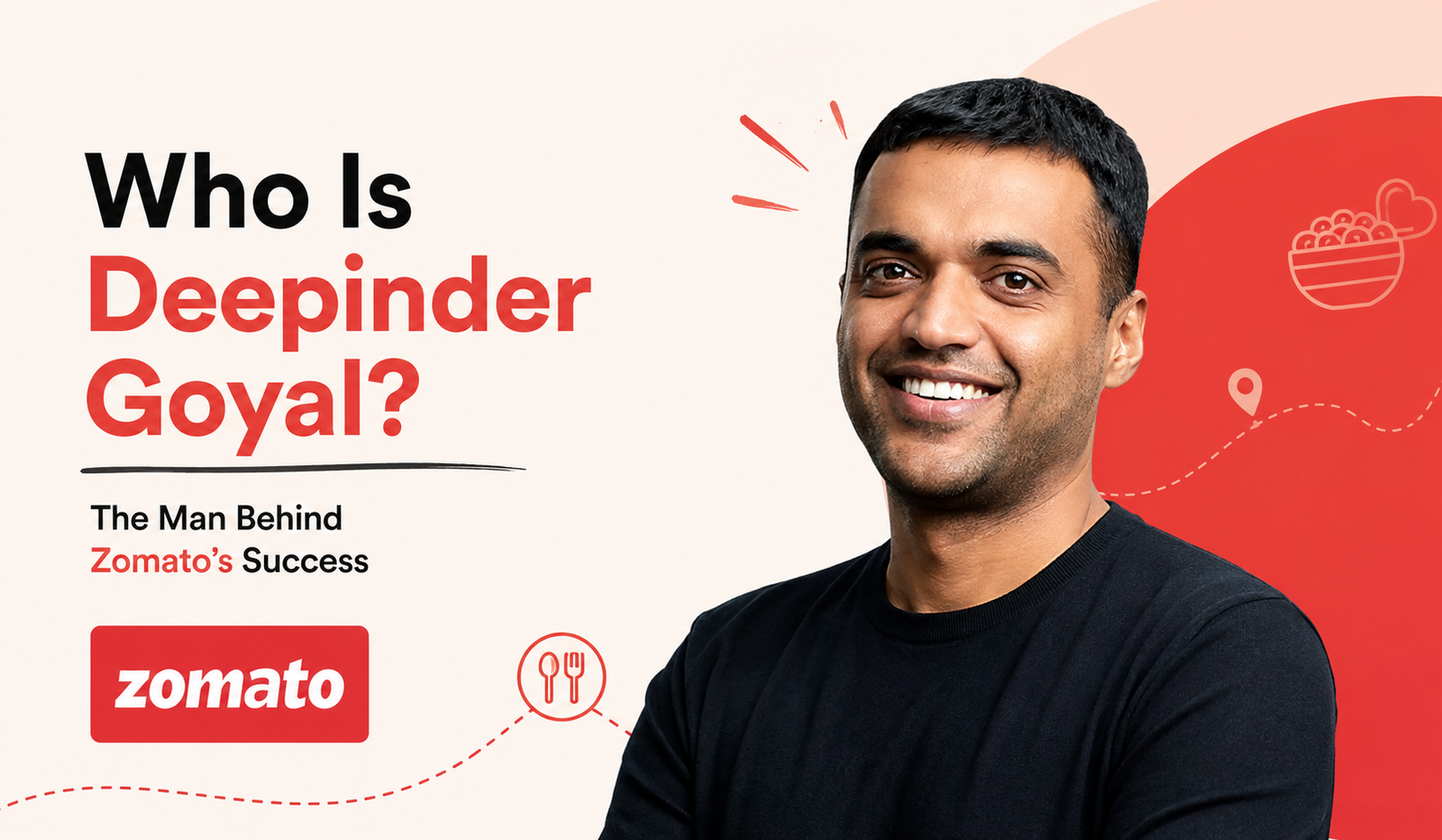
Who Is Deepinder Goyal The Entrepreneur Behind Zomato and Eternal’s Remarkable Growth
Deepinder Goyal is the co-founder and CEO of Zomato (now rebranded as Eternal), India’s largest food delivery and quick commerce platform. From launching a restaurant menu digitization startup out of a Delhi office in 2008, Goyal has built a multi-billion-dollar technology empire that now spans food delivery, hyperpure grocery supply, rapid commerce, and dining-out experiences across India and beyond.
Deepinder Goyal is one of the most closely watched entrepreneurs in Asia. His company’s pivot, its controversies, its meteoric growth, and his personal philosophy have kept him in the headlines for nearly two decades. But who exactly is he, where did he come from, and what has he built by 2026? This post answers all of that—and more.
Whether you follow Indian tech closely or are just hearing his name for the first time, understanding Goyal’s journey offers a masterclass in how a founder can reinvent both a company and an entire industry. By the end of this article, you’ll have a detailed picture of his background, his business philosophy, his most significant decisions, and what Zomato’s evolution into Eternal means for the future of commerce in India.
Who Is Deepinder Goyal? A Look at the Man Behind Zomato
Deepinder Goyal was born in 1983 in Muktsar, a small town in Punjab, India. He completed his schooling in Punjab before earning a degree in Mathematics and Computing from the prestigious Indian Institute of Technology (IIT) Delhi in 2005. After graduating, he joined Bain & Company as a management consultant—a career path that, on the surface, seemed far removed from the world of food tech.
The origin story of Zomato is well documented but still fascinating. While working at Bain, Goyal noticed that colleagues were crowding around a physical food menu binder to decide where to order lunch. He scanned those menus, put them online on an internal Bain portal, and watched the traffic explode. That single observation—a recognition of friction in everyday behavior—became the seed of what would eventually become one of India’s most recognized technology brands.
In 2008, Goyal co-founded FoodieBay with Pankaj Chaddah, a fellow IIT Delhi graduate. The company was renamed Zomato in 2010, and the trajectory from that point forward was one of relentless expansion, pivots, and occasional turbulence.
How Did Deepinder Goyal Build Zomato Into a Global Brand?
Zomato’s early growth was built on restaurant discovery—helping users find nearby restaurants, browse menus, and read reviews. The model was deceptively simple, but scaling it required an enormous operational effort: teams of people physically visiting restaurants, collecting menus, photographing food, and updating listings in real time.
By 2012, Zomato had expanded beyond India into markets including the United Arab Emirates, Sri Lanka, Qatar, the United Kingdom, and the Philippines. This international push was aggressive, and at its peak, Zomato was operating in 24 countries. However, Goyal made a pivotal decision around 2016 and 2017 to pull back from many international markets and refocus on India—a move that, in retrospect, proved prescient.
The entry into food delivery changed everything. As Swiggy emerged as a formidable rival and consumer behavior shifted toward app-based ordering, Zomato doubled down on its delivery infrastructure. Investments poured in from Ant Financial, Info Edge, and later from public markets. The company listed on Indian stock exchanges in July 2021 in one of India’s most high-profile IPOs, raising approximately ₹9,375 crore (around $1.25 billion at the time).
What Are Deepinder Goyal’s Most Significant Business Decisions?
Several decisions stand out in Goyal’s leadership of Zomato:
Acquiring Blinkit in 2022 was arguably the most consequential bet of his career. Blinkit, formerly known as Grofers, was a quick commerce platform promising grocery delivery in under 10 minutes. At the time of the acquisition, many analysts were skeptical. Blinkit was burning cash, and the quick commerce category was considered high-risk. Goyal pushed ahead regardless, and by 2024 and 2025, Blinkit had become one of Zomato’s fastest-growing business segments.
The rebrand to Eternal in early 2025 was another defining moment. Zomato Limited officially renamed itself Eternal Limited to reflect its evolution from a food delivery company into a broader consumer commerce platform. The parent entity now houses four distinct businesses: Zomato (food delivery), Blinkit (quick commerce), Hyperpure (B2B ingredient supply to restaurants), and District (a dining-out and events platform). The rebrand was not merely cosmetic—it signaled a fundamental shift in how Goyal views the company’s identity and long-term ambition.
Controversies and public moments have also defined his public persona. A now-famous 2023 episode where Zomato charged a fee for the option to have an “older delivery partner” sparked significant backlash and debate about gig worker welfare. Goyal addressed it publicly and directly, which was consistent with his pattern of engaging with criticism on social media rather than deflecting it.
What Is Deepinder Goyal’s Net Worth in 2026?
As of 2026, Deepinder Goyal’s estimated net worth stands at approximately $1.7 to $2 billion, according to various financial tracking sources. His wealth is primarily tied to his stake in Eternal Limited (formerly Zomato), which has seen substantial stock appreciation since its 2021 IPO.
Goyal’s financial standing has also attracted attention for reasons beyond raw numbers. He reportedly donated his entire annual salary of ₹1 to the PM CARES Fund during the COVID-19 pandemic. He has also publicly committed a significant portion of his wealth to philanthropic causes, aligning with the broader Giving Pledge philosophy, though he has not formally signed that pledge as of this writing.
What Is Deepinder Goyal’s Leadership Philosophy?
Goyal is known for an unfiltered, direct leadership style that is unusually candid by the standards of corporate India. He regularly posts on X (formerly Twitter) about company decisions, mistakes, and strategies—sometimes in real time. This transparency has earned him both admirers and critics.
He has spoken publicly about the importance of long-term thinking over short-term profitability, often referencing Amazon’s model of sustained reinvestment as an inspiration. His decisions around Blinkit and quick commerce reflect this mindset: taking pain in the short term for structural advantages over a multi-year horizon.
Goyal is also known for a strong emphasis on culture-building. In internal communications and interviews, he has repeatedly stressed that the values a company builds in its early years are nearly impossible to change later. This conviction has shaped how Zomato—and now Eternal—hires, promotes, and evaluates performance.
One notable example of his unconventional approach was a 2023 job listing that asked applicants to pay ₹20 lakh (approximately $24,000) to become a “Chief of Staff” to Goyal, with the fee being donated to Feeding India. The move generated enormous media coverage and debate, but Goyal defended it as a way to filter for candidates who were serious and mission-aligned.
What Is Eternal Limited and What Does It Mean for the Future?
Eternal Limited, as Zomato’s parent company is now known, represents Goyal’s vision of a diversified consumer platform that touches multiple moments in a person’s daily life. Food delivery handles the “order in” moment. Blinkit handles grocery and convenience needs. District handles dining out and live events. Hyperpure sits behind the scenes, supplying quality ingredients to restaurant partners.
This portfolio approach mirrors what global players like Grab in Southeast Asia or Meituan in China have built—what the industry broadly calls a “super app” or multi-vertical consumer platform. The logic is straightforward: once you have the delivery infrastructure and consumer trust, extending into adjacent categories becomes significantly cheaper than it would be for a new entrant.
By 2026, Blinkit operates thousands of dark stores across India and has expanded its average delivery time promises to include larger categories like electronics, toys, and even furniture for smaller items. The quick commerce segment has become a meaningful revenue contributor, and analysts have revised upward their long-term projections for the segment multiple times.
What Challenges Does Deepinder Goyal Still Face in 2026?
Despite the growth trajectory, Goyal and Eternal face a set of genuine challenges that will define the next chapter.
Profitability pressure remains a recurring theme. While Zomato’s core food delivery business turned profitable, Blinkit’s rapid expansion requires significant ongoing investment. Balancing growth ambition with profitability expectations from public market investors is a tension Goyal navigates continuously.
Competition from Swiggy and new entrants keeps the landscape competitive. Swiggy, which also listed publicly in 2024, has accelerated its own quick commerce offering (Instamart) and continues to compete aggressively on delivery subsidies and restaurant partnerships.
Gig worker rights and regulation represent a systemic risk. India’s regulatory environment around platform workers is evolving, and any significant policy shift around minimum wages, benefits, or labor classifications could materially affect Eternal’s cost structure.
International expansion remains largely off the table for now, with Goyal having explicitly stated his focus is on deepening penetration within India rather than chasing global market share.
Frequently Asked Questions About Deepinder Goyal
Who co-founded Zomato with Deepinder Goyal?
Pankaj Chaddah co-founded Zomato (originally called FoodieBay) with Deepinder Goyal in 2008. Chaddah later departed from the company in 2018 to pursue other ventures.
Why did Zomato rename itself to Eternal?
Zomato Limited rebranded its parent entity to Eternal Limited in early 2025 to reflect the company’s evolution beyond food delivery into a multi-vertical consumer platform that includes Blinkit, Hyperpure, and District.
What is Deepinder Goyal’s educational background?
Deepinder Goyal holds a degree in Mathematics and Computing from IIT Delhi, which he completed in 2005.
Is Eternal (formerly Zomato) profitable in 2026?
Eternal’s core food delivery segment has achieved profitability, but the company as a whole continues to invest heavily in Blinkit’s expansion, which affects overall consolidated margins. The company’s financial results are publicly available via Indian stock exchange filings.
What is Blinkit and why did Zomato acquire it?
Blinkit is a quick commerce platform that delivers groceries and other essentials in under 10 minutes. Zomato acquired Blinkit in 2022 because Deepinder Goyal believed rapid delivery of everyday items was a structural consumer shift—not a temporary trend—and that Zomato’s delivery infrastructure could be leveraged to scale the business quickly.
What Deepinder Goyal’s Story Tells Us About Building for the Long Term
Deepinder Goyal’s career resists simple summary. He is not the typical “zero to unicorn” founder story, because the Zomato journey has been far messier, more iterative, and more publicly scrutinized than most. He has made bets that looked wrong before they looked right. He has sparked controversies, addressed them, and moved forward. He has rebuilt the company’s identity more than once.
What remains consistent is his willingness to think in decades rather than quarters, to be publicly accountable, and to bet on structural shifts in consumer behavior rather than chasing what is fashionable. Whether Eternal fulfills its ambition of becoming the defining consumer technology platform of India’s next decade remains to be seen—but the foundation Goyal has built makes it a story worth watching closely.
If you want to follow Deepinder Goyal’s thinking in real time, his posts on X (formerly Twitter) offer unfiltered access to how he thinks about business, culture, and leadership.
If you are interested in inspiring digital creators and entrepreneurs, don’t miss our detailed article on Who Is Dhar Mann and discover how he built one of the world’s most influential storytelling brands.
