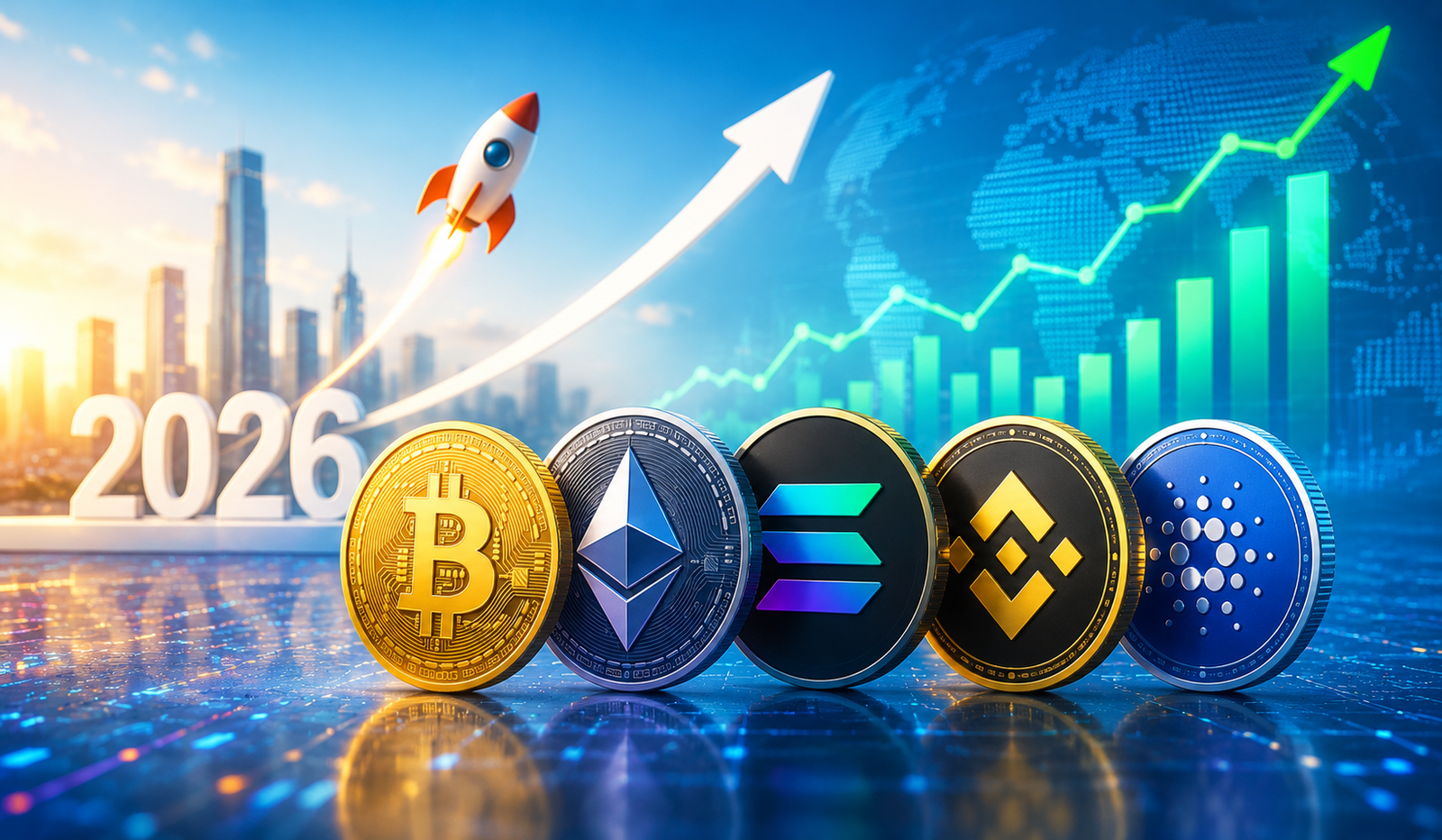
Best Digital Coins to Invest in 2026 for Every Risk Profile
The best digital coins to invest in 2026 include Bitcoin (BTC), Ethereum (ETH), Solana (SOL), and a handful of emerging altcoins with strong fundamentals. The right choice depends on your risk tolerance, investment horizon, and whether you prioritize store-of-value stability or high-growth potential.
Cryptocurrency is no longer a fringe conversation happening in online forums. By 2026, digital assets have become a legitimate component of institutional portfolios, retail investment strategies, and even national financial systems. Bitcoin achieved legal tender status in El Salvador back in 2021, and since then, the conversation around crypto as a viable asset class has only grown louder.
But the question everyone keeps asking hasn’t changed: which digital coin is actually worth investing in? With thousands of tokens in circulation and new projects launching every week, narrowing down the field is no small task. Some coins are backed by transformative technology. Others are driven by speculation, hype, and the fleeting attention of social media. Knowing the difference is what separates informed investors from gamblers.
This guide cuts through the noise. It examines the strongest digital coins available in 2026, the criteria that make a cryptocurrency worth your capital, and the risks you need to understand before committing a single dollar. Whether you’re new to crypto or looking to refine an existing portfolio, you’ll walk away with a clearer picture of where the real opportunities lie.
What Makes a Digital Coin Worth Investing in for 2026?
Before evaluating individual coins, it helps to understand what distinguishes a high-quality digital asset from one that’s destined to fade into obscurity. Not all cryptocurrencies are created equal, and market capitalization alone doesn’t tell the full story.
The most reliable digital coins share a set of common traits. They have a clearly defined use case—a reason to exist beyond speculation. They are supported by an active and transparent development team. They have demonstrable network activity, meaning people are actually using the blockchain. And they have survived at least one major market cycle, which separates durable projects from those built on temporary enthusiasm.
Liquidity matters too. A coin that trades millions of dollars in volume per day is far less susceptible to price manipulation than one with thin order books. Regulatory clarity is another growing factor; as governments around the world develop clearer crypto frameworks, coins that operate within legal boundaries are better positioned for mainstream adoption.
With those criteria in mind, here are the strongest candidates for 2026.
Why Bitcoin Remains the Most Reliable Digital Asset to Hold in 2026
Bitcoin (BTC) is the oldest, most liquid, and most widely recognized cryptocurrency in existence. It was created in 2009 by the pseudonymous Satoshi Nakamoto and has since grown to become a multi-trillion-dollar asset class that institutional investors, sovereign wealth funds, and publicly traded companies hold on their balance sheets.
What makes Bitcoin particularly compelling in 2026 is its fixed supply. Only 21 million Bitcoin will ever exist, and as of this writing, more than 19.5 million have already been mined. The Bitcoin halving—a programmatic event that reduces new supply by 50% approximately every four years—occurred in April 2024. Historically, halving events have preceded significant price appreciation over the 12 to 18 months that follow, a pattern that has continued to attract long-term holders.
Bitcoin also benefits from what analysts call the “network effect.” The more people who use and trust Bitcoin, the more secure and valuable the network becomes. With spot Bitcoin ETFs now available in the United States following the SEC’s landmark approval in January 2024, institutional money has a direct and regulated channel into Bitcoin exposure. According to CoinMarketCap, Bitcoin consistently commands the largest share of total cryptocurrency market capitalization, often exceeding 40–50%.
For investors who prioritize capital preservation over aggressive growth, Bitcoin remains the most defensible position in crypto.
How Ethereum’s Technology Makes It One of the Most Valuable Coins for Long-Term Investors
Ethereum (ETH) occupies a fundamentally different space from Bitcoin. Where Bitcoin functions primarily as a store of value and medium of exchange, Ethereum is a programmable blockchain—a platform that developers use to build decentralized applications (dApps), smart contracts, NFT platforms, decentralized finance (DeFi) protocols, and more.
This utility gives Ethereum a demand driver that Bitcoin doesn’t have: network usage. Every transaction on the Ethereum blockchain requires ETH to pay for computation, which means ETH demand rises as Ethereum adoption grows. Since the network’s transition to proof-of-stake consensus (known as “The Merge”) in September 2022, Ethereum has also become deflationary under high-usage conditions, meaning ETH can be burned faster than it is issued.
The Ethereum ecosystem is the largest in decentralized finance. According to DeFiLlama, Ethereum and its layer-2 networks consistently account for the majority of total value locked (TVL) across all DeFi protocols globally. Layer-2 solutions like Arbitrum, Optimism, and Base have significantly reduced transaction costs on Ethereum, addressing one of its most persistent criticisms.
Ethereum’s risk profile sits between Bitcoin and higher-volatility altcoins. Its strong developer community, broad institutional recognition, and continuous technological upgrades make it a foundational holding for many serious crypto portfolios.
Why Solana Has Emerged as a Serious Competitor Worth Considering in 2026
Solana (SOL) made headlines for all the wrong reasons in 2022 when the FTX collapse threatened its ecosystem. But the network’s recovery has been nothing short of remarkable. By 2024 and into 2026, Solana re-established itself as one of the fastest and most cost-efficient layer-1 blockchains available.
Solana’s key technical advantage is throughput. The network can theoretically process tens of thousands of transactions per second, far exceeding Ethereum’s base-layer capacity. Transaction fees on Solana are a fraction of a cent, which makes it particularly attractive for consumer-facing applications, gaming, payments, and high-frequency DeFi activity.
The Solana ecosystem has grown substantially, particularly in the area of NFTs and decentralized exchanges. Platforms like Jupiter and Raydium have become leading DEX aggregators, while Solana’s consumer payment initiatives have attracted attention from payment processors and fintech companies.
Solana carries more technical and ecosystem risk than Bitcoin or Ethereum, including a history of network outages that developers have worked to address. But for investors comfortable with a higher risk-reward profile, SOL’s growth trajectory and adoption metrics make it one of the more compelling mid-cap opportunities in 2026.
What Role Do Emerging Altcoins Play, and Which Projects Show Real Potential?
Beyond the top three, a broader category of altcoins offers higher potential returns alongside considerably higher risk. These are projects built around specific use cases—artificial intelligence, decentralized identity, real-world asset tokenization, and cross-chain interoperability among them.
A few noteworthy names in 2026 include:
Chainlink (LINK), which serves as critical infrastructure for connecting real-world data to blockchain smart contracts. As tokenization of real-world assets (RWAs) accelerates, Chainlink’s oracle network becomes increasingly essential plumbing for the broader crypto ecosystem.
Render Network (RNDR), which leverages decentralized GPU computing power for AI and 3D rendering tasks. As artificial intelligence workloads grow exponentially, RNDR’s model of connecting idle GPU capacity with demand represents a genuinely novel and needed solution.
Celestia (TIA) and other modular blockchain projects are gaining traction among developers looking to build scalable applications without the constraints of monolithic blockchains.
The critical caveat with altcoins is position sizing. No single altcoin should represent an outsized share of a portfolio. These assets can lose 80–90% of their value in bear markets even when their underlying technology remains sound. Treat them as high-conviction, small-allocation positions rather than core holdings.
How to Assess Risk and Manage Your Crypto Portfolio Responsibly in 2026
Investing in digital coins without a clear risk management strategy is one of the most common and costly mistakes new investors make. The crypto market is still volatile by traditional financial standards, and no level of research eliminates that reality entirely.
A few principles hold up well regardless of market conditions. First, only invest capital you can afford to lose in full—not because loss is inevitable, but because that framing forces disciplined decision-making. Second, consider a dollar-cost averaging (DCA) strategy rather than making lump-sum purchases. DCA involves investing a fixed amount at regular intervals, which reduces the impact of buying at local price peaks.
Diversification within crypto is valuable, but overdiversification creates complexity without meaningful risk reduction. A portfolio anchored by Bitcoin and Ethereum, with smaller allocations to high-conviction altcoins, is a structure many experienced investors and analysts recommend.
Finally, custody matters. Leaving large amounts of crypto on exchanges exposes you to counterparty risk. Hardware wallets—physical devices that store your private keys offline—are the gold standard for long-term holders.
For regulatory and tax guidance specific to your jurisdiction, the IRS publishes clear cryptocurrency tax guidance for U.S. residents (IRS Virtual Currencies), and CoinDesk regularly publishes updated regulatory developments (CoinDesk).
The Smartest Way to Start Investing in Digital Coins Right Now
The best entry point into crypto is not after a 300% rally or at the bottom of a panic sell-off—it’s whenever you have a clear strategy, an understanding of what you own, and the patience to hold through volatility. The investors who have generated meaningful returns from digital assets over the past decade are not those who timed markets perfectly. They are those who identified high-quality projects early, sized their positions appropriately, and resisted the urge to panic during downturns.
Bitcoin and Ethereum form the most defensible foundation. Solana offers a compelling growth opportunity with demonstrated real-world utility. Selective exposure to infrastructure-layer altcoins like Chainlink and Render Network can add meaningful upside for those with an appropriate risk appetite.
The digital asset space will continue to evolve rapidly. New regulations will reshape certain sectors. New technology will create winners and eliminate projects that fail to adapt. Staying informed—through reliable sources like CoinMarketCap (CoinMarketCap) and Messari (Messari)—is not optional. It is part of the work that responsible investing in this space requires.
Frequently Asked Questions About the Best Digital Coins to Invest In
What is the safest digital coin to invest in for beginners in 2026?
Bitcoin (BTC) is generally considered the safest entry point for new crypto investors. Bitcoin has the longest track record, the highest liquidity, and the broadest institutional adoption of any digital asset. While it is still volatile compared to traditional assets, it carries less project-specific risk than altcoins.
Is Ethereum a better investment than Bitcoin in 2026?
Bitcoin and Ethereum serve different purposes, so the comparison depends on what you’re looking for. Bitcoin is better suited to investors seeking a digital store of value with a fixed supply. Ethereum is better suited to investors who want exposure to the growth of decentralized applications and programmable finance. Many experienced investors hold both.
How much of my portfolio should I allocate to cryptocurrency?
Financial advisors commonly suggest that crypto should represent no more than 5–10% of a diversified investment portfolio, given its volatility. Within that allocation, higher-risk altcoins should represent a smaller share than established assets like Bitcoin and Ethereum.
What is the difference between a coin and a token?
A coin (like Bitcoin or Ethereum) operates on its own native blockchain. A token is built on top of an existing blockchain—most commonly Ethereum. The distinction matters because coins tend to have more infrastructure independence, while tokens are dependent on the health of their host network.
Are crypto investments taxable in the United States?
Yes. The IRS treats cryptocurrency as property, meaning that selling, trading, or spending crypto may trigger capital gains taxes. The tax rate depends on how long you held the asset and your income bracket. The IRS provides detailed guidance on virtual currency taxation at irs.gov.
