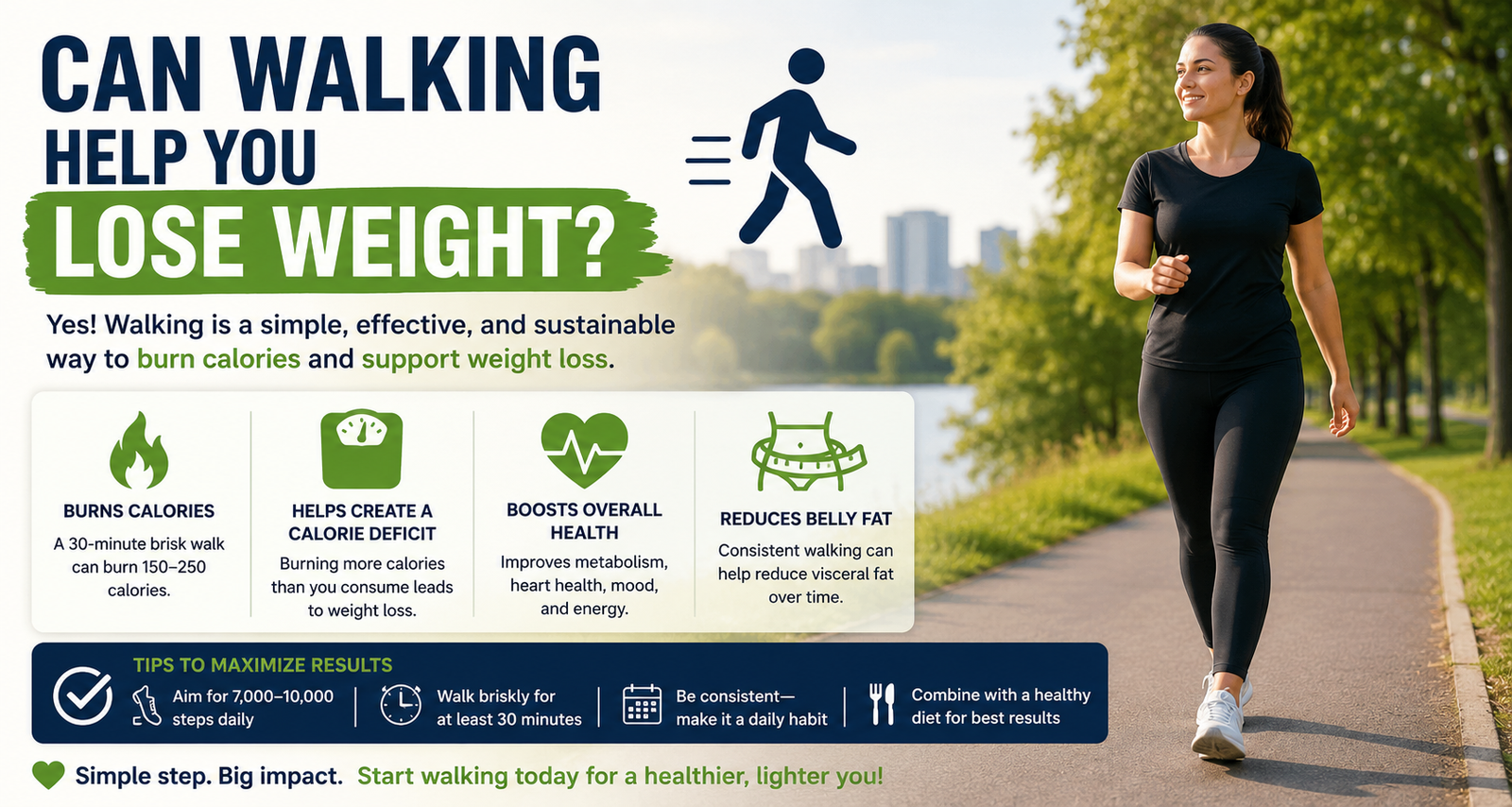
Walking can support weight loss by burning calories, reducing appetite hormones, and improving metabolic health. Most studies suggest 30–60 minutes of brisk walking most days of the week produces meaningful results, especially when combined with a balanced diet. Results vary based on body weight, walking speed, and consistency.
You don’t need a gym membership, expensive equipment, or a strict training plan to start losing weight. Walking — something most people do every day without thinking — turns out to be one of the most effective and sustainable tools for managing body weight.
That might sound too simple to be true. But the research is consistent: regular walking burns calories, shifts body composition, and supports the kind of metabolic health that makes long-term weight management easier. The key is understanding how it works, how much you need to do, and how to make it work for your specific situation.
This guide covers all of it. By the end, you’ll know exactly how walking drives weight loss, what the evidence says about pace and duration, and how to build a walking habit that produces real, lasting results.
How does walking help with weight loss?
Weight loss, at its most fundamental level, comes down to a calorie deficit — burning more energy than you consume. Walking contributes to that deficit by increasing your total daily energy expenditure.
The number of calories you burn per walk depends on three main factors: your body weight, your walking speed, and the terrain. A 155-pound (70 kg) person walking at a moderate pace (about 3.5 mph) burns roughly 300–400 calories per hour, according to estimates from Harvard Medical School. A heavier person burns more; a lighter person, less.
But calorie burn isn’t the only mechanism at work.
Metabolic effects: Studies suggest that regular walking improves insulin sensitivity — the body’s ability to use glucose efficiently. Better insulin sensitivity means your body is less likely to store excess glucose as fat, and more likely to draw on fat stores for energy.
Appetite regulation: Some research indicates that moderate aerobic exercise like walking may help regulate hunger hormones, including ghrelin (the hormone that signals hunger) and peptide YY (which signals fullness). The practical effect: you may feel less driven to overeat after a walk compared to after sedentary periods.
Visceral fat reduction: Studies published in the Journal of Exercise Nutrition & Biochemistry have shown that regular walking specifically reduces visceral fat — the deep abdominal fat that wraps around internal organs and is most strongly linked to metabolic disease. This type of fat is often the first to respond to aerobic exercise.
How much walking do you need to lose weight?
There’s no universal answer, but the evidence points to some useful benchmarks.
The general recommendation from the American Heart Association is 150 minutes of moderate-intensity aerobic activity per week — which translates to about 30 minutes of brisk walking five days a week. For weight loss specifically, many studies suggest more is better, with 45–60 minutes most days producing more significant results.
What counts as “brisk”? A brisk walking pace is typically 3–4 mph — fast enough that you can hold a conversation but not sing a full sentence comfortably. At this pace, your heart rate should sit at roughly 50–70% of your maximum heart rate, which falls in the moderate-intensity aerobic zone.
What about step counts? The popular target of 10,000 steps per day has limited scientific backing as a specific threshold, but research from a 2019 study published in JAMA Internal Medicine found that taking more steps per day was associated with lower mortality rates and better weight outcomes. For most people, aiming for 7,000–10,000 steps daily is a reasonable and practical goal.
If you’re starting from a low baseline, don’t let those numbers discourage you. A 2017 meta-analysis in the British Journal of Sports Medicine found that even short bouts of walking — 10 minutes at a time — accumulate meaningful health benefits over the course of a day.
Does walking speed matter for fat loss?
Yes, but perhaps not in the way you’d expect.
Walking faster burns more calories per minute. A 155-pound person burns about 232 calories per hour walking at 2.5 mph, compared to around 372 calories at 3.5 mph, according to Harvard Health estimates. If your goal is to maximize calorie burn in a limited time, picking up the pace makes a real difference.
That said, total duration and consistency matter more than speed for most people. A 60-minute moderate walk burns more total calories than a 20-minute fast walk, and it’s easier to sustain as a daily habit. If walking faster causes discomfort or makes the activity feel unpleasant, a slower, longer walk is likely to serve you better in the long run.
Interval walking is a useful middle ground. This approach alternates between periods of brisk walking and slower recovery walking — for example, 2 minutes fast, 1 minute slow, repeated throughout a 30-minute session. A 2017 study in the Scandinavian Journal of Public Health found that interval walking improved aerobic fitness and body composition more effectively than continuous moderate walking over a 5-month period.
Walking vs. other forms of exercise for weight loss
Walking is less intense than running, cycling, or strength training, which means it burns fewer calories in the same amount of time. That’s a genuine trade-off worth acknowledging.
However, walking has several practical advantages that make it uniquely effective for sustained weight loss:
- Lower injury risk. High-impact activities like running carry significant injury risk, particularly for people who are overweight or just starting out. Walking places far less stress on joints.
- Easier to maintain. Consistency drives weight loss more than intensity. An activity you’ll do five days a week reliably outperforms one you’ll do twice a week enthusiastically.
- Accessible everywhere. Walking requires no equipment, no membership, and no specific location. This removes most of the barriers that derail other exercise plans.
- Compatible with daily life. Commuting on foot, taking the stairs, or walking during lunch breaks all count toward your daily total without requiring dedicated workout time.
Strength training builds muscle mass, which raises your resting metabolic rate — the number of calories you burn at rest. Walking doesn’t produce the same effect. Combining regular walking with two or three strength sessions per week addresses both cardiovascular health and muscle maintenance, producing better long-term results than either approach alone.
How to make walking more effective for weight loss
The basic formula — walk more, walk consistently — works. But a few adjustments can meaningfully increase the results you get from the same time investment.
Add incline. Walking uphill or on a treadmill incline increases calorie burn without requiring you to walk faster. Research suggests incline walking can increase calorie expenditure by 8–16% compared to flat walking at the same speed.
Walk after meals. A 2022 study published in Sports Medicine found that walking for 2–5 minutes after eating reduced post-meal blood glucose spikes significantly. Lower post-meal glucose levels reduce the likelihood of fat storage and support better energy regulation throughout the day.
Carry light weights or use a weighted vest. Adding load increases the energy cost of walking. A weighted vest of 10–15% of your body weight has been shown to increase calorie burn by roughly 12%, according to research in the Journal of Strength and Conditioning Research. Note that holding hand weights can alter your gait and increase joint strain — a weighted vest is generally the safer option.
Track your steps. Wearing a pedometer or using a fitness tracker is associated with increased daily step counts, according to a systematic review in the Journal of the American Medical Association. Simply knowing your daily total appears to motivate more movement.
Pair walking with dietary changes. Exercise alone rarely produces dramatic weight loss without attention to diet. A 2017 review in BMC Public Health found that combining walking with caloric restriction led to significantly greater weight loss than either strategy alone.
What results can you realistically expect from walking?
Walking produces modest but real weight loss. A 2001 study published in the International Journal of Obesity found that women who walked briskly for 45 minutes, five days a week, lost an average of 4.4 pounds over 16 weeks without changing their diet. With dietary changes alongside walking, results are typically greater.
Realistic expectations for most people:
- 0.5–1 pound per week when walking is paired with a modest calorie deficit
- Visible reduction in abdominal circumference within 8–12 weeks of consistent moderate walking
- Improved fitness and energy levels often apparent within the first 2–4 weeks
Weight loss from walking tends to be gradual. That’s not a flaw — gradual weight loss is strongly associated with better long-term maintenance, according to findings from the National Weight Control Registry.
Build a walking habit that sticks
The most effective walking plan is one you’ll follow consistently for months, not days. A few principles make that more likely:
- Start where you are. If you’re currently sedentary, begin with 15–20 minutes daily and add 5 minutes per week rather than jumping to an hour on day one.
- Schedule it like an appointment. Research on habit formation suggests that attaching a new behavior to an existing routine — like walking after dinner or during a lunch break — significantly improves adherence.
- Find a route you enjoy. Environmental variety reduces boredom. Parks, trails, and neighborhoods with visual interest tend to make walks feel less like exercise and more like a natural part of the day.
- Walk with someone. Social accountability is one of the strongest predictors of exercise consistency. A walking partner or group adds enjoyment and makes skipping harder.
The bottom line on walking for weight loss
Walking works. It burns calories, reduces visceral fat, improves metabolic health, and supports the kind of sustainable, daily movement that long-term weight management requires. It won’t produce results as quickly as high-intensity training, and diet still plays the larger role in creating a calorie deficit — but as a foundation for a healthier lifestyle, few activities are as accessible or as easy to maintain.
Start with 30 minutes of brisk walking most days. Add incline when you can, walk after meals when it’s practical, and pair the habit with balanced eating. Give it 8–12 weeks before judging the results.
Talk to your doctor before starting a new exercise routine if you have existing joint issues, cardiovascular conditions, or haven’t been active for an extended period.
Frequently asked questions
How long does it take to see weight loss results from walking?
Most people notice changes in energy levels and fitness within 2–4 weeks. Visible weight loss typically takes 6–12 weeks of consistent walking, depending on pace, duration, diet, and starting weight. Studies suggest meaningful reductions in body fat and abdominal circumference are measurable within 8–16 weeks.
Is walking enough to lose weight without changing your diet?
Walking can produce weight loss without dietary changes, but the results are slower and more limited. A 2001 study found women walking briskly five days a week lost an average of 4.4 pounds over 16 weeks without dieting. Combining walking with moderate caloric reduction produces significantly greater results.
How many steps per day are needed for weight loss?
There’s no precise threshold, but most research supports aiming for 7,000–10,000 steps per day for meaningful health and weight outcomes. People currently walking fewer than 5,000 steps daily will likely see measurable benefits from simply increasing their daily total, even if they don’t reach 10,000.
Does walking speed matter, or is duration more important?
Both matter, but for most people, duration and consistency are more important than speed. A longer moderate walk burns more total calories than a short fast one, and moderate-intensity walking is easier to sustain daily. If you have limited time, walking faster increases calorie burn per minute. Interval walking — alternating fast and slow periods — is a practical way to get benefits from both.
Is walking better for weight loss than running?
Running burns more calories per minute, but walking carries a lower injury risk and is easier to maintain as a daily habit. Over time, consistent walking often outperforms inconsistent running in terms of total calorie burn and weight loss. For people who are overweight or new to exercise, walking is generally the more practical and sustainable starting point.
Can short walks throughout the day add up for weight loss?
Yes. Research supports the idea that accumulated short bouts of walking — three 10-minute walks, for example — produce comparable health and metabolic benefits to a single continuous 30-minute walk. Breaking up sedentary time with short walks also helps regulate blood glucose levels throughout the day.
