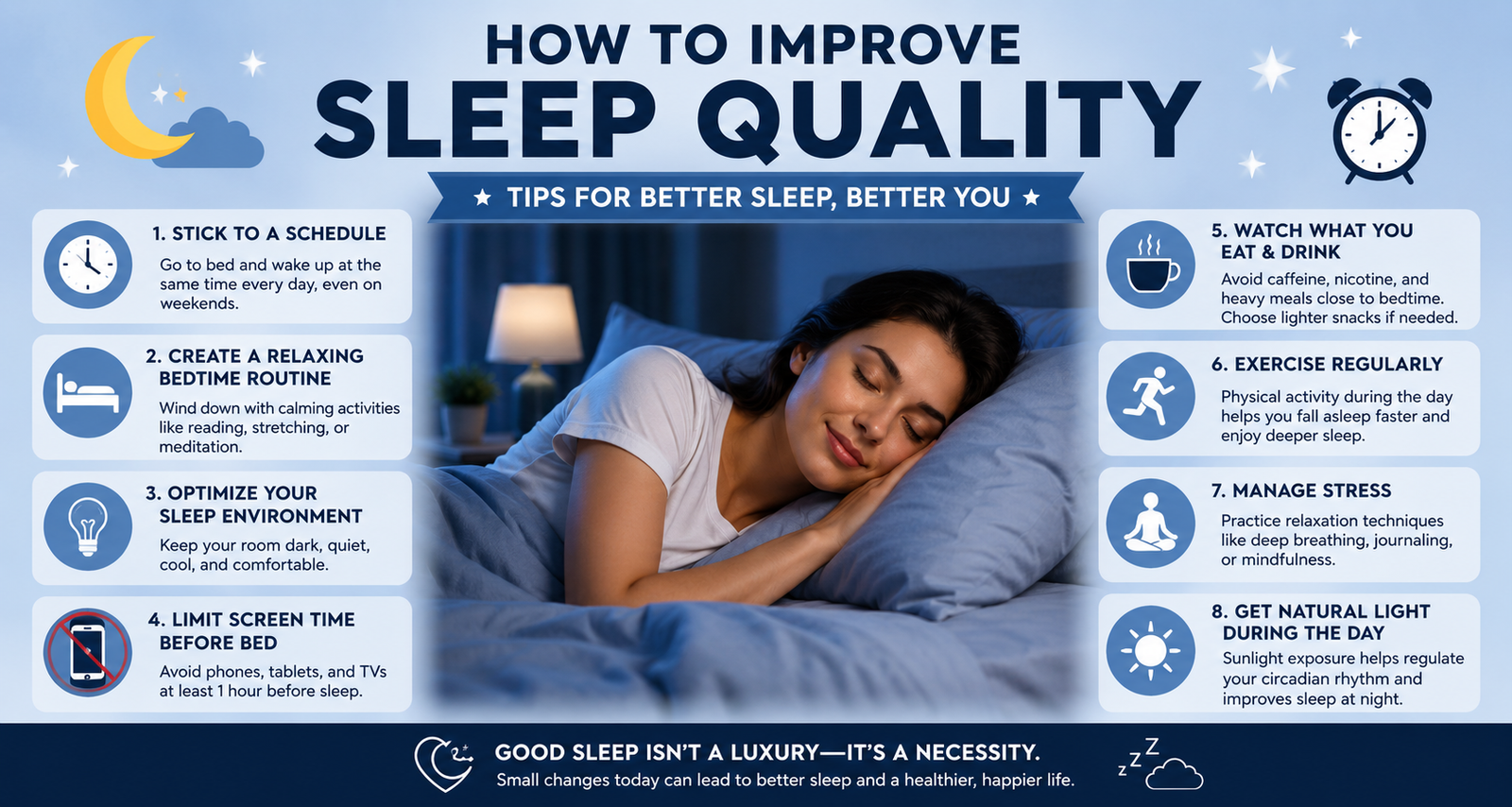
Sleep quality depends on more than just hours in bed. Consistent sleep schedules, lower bedroom temperatures, reduced evening light exposure, and limiting caffeine and alcohol are among the most effective evidence-based strategies for improving how deeply and restofully you sleep.
Most people know they should sleep more. Fewer know how to sleep better. You can spend eight hours in bed and still wake up feeling foggy, sluggish, and unrefreshed—because the number of hours you sleep and the quality of those hours are two very different things.
Poor sleep quality is more common than most people realize. According to the Centers for Disease Control and Prevention (CDC), about one in three American adults do not get enough sleep on a regular basis. Beyond fatigue, consistently poor sleep is linked to higher risks of heart disease, obesity, depression, and impaired immune function. Sleep is not passive recovery—it’s when your body consolidates memory, regulates hormones, repairs tissue, and clears metabolic waste from the brain.
The good news is that sleep quality responds well to behavioral and environmental changes. You don’t need a prescription or an expensive gadget to sleep better. For most people, a handful of consistent habits can make a significant difference within a few weeks.
This guide walks you through ten practical, evidence-based strategies to help you fall asleep faster, stay asleep longer, and wake up feeling genuinely rested.
Why does sleep quality matter more than sleep quantity?
Sleep quality refers to how restorative your sleep actually is—how quickly you fall asleep, how often you wake up, and how much time you spend in the deeper stages of sleep, including slow-wave sleep and REM (rapid eye movement) sleep.
During slow-wave sleep, your body releases growth hormone, repairs muscle tissue, and strengthens the immune system. During REM sleep, your brain processes emotions, consolidates memories, and clears neural waste via the glymphatic system—a network of channels that flushes out proteins linked to neurodegenerative diseases like Alzheimer’s.
Disrupted sleep interrupts these cycles. Even if you technically sleep for eight hours, frequent awakenings or time spent in light sleep stages can leave you under-recovered. That’s why quality matters as much as quantity.
How does your body regulate sleep, and what disrupts it?
Your sleep is governed by two biological systems: the circadian rhythm and sleep pressure.
Your circadian rhythm is a roughly 24-hour internal clock that regulates alertness and sleepiness based on light exposure and time of day. When light hits your eyes in the morning, it signals your brain to suppress melatonin—a hormone that promotes drowsiness—and increase cortisol, which promotes alertness. As daylight fades, melatonin rises again, preparing your body for sleep.
Sleep pressure, by contrast, builds the longer you stay awake. It’s driven by a compound called adenosine, which accumulates in the brain throughout the day and creates the urge to sleep. Caffeine works by blocking adenosine receptors, which is why it can keep you alert—and why drinking it too late in the day can delay sleep onset.
Both systems can be disrupted by modern habits: irregular schedules, evening screen use, late caffeine intake, alcohol, and stress. Understanding these mechanisms makes the strategies below easier to apply consistently.
10 evidence-based ways to improve your sleep quality
1. Keep a consistent sleep and wake time
Your circadian rhythm runs best on a predictable schedule. Going to bed and waking up at the same time every day—even on weekends—reinforces your internal clock and makes it easier to fall asleep and wake up naturally.
Studies suggest that social jetlag, the shift in sleep timing between weekdays and weekends, is associated with poorer sleep quality and increased daytime fatigue. Even a one- to two-hour difference can disrupt your rhythm. Start by anchoring your wake time first; a consistent alarm is easier to maintain than a consistent bedtime.
2. Lower your bedroom temperature
Your core body temperature needs to drop by about 1–2°F (0.5–1°C) to initiate sleep. A cooler room supports this process. Research from the National Sleep Foundation points to 60–67°F (15–19°C) as the range most conducive to sleep for adults.
If you tend to sleep hot, consider breathable, moisture-wicking bedding and keeping a window slightly open. Conversely, if you’re often cold at night, warm your hands and feet before bed—warming the extremities helps redirect blood flow away from your core, which paradoxically supports that necessary drop in core temperature.
3. Limit blue light exposure in the evening
Screens emit blue-wavelength light, which is particularly effective at suppressing melatonin. Using a phone, tablet, or laptop in the hour or two before bed delays melatonin release and can push back your sleep onset time.
Practically, this means dimming your screens after sunset, enabling night mode or warm-tone display settings, and—if possible—putting screens away for the last 30–60 minutes before bed. Reading a physical book or listening to a podcast are effective substitutes that don’t carry the same melatonin-suppressing effect.
4. Watch your caffeine cutoff time
Caffeine has a half-life of roughly five to six hours in most people, meaning half of a 200mg cup of coffee is still active in your system six hours after you drink it. For someone sensitive to caffeine, a 3 p.m. coffee could still be affecting sleep at 9 p.m.
A reasonable guideline for most people is to stop caffeine intake by early-to-mid afternoon. If you’re particularly sensitive—or if you’ve been struggling with sleep onset—try moving your cutoff back to noon and observe whether your sleep improves.
5. Limit alcohol, especially close to bedtime
Alcohol is a common sleep aid misconception. While it does make falling asleep easier, it fragments sleep in the second half of the night and suppresses REM sleep. Studies published in the journal Alcoholism: Clinical and Experimental Research found that alcohol reduces REM sleep duration in direct proportion to the amount consumed, even when subjects fall asleep faster.
The result is often waking between 2 and 4 a.m. as the sedative effects wear off and the nervous system rebounds. If you drink, try to finish at least three hours before bed, and aim to keep total intake moderate.
6. Create a wind-down routine
Your nervous system needs time to shift from alert to relaxed. A consistent pre-sleep routine—roughly 30 to 60 minutes of calm, low-stimulation activity—acts as a behavioral cue that signals your brain to begin transitioning toward sleep.
Effective wind-down activities include:
- Light stretching or yoga
- Reading fiction or non-fiction (physical copy, not screen)
- Taking a warm shower or bath (the subsequent skin cooling helps lower core body temperature)
- Journaling or writing a brief to-do list for the next day, which studies suggest can reduce intrusive thoughts at bedtime
The specific activities matter less than their consistency. Over time, your brain associates the routine with sleep onset.
7. Reserve your bed for sleep and sex only
Stimulus control is a core principle of Cognitive Behavioral Therapy for Insomnia (CBT-I), the most evidence-backed treatment for chronic sleep difficulties. The idea is straightforward: if you work, watch TV, or scroll your phone in bed, your brain starts to associate the bed with wakefulness. Using your bed exclusively for sleep strengthens the mental association between lying down and falling asleep.
If you can’t sleep after about 20 minutes, get up and do something quiet in dim light until you feel sleepy. Lying awake in bed reinforces the association between your bed and wakefulness rather than resolving it.
8. Manage stress and nighttime rumination
Stress and anxiety are among the most common causes of disrupted sleep. When your brain is running through tomorrow’s meeting or replaying a difficult conversation, the resulting cortisol release is directly antagonistic to sleep onset.
Two strategies have good evidence behind them. The first is expressive writing—spending 5–10 minutes writing out worries or a task list before bed, which externalizes the thoughts and reduces their intrusive pull. The second is relaxation techniques like diaphragmatic breathing (slow, deep breaths that activate the parasympathetic nervous system) or progressive muscle relaxation (systematically tensing and releasing muscle groups from feet to head). Neither requires equipment or expertise, and both can be integrated into your wind-down routine.
9. Get morning light exposure
Natural light exposure within the first hour of waking is one of the most powerful anchors for your circadian rhythm. Morning sunlight—even on a cloudy day—is far brighter than indoor lighting, and it sends a strong signal to your internal clock that the day has begun.
This matters for sleep quality because a well-anchored circadian rhythm means melatonin rises more reliably in the evening. A 10–15 minute walk outside in the morning, or sitting near a window while having breakfast, can meaningfully reinforce this pattern over time.
10. Evaluate your sleep environment
Your bedroom should be dark, quiet, and cool. Even low levels of light during sleep can suppress melatonin and interfere with sleep depth. Blackout curtains or a sleep mask address this effectively.
Noise is more disruptive than many people recognize—intermittent sounds (like traffic or a partner snoring) are particularly problematic because they trigger brief arousals, even when you don’t fully wake up. White noise machines or earplugs can reduce this effect. And if your mattress or pillow doesn’t support your preferred sleep position, that’s worth addressing too—discomfort consistently reduces time spent in deep sleep stages.
What if these strategies don’t help?
For most people, consistent application of the habits above leads to noticeable improvement within two to four weeks. Sleep responds to behavioral change, but it takes time for new patterns to consolidate.
If you’ve tried these approaches consistently and still struggle with sleep, it’s worth speaking to a doctor. Conditions like sleep apnea—where breathing repeatedly stops during sleep—are common, underdiagnosed, and not addressable through behavioral change alone. Other conditions like restless leg syndrome, chronic pain, or mood disorders can also significantly disrupt sleep and require their own management.
CBT-I, delivered by a trained therapist or through a digital program, is considered the first-line treatment for chronic insomnia and has stronger long-term outcomes than sleep medication for most people. Your doctor can refer you to a program or specialist.
Sleep better by starting small
Better sleep doesn’t require an overhaul. Pick one or two of the strategies above—ideally a consistent wake time and reduced evening screen use—and practice them daily for two weeks before adding more. Small, consistent changes compound quickly when it comes to sleep.
The goal isn’t a perfect sleep score on a wearable device. It’s waking up most mornings feeling genuinely rested and alert. That’s an achievable outcome for most people, and the evidence on how to get there is clearer than it’s ever been.
Frequently asked questions about improving sleep quality
How long does it take to improve sleep quality with behavioral changes?
Most people notice improvement within two to four weeks of consistently applying sleep hygiene strategies. Changes like maintaining a regular sleep schedule and reducing evening light exposure tend to show effects relatively quickly, though individual variation is common.
What is the most effective way to fall asleep faster?
Consistent sleep and wake times, a 30–60 minute wind-down routine, and keeping your bedroom cool and dark are among the most reliable methods for reducing sleep onset time. For people with chronic difficulty falling asleep, CBT-I (Cognitive Behavioral Therapy for Insomnia) has stronger evidence than any sleep aid.
Does alcohol help or hurt sleep quality?
Alcohol makes falling asleep easier but reduces overall sleep quality. It suppresses REM sleep and fragments the second half of the night, leading to earlier waking and less restorative sleep, even if the total hours in bed appear adequate.
What temperature should my bedroom be for the best sleep quality?
Research supports a bedroom temperature of 60–67°F (15–19°C) for most adults. Your core body temperature needs to drop slightly to initiate and maintain sleep, and a cooler room facilitates that process.
How does caffeine affect sleep quality?
Caffeine blocks adenosine receptors, delaying the build-up of sleep pressure and making it harder to fall asleep. With a half-life of five to six hours, caffeine consumed in the afternoon can still meaningfully affect sleep onset at night. Most sleep specialists recommend stopping caffeine intake by early-to-mid afternoon.
When should I see a doctor about poor sleep quality?
See a doctor if poor sleep persists despite consistent behavioral changes, if you snore loudly or wake up gasping, if you feel unrefreshed despite adequate sleep duration, or if daytime fatigue is affecting your work or safety. These may indicate an underlying condition like sleep apnea that requires medical evaluation.
