
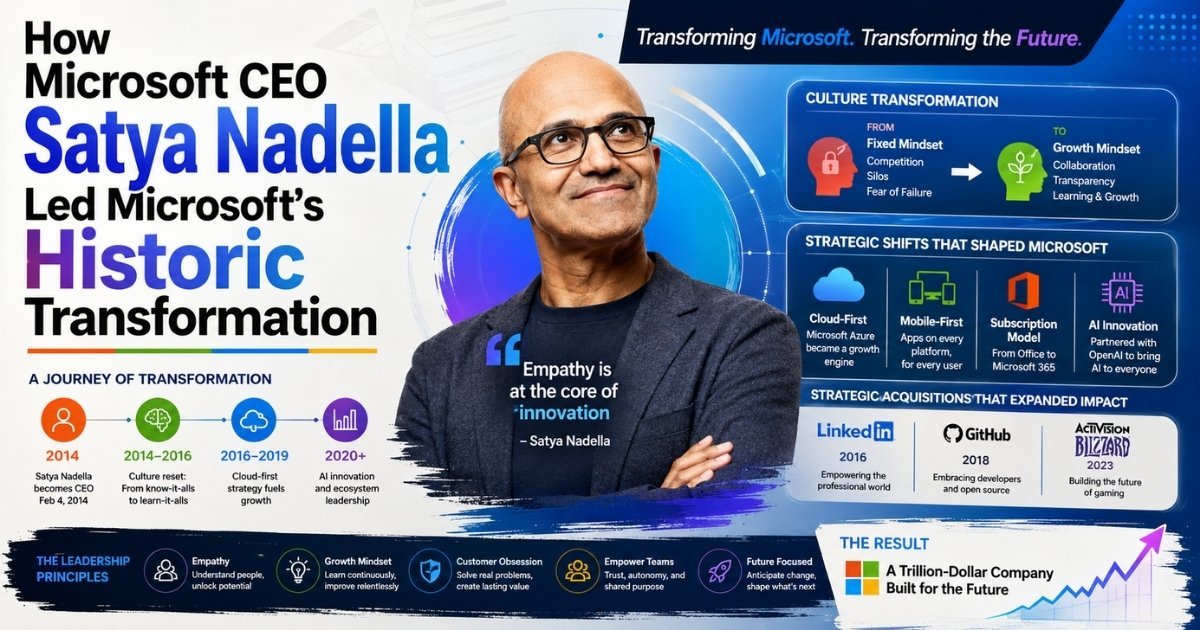
Microsoft CEO Satya Nadella transformed the technology giant by shifting its corporate culture from a fixed mindset to a growth mindset. Appointed in February 2014, Nadella pivoted Microsoft toward cloud computing and artificial intelligence, dramatically increasing the company’s market valuation through strategic acquisitions and a focus on empathy-driven leadership.
When the Microsoft board of directors announced Satya Nadella as the company’s third Chief Executive Officer in February 2014, the technology industry responded with cautious optimism. At the time, Microsoft struggled with internal bureaucracy, a stagnating stock price, and a reputation for aggressively protecting its Windows operating system monopoly. Competitors like Apple and Google had largely captured the mobile computing market, leaving Microsoft searching for a new corporate identity.
Nadella approached this monumental challenge not with massive layoffs or aggressive restructuring, but with a fundamental shift in corporate psychology. Drawing on his decades of experience within the company’s engineering and cloud divisions, Microsoft CEO Satya Nadella recognized that the organization’s existing culture actively stifled innovation. By prioritizing continuous learning and emotional intelligence, Nadella orchestrated one of the most successful corporate turnarounds in modern business history.
This blog post examines the specific leadership strategies, cultural reforms, and business decisions that define Satya Nadella’s tenure as Microsoft CEO. Business professionals, corporate executives, and aspiring managers will discover actionable insights on how to foster a healthier workplace culture, pivot large organizations toward new technologies, and leverage empathy as a core driver of sustainable corporate growth.
Table of Content
What was Microsoft’s corporate environment like before 2014?
To understand the magnitude of Satya Nadella’s leadership impact, one must first examine the corporate environment he inherited. During the early 2000s, Microsoft operated under a highly competitive internal structure. The company utilized a performance review system known as “stack ranking,” which forced managers to grade employees on a curve. This system meant that a certain percentage of workers had to receive poor performance ratings, regardless of the team’s overall success.
This evaluation method created a hostile work environment. Employees frequently competed against their own team members rather than external competitors. Department leaders hoarded resources and information, leading to highly siloed business units that rarely collaborated. Consequently, Microsoft missed several major technological shifts. The company failed to capitalize on the rise of search engines, social media platforms, and smartphones, largely because different product teams refused to integrate their technologies efficiently.
Furthermore, Microsoft’s business model relied heavily on selling software licenses for the Windows operating system and the Microsoft Office productivity suite. Company leaders actively discouraged any product developments that might threaten Windows’ dominance. This protectionist strategy alienated software developers and frustrated enterprise customers who wanted cross-platform compatibility. Microsoft needed a leader who could dismantle these internal barriers and refocus the company on solving actual customer problems.
How did Satya Nadella implement a growth mindset at Microsoft?
Upon assuming the role of Chief Executive Officer, Satya Nadella immediately diagnosed Microsoft’s primary issue as a cultural failure rather than a technological one. To address this, Nadella introduced the concept of the “growth mindset,” a psychological framework developed by Stanford University psychologist Carol Dweck.
In her research, Carol Dweck distinguishes between a fixed mindset, where individuals believe their talents and intelligence are static, and a growth mindset, where individuals believe they can develop their abilities through dedication and hard work. Nadella distributed Dweck’s book, Mindset: The New Psychology of Success, to his senior leadership team. He explicitly instructed Microsoft management to transition the company from a culture of “know-it-alls” to a culture of “learn-it-alls.”
This philosophical shift produced immediate practical changes. Microsoft eliminated the stack ranking system, replacing it with a performance review process that rewarded collaboration and continuous learning. Nadella encouraged employees to take calculated risks and view failures as valuable data points rather than career-ending mistakes. By removing the fear of internal punishment, Microsoft engineers began sharing code across departments, leading to faster product development cycles and more innovative software solutions.
Why is empathy critical for modern corporate leadership?
Satya Nadella frequently cites empathy as the most important attribute for effective corporate leadership. While traditional business literature often frames empathy as a soft skill, Nadella views empathy as an essential driver of commercial innovation.
Microsoft CEO Satya Nadella argues that a company cannot design products that solve customer problems if the company’s employees cannot understand the customer’s daily struggles. Empathy allows software engineers and product managers to perceive unarticulated customer needs. When employees actively listen to users and understand their perspectives, the resulting technology becomes more accessible, intuitive, and valuable. Choose an empathy-driven leadership approach if long-term customer retention and product innovation matter more to your organization than short-term aggressive sales tactics.
What strategic business shifts did Microsoft make under Satya Nadella?
Cultural transformation provided the necessary foundation, but Satya Nadella also executed a series of bold strategic pivots that redefined Microsoft’s business model. Upon taking office, Nadella established a new corporate mantra: “mobile-first, cloud-first.” This declaration officially ended the company’s obsession with protecting the Windows operating system at all costs.
Nadella recognized that the future of computing existed in decentralized cloud servers and mobile devices. He directed massive investments into Microsoft Azure, the company’s cloud computing platform. Rather than forcing customers to buy Windows-based hardware, Microsoft began building applications for competing operating systems. The company released robust versions of Microsoft Office for Apple’s iOS and Google’s Android platforms, acknowledging that users wanted access to Microsoft productivity tools regardless of the device they owned.
Additionally, Microsoft transitioned its core software products from one-time perpetual licenses to subscription-based models. Microsoft Office became Office 365 (now Microsoft 365), providing users with continuous updates and cloud storage while securing predictable, recurring revenue for the company. This transition required immense patience, as revenue initially dipped during the shift, but it ultimately created a vastly more profitable and stable financial structure.
How did the shift to Microsoft Azure drive revenue growth?
Under Satya Nadella’s direction, Microsoft Azure grew from a secondary project into the primary engine of Microsoft’s financial resurgence. By aggressively expanding Azure’s data center infrastructure and courting enterprise clients, Microsoft established itself as the primary alternative to Amazon Web Services (AWS) in the cloud infrastructure market.
Nadella understood that large enterprise organizations needed a trusted partner to navigate digital transformation. Microsoft leveraged its decades-long relationships with corporate IT departments to sell comprehensive cloud solutions. By integrating Azure with existing Microsoft enterprise software, the company offered a seamless transition for businesses migrating away from on-premises servers. This strategic focus on enterprise cloud computing propelled Microsoft’s market capitalization past the trillion-dollar mark.
Why did Microsoft acquire companies like LinkedIn and GitHub?
Satya Nadella also utilized strategic acquisitions to expand Microsoft’s reach and secure critical user communities. Unlike previous Microsoft acquisitions, which often resulted in the absorbed company losing its unique identity, Nadella championed an integration strategy that preserved the acquired company’s culture and autonomy.
In 2016, Microsoft acquired the professional networking platform LinkedIn for $26.2 billion. This acquisition provided Microsoft with an unparalleled database of professional profiles, enhancing its enterprise software ecosystem and providing crucial data for its artificial intelligence initiatives.
Two years later, Microsoft acquired the software development platform GitHub for $7.5 billion. Historically, open-source developers viewed Microsoft with intense suspicion due to the company’s aggressive patent litigation in the 1990s and early 2000s. By acquiring GitHub and allowing it to operate independently, Satya Nadella signaled a complete reversal of Microsoft’s historical hostility toward open-source software. Today, Microsoft ranks among the largest corporate contributors to open-source projects globally.
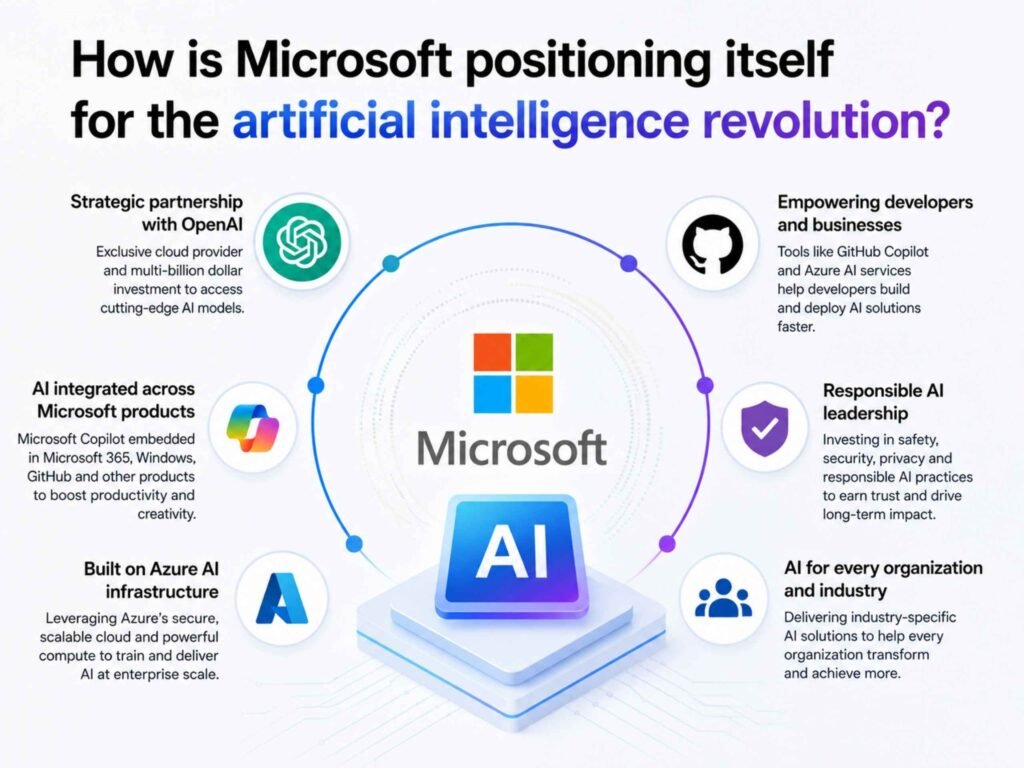
How is Microsoft positioning itself for the artificial intelligence revolution?
Having successfully navigated the transition to cloud computing, Microsoft CEO Satya Nadella positioned the company to lead the next major technological paradigm shift: artificial intelligence.
Recognizing the immense capital and computing power required to train large language models, Microsoft formed a strategic partnership with OpenAI, the research laboratory behind ChatGPT. Beginning with a $1 billion investment in 2019, Microsoft became OpenAI’s exclusive cloud provider. This partnership granted Microsoft preferential access to OpenAI’s cutting-edge models.
Nadella quickly integrated these generative AI capabilities across Microsoft’s entire product portfolio. The company launched Microsoft Copilot, an AI assistant embedded directly into Microsoft 365 applications, the GitHub coding environment, and the Windows operating system. By rapidly deploying AI tools to hundreds of millions of enterprise users, Microsoft established an early and formidable lead in the commercialization of artificial intelligence.
Applying Satya Nadella’s Leadership Principles to Your Organization
The success of Microsoft CEO Satya Nadella provides a reproducible blueprint for modern organizational leadership. Transforming a large, entrenched institution requires leaders to prioritize psychological safety, dismantle internal silos, and remain aggressively focused on future technological trends rather than past successes.
Begin by assessing your organization’s current performance evaluation metrics. Ensure your reward systems encourage collaboration and knowledge sharing rather than zero-sum internal competition. Next, adopt the “learn-it-all” philosophy by explicitly encouraging employees to experiment and view occasional failures as necessary components of the research and development process. Finally, actively listen to your customers without attempting to force them into a specific technological ecosystem. By letting empathy guide your product development, your organization can identify new market opportunities and build lasting commercial resilience.
Discover Mark Zuckerberg’s leadership journey at Meta and explore how his growing net worth reflects the massive impact of one of the world’s biggest technology companies.
Frequently Asked Questions
When did Satya Nadella become CEO of Microsoft?
Satya Nadella officially became the Chief Executive Officer of Microsoft on February 4, 2014. He succeeded Steve Ballmer to become the third CEO in Microsoft’s history, following Ballmer and company co-founder Bill Gates.
What is Satya Nadella’s leadership style?
Satya Nadella’s leadership style relies heavily on empathy, active listening, and the promotion of a “growth mindset.” He focuses on empowering employees to learn continuously, removing internal bureaucratic silos, and building products that genuinely solve unarticulated customer problems.
What are the most significant companies Microsoft acquired under Satya Nadella?
Under Satya Nadella, Microsoft executed several massive acquisitions to expand its enterprise and developer ecosystems. The most significant acquisitions include the professional networking site LinkedIn in 2016, the software development platform GitHub in 2018, and the video game holding company Activision Blizzard in 2023.
How did Satya Nadella change Microsoft’s business strategy?
Satya Nadella changed Microsoft’s business strategy by moving the company away from its strict dependence on the Windows operating system. He pivoted Microsoft toward a “mobile-first, cloud-first” approach, focusing heavy investments on the Microsoft Azure cloud platform and transitioning Microsoft Office into a subscription-based service.
What is Microsoft Copilot?
Microsoft Copilot is an artificial intelligence assistant integrated into Microsoft’s software products, including Microsoft 365, Windows, and GitHub. Driven by Microsoft’s partnership with OpenAI, Copilot helps users automate routine tasks, draft documents, and write software code by utilizing advanced large language models.
Explore the latest rankings and wealth stories of India’s leading entrepreneurs while discovering how business growth continues to create new billionaire success stories.
