
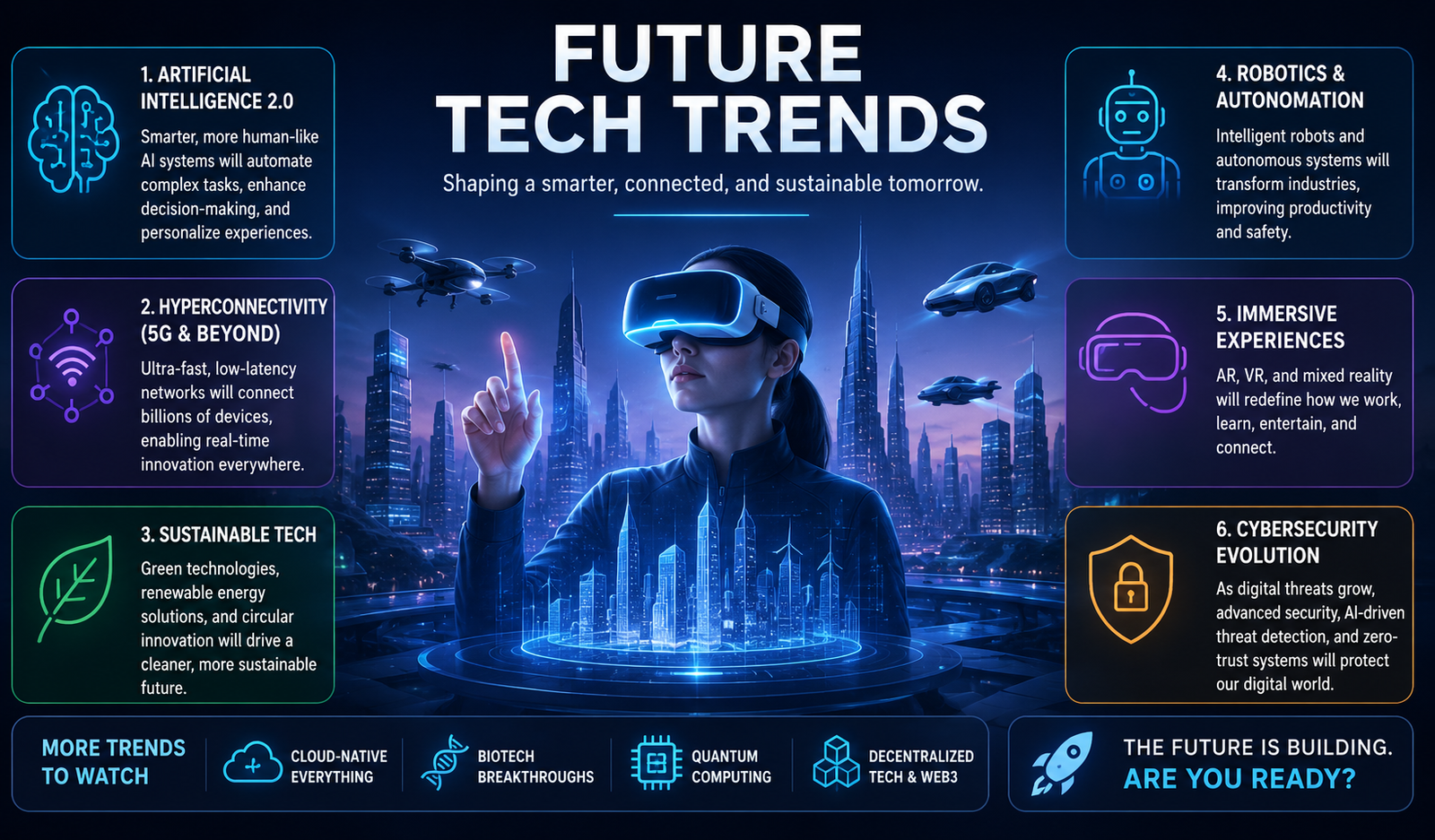
Technology evolves at a staggering pace, fundamentally altering how we interact, work, and solve global challenges. A few decades ago, smartphones were the stuff of science fiction. Now, they are indispensable tools that connect us to the entirety of human knowledge. The next wave of innovation promises shifts that are even more profound.
Understanding these future tech trends is critical for businesses aiming to stay competitive and individuals looking to navigate a rapidly changing job market. We are moving beyond simple automation and connectivity. The emerging landscape is defined by systems that can think, environments that blend the physical and digital, and computing power that defies traditional physics.
This post explores the most significant technological advancements on the horizon. From the maturation of artificial intelligence to the dawn of quantum computing, you will discover how these emerging tools operate and why they matter. By grasping the trajectory of these future tech trends, you can better prepare for the opportunities and challenges of the coming decade.
Artificial Intelligence and Machine Learning Maturation
Artificial intelligence has officially moved out of the experimental phase and into everyday application. We are witnessing a transition from narrow AI, which handles specific tasks, to highly adaptable machine learning models that can generate original content, write code, and diagnose medical conditions with striking accuracy.
Generative AI as a Collaborative Tool
Generative AI models have dominated recent headlines, but their future lies in seamless collaboration with human workers. Instead of replacing employees, these tools act as highly capable assistants. Software developers use them to debug code, while architects leverage them to generate sustainable building designs in seconds. The next iteration of generative AI will be deeply integrated into enterprise software, anticipating user needs and automating complex workflows without requiring explicit prompts.
Ethical AI and Governance
As AI systems gain autonomy, the focus is shifting heavily toward governance. Organizations and governments are prioritizing the development of ethical AI frameworks. This involves creating transparent algorithms that can explain their decision-making processes. Reducing bias in training data and ensuring data privacy are top priorities for researchers. Expect to see strict regulatory standards emerge, requiring companies to audit their AI models regularly to ensure fairness and accountability.
The Quantum Computing Leap
Traditional computers process information using bits, represented as either zeros or ones. Quantum computers use quantum bits, or qubits, which can exist as zeros, ones, or both simultaneously. This fundamental difference grants them processing power that is exponentially greater than the most advanced supercomputers available today.
Solving Complex Global Problems
The true potential of quantum computing lies in its ability to model complex natural systems. Pharmaceutical companies are investing heavily in this technology to simulate molecular interactions, potentially reducing the time required to discover new life-saving drugs from years to mere days. Similarly, climate scientists plan to use quantum algorithms to model atmospheric changes with unprecedented precision, helping us develop more effective strategies to combat global warming.
The Cryptography Challenge
While quantum computing offers incredible benefits, it also presents a significant security challenge. The immense calculating power of these machines could easily break the cryptographic codes that currently protect the world’s financial and communication networks. In response, a massive industry effort is underway to develop quantum-resistant cryptography. Organizations are upgrading their digital infrastructure now to protect sensitive data from future quantum attacks.
Hyper-Connectivity Through IoT and 6G
The Internet of Things (IoT) has already connected billions of devices, from smart thermostats to industrial sensors. The next evolution of connectivity involves refining these networks and preparing for the rollout of 6G internet.
Smart Cities and Infrastructure
Future tech trends point toward fully integrated smart cities. IoT sensors embedded in roads, bridges, and public transport systems will collect real-time data to optimize traffic flow, reduce energy consumption, and alert maintenance crews to structural weaknesses before accidents occur. This hyper-connectivity allows urban centers to operate highly efficiently, reducing waste and improving the quality of life for residents.
The Journey Toward 6G Networks
While 5G is still rolling out globally, researchers are actively developing 6G technology. Expected to launch in the early 2030s, 6G will offer speeds up to 100 times faster than 5G. This massive leap in bandwidth will eliminate latency entirely. It will enable flawless remote surgeries, real-time holographic communications, and the seamless operation of autonomous vehicle fleets across vast distances.
Green Technology and Sustainable Innovation
The urgent need to address climate change is driving massive investments in green technology. Future tech trends in this sector are focused on transitioning away from fossil fuels and creating completely sustainable industrial processes.
Renewable Energy Storage
Generating solar and wind power is highly efficient, but storing that energy for use when the sun isn’t shining or the wind isn’t blowing remains a challenge. The technology sector is responding with advanced battery technologies. Solid-state batteries promise higher energy density and faster charging times than current lithium-ion models. Furthermore, grid-scale storage solutions using gravity or compressed air are being tested to ensure a stable, continuous supply of green energy to major cities.
Circular Economy Tech
Manufacturing is shifting toward a circular economy model, where waste is eliminated, and materials are continuously reused. Technology plays a crucial role here through advanced material science and AI-driven supply chain management. Companies are developing biodegradable plastics derived from algae and using machine learning to track products through their entire lifecycle, ensuring they are properly disassembled and recycled at the end of their usefulness.
Augmented and Virtual Reality in Daily Life
Virtual reality (VR) and augmented reality (AR) are shedding their reputations as niche gaming accessories. These technologies are fundamentally altering how we learn, work, and interact with our environment.
The Industrial Metaverse
The concept of the metaverse is finding its most practical application in the industrial sector. Companies use digital twins—highly detailed virtual replicas of physical factories, supply chains, or products—to run simulations and optimize performance. Engineers can put on a VR headset and walk through a digital version of a manufacturing plant, identifying bottlenecks and testing new machinery layouts without disrupting actual production.
Transforming Education and Healthcare
AR and VR are creating deeply immersive learning environments. Medical students now practice complex surgical procedures on virtual patients, gaining valuable experience without risk. In primary education, students can take virtual field trips to ancient historical sites or explore the human circulatory system from the inside. By making learning experiential rather than passive, these technologies dramatically improve information retention and student engagement.
Frequently Asked Questions
What is the most impactful future tech trend?
While opinions vary, many experts point to the maturation of Artificial Intelligence as the most immediately impactful trend. AI serves as a foundational technology that accelerates advancements in other fields, from optimizing green energy grids to analyzing quantum computing data.
How will future technology affect jobs?
Technological advancement will inevitably automate certain routine tasks, but it will also create entirely new industries and roles. The focus will shift toward jobs that require emotional intelligence, complex problem-solving, and the ability to manage and maintain advanced technological systems. Continuous learning and adaptability will be essential for the future workforce.
When will quantum computing become widely available?
Quantum computing is currently in the experimental and research phase, largely confined to major tech companies and academic institutions. While we may see commercial applications for highly specific industries within the next five to ten years, broad consumer availability is likely decades away.
Preparing for the Next Technological Era
The future tech trends discussed here are not isolated developments. They are deeply interconnected forces that will compound one another’s progress. Artificial intelligence will help design better quantum computers, which will in turn process the massive data generated by a 6G-powered Internet of Things, all while driving the transition to sustainable green energy.
Organizations that wait for these technologies to mature fully before engaging with them risk being left behind. The time to invest in digital literacy, upgrade infrastructure, and cultivate an adaptable workforce is now. By embracing these innovations thoughtfully and proactively, you can ensure that you are ready to thrive in the next great technological era.
