
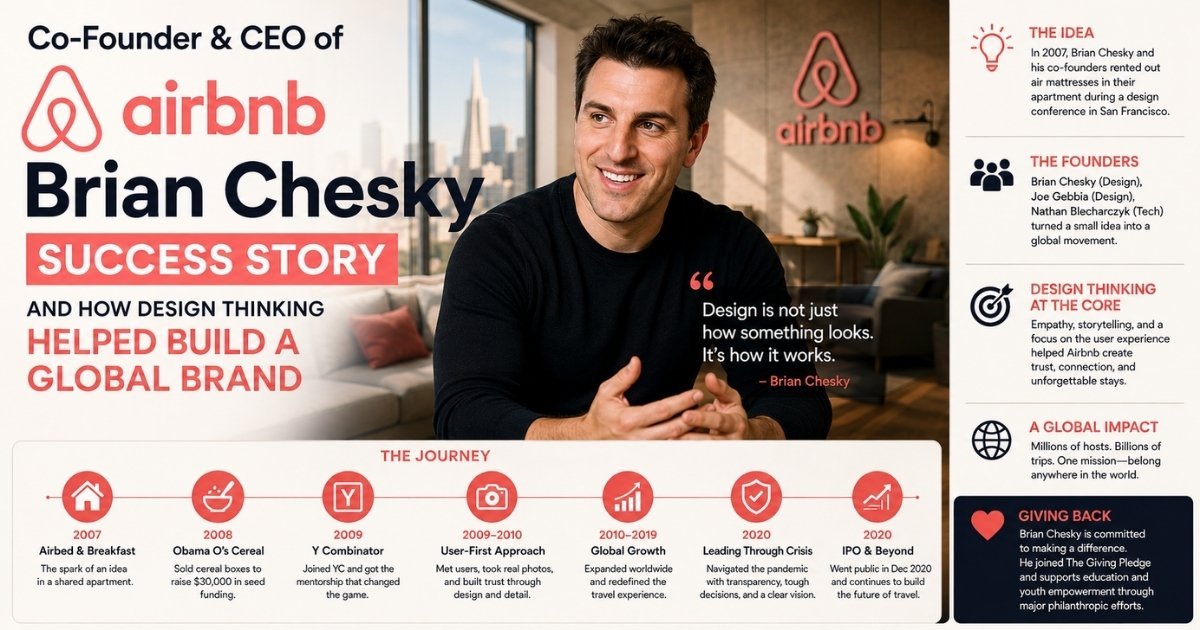
Brian Chesky is the co-founder and Chief Executive Officer of Airbnb. After graduating from the Rhode Island School of Design, Chesky partnered with Joe Gebbia and Nathan Blecharczyk in 2007 to launch a home-sharing platform. Today, Brian Chesky leads Airbnb as a globally recognized hospitality and technology brand.
Many tech founders start their careers writing code or studying computer science. Brian Chesky took a very different path. As an industrial design student, Chesky learned how to solve complex user problems through empathy and aesthetics. This design-first approach ultimately shaped the foundation of Airbnb, a platform that permanently altered the global travel industry.
Understanding the Brian Chesky biography requires looking past standard Silicon Valley success stories. Chesky did not have a background in business management or software engineering. He moved to San Francisco with little money and a desire to build something new. By focusing heavily on the actual user experience, Chesky and his co-founders turned a simple idea for renting out air mattresses into a publicly traded powerhouse.
This post explores the life, career, and leadership philosophy of Airbnb CEO Brian Chesky. You will learn about his early educational background, the initial struggles of launching Airbnb, and the specific strategies he used to guide the company through global crises. By examining his journey, aspiring entrepreneurs and business leaders can extract valuable lessons on resilience, design thinking, and adaptable leadership.
What is Brian Chesky’s early life and educational background?
Brian Chesky developed a passion for art and design long before he entered the tech industry. His early environments heavily influenced his later approach to building consumer products.
Where did Brian Chesky grow up?
Brian Chesky was born on August 29, 1981, in Niskayuna, New York. His parents, Robert and Deborah Chesky, were both social workers. Growing up in upstate New York, Chesky showed a strong early interest in art, drawing, and redesigning everyday objects. He frequently spent time sketching and studying the architecture of homes in his neighborhood. This early fascination with living spaces and design mechanics laid the groundwork for his future career in the hospitality and housing sector.
How did the Rhode Island School of Design influence Brian Chesky?
In 1999, Brian Chesky enrolled at the Rhode Island School of Design (RISD), one of the most prestigious art and design schools in the United States. He majored in industrial design, a discipline that focuses on creating products that are both functional and visually appealing. According to Chesky, RISD taught him that design is not just about how something looks, but how it fundamentally works.
During his time at the Rhode Island School of Design, Brian Chesky met Joe Gebbia. The two students bonded over their shared entrepreneurial interests and design philosophies. Gebbia would later convince Chesky to move to San Francisco, setting the stage for their historic business partnership. Chesky graduated from RISD in 2004 with a Bachelor of Fine Arts in Industrial Design.
How did Brian Chesky start Airbnb?
The founding of Airbnb is one of the most studied origin stories in modern technology. It required unconventional thinking, aggressive problem-solving, and a willingness to embrace seemingly unscalable ideas.
What was the original idea behind Airbnb?
In October 2007, Brian Chesky moved to San Francisco to live with Joe Gebbia. The two friends quickly realized they could not afford their rent. A major design conference was happening in the city, and local hotels were completely booked. Chesky and Gebbia decided to buy three air mattresses, place them in their living room, and offer them to conference attendees along with a homemade breakfast. They called this initial concept “Airbed and Breakfast.”
The founders hosted three guests during that weekend. Realizing they had discovered a viable market demand, Chesky and Gebbia recruited their former roommate, Nathan Blecharczyk, a software engineer, to help build a proper digital platform. Blecharczyk became the third co-founder of Airbnb, bringing the necessary technical infrastructure to support Chesky and Gebbia’s design vision.
How did the 2008 financial crisis impact early Airbnb growth?
The early days of Airbnb were incredibly difficult. Investors repeatedly rejected the platform, arguing that strangers would never feel safe sleeping in each other’s homes. By the summer of 2008, the founders were burdened with credit card debt.
To fund the company, Brian Chesky and his co-founders created custom cereal boxes during the 2008 United States Presidential Election. They designed and sold “Obama O’s” and “Cap’n McCain’s” cereal for $40 a box. This creative marketing stunt generated $30,000 in vital seed funding.
More importantly, the cereal boxes caught the attention of Paul Graham, the co-founder of the startup accelerator Y Combinator. Graham admitted he thought the home-sharing idea was flawed, but he respected the founders’ immense determination. Airbnb joined the Y Combinator program in 2009. During this period, Paul Graham advised Brian Chesky to travel to New York City, meet directly with early users, and professionally photograph their apartments. This focus on high-quality visuals and hands-on customer research dramatically improved the platform’s booking rates.
How has Brian Chesky led Airbnb through major crises?
Scaling a global travel company involves managing complex regulatory battles, safety concerns, and macroeconomic shocks. Chesky has faced several defining leadership moments during his tenure as Airbnb CEO.
How did Brian Chesky navigate the COVID-19 pandemic?
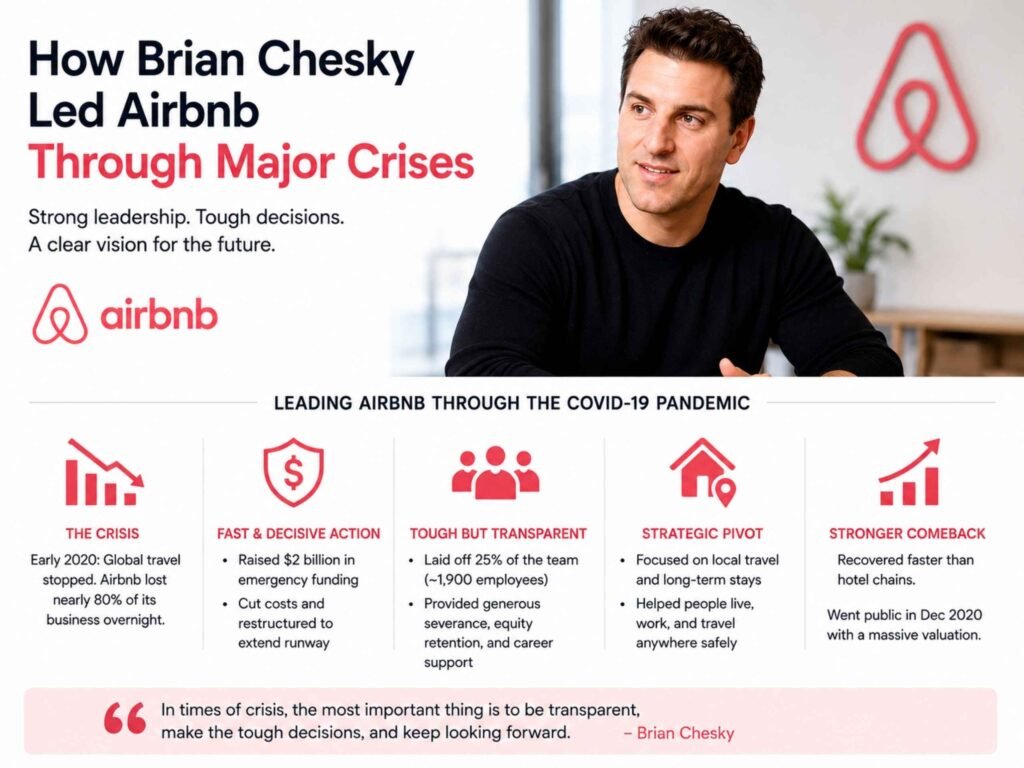
The COVID-19 pandemic presented the most severe threat to Airbnb’s existence. In early 2020, global travel completely halted. Airbnb lost nearly 80% of its business in a matter of weeks. According to public company statements from 2020, Airbnb forecasted revenue drops of more than 50% for the year.
Brian Chesky responded by making swift, difficult decisions. He raised $2 billion in emergency debt funding to stabilize the company’s balance sheet. Chesky also made the painful choice to lay off 25% of the Airbnb workforce, amounting to nearly 1,900 employees. He handled the layoffs with noted transparency, providing generous severance packages, equity retention, and job placement support for departing staff.
Simultaneously, Brian Chesky pivoted the Airbnb platform to focus on local travel and long-term stays. He realized that while people could not fly internationally, they still wanted to escape their primary residences to work remotely from nearby locations. This strategic shift allowed Airbnb to recover faster than traditional hotel chains. By December 2020, Brian Chesky successfully led Airbnb through its Initial Public Offering (IPO), achieving a massive first-day valuation.
What is Brian Chesky’s leadership style and design philosophy?
Brian Chesky operates Airbnb differently than a traditional technology executive. He famously views Airbnb as a design company rather than purely a software company.
Chesky actively champions “design thinking” at every level of the organization. He requires product teams to storyboard the customer journey, treating the travel experience like a cinematic narrative. By mapping out every touchpoint—from the moment a user opens the Airbnb app to the moment they leave their rental—Chesky ensures the company prioritizes emotional resonance alongside technical functionality.
Furthermore, Brian Chesky relies heavily on written communication and structured delegation. Following the pandemic, he centralized the company’s marketing and product development efforts. Instead of running multiple fragmented divisions, Chesky aligned the entire organization around a few core annual product releases. This centralized, design-led approach ensures that every new Airbnb feature maintains a consistent brand identity.
What is Brian Chesky’s net worth and philanthropic impact?
As Airbnb grew into a global enterprise, Brian Chesky accumulated significant personal wealth. However, he has also committed to substantial philanthropic efforts.
According to the Forbes Billionaires List for 2024, Chesky has an estimated net worth fluctuating around $9 billion to $10 billion, primarily tied to his equity in Airbnb. Recognizing the responsibility that comes with this wealth, Chesky joined The Giving Pledge in 2016. The Giving Pledge is a commitment created by Bill Gates and Warren Buffett, asking billionaires to donate the majority of their wealth to charitable causes during their lifetimes.
Chesky focuses his philanthropic efforts on education, youth empowerment, and public service. In 2022, Chesky donated $100 million to the Obama Foundation to launch the Voyager Scholarship. This scholarship program provides financial aid, travel stipends, and mentorship to college students pursuing careers in public service. Chesky believes that travel fundamentally broadens a person’s perspective, making it a crucial component of developing future leaders.
Key lessons from the Brian Chesky biography
Brian Chesky’s evolution from a college design student to the CEO of a publicly traded company offers a masterclass in founder growth. If you are building a company or leading a team, consider applying these core principles from Chesky’s career.
First, prioritize unscalable actions in the early days. Chesky did not rely on algorithms to fix his early product; he flew to New York and knocked on doors to meet his users. Second, treat design as a core business function. By prioritizing the user’s emotional experience, Chesky differentiated Airbnb from sterile booking websites. Third, communicate transparently during a crisis. Chesky’s handling of the 2020 pandemic layoffs preserved the company’s culture and reputation during an incredibly dark period.
If you want to learn more about applying design thinking to your own projects, consider studying the principles of industrial design or reading about the history of Y Combinator’s most successful startups.
Daniel Ek’s journey with Spotify shows how innovation and long-term vision can transform an entire industry, while Gautam Adani’s business growth highlights how strategic expansion can build global influence across multiple sectors. Together, these stories offer valuable lessons in entrepreneurship, scaling, and creating lasting impact.
Frequently Asked Questions
What is Brian Chesky’s net worth?
According to Forbes data from 2024, Chesky has an estimated net worth of approximately $9 billion to $10 billion. His wealth is predominantly tied to his ownership stakes and stock options in Airbnb.
Who are the other co-founders of Airbnb?
Brian Chesky co-founded Airbnb with Joe Gebbia, a fellow design student from the Rhode Island School of Design, and Nathan Blecharczyk, a software engineer who built the initial technical architecture for the platform.
What degree does Brian Chesky have?
Brian_Chesky holds a Bachelor of Fine Arts (BFA) in Industrial Design. He earned this degree from the Rhode Island School of Design (RISD) in 2004.
Does Brian Chesky still run Airbnb today?
Yes, Chesky is the current Chief Executive Officer of Airbnb. He continues to actively manage the company’s product strategy, marketing rollouts, and overall corporate direction.
How did Brian Chesky fund Airbnb in the early days?
Before securing venture capital, Chesky and his co-founders funded Airbnb by selling custom-designed cereal boxes called “Obama O’s” and “Cap’n McCain’s” during the 2008 election, which generated $30,000 in seed capital.
