
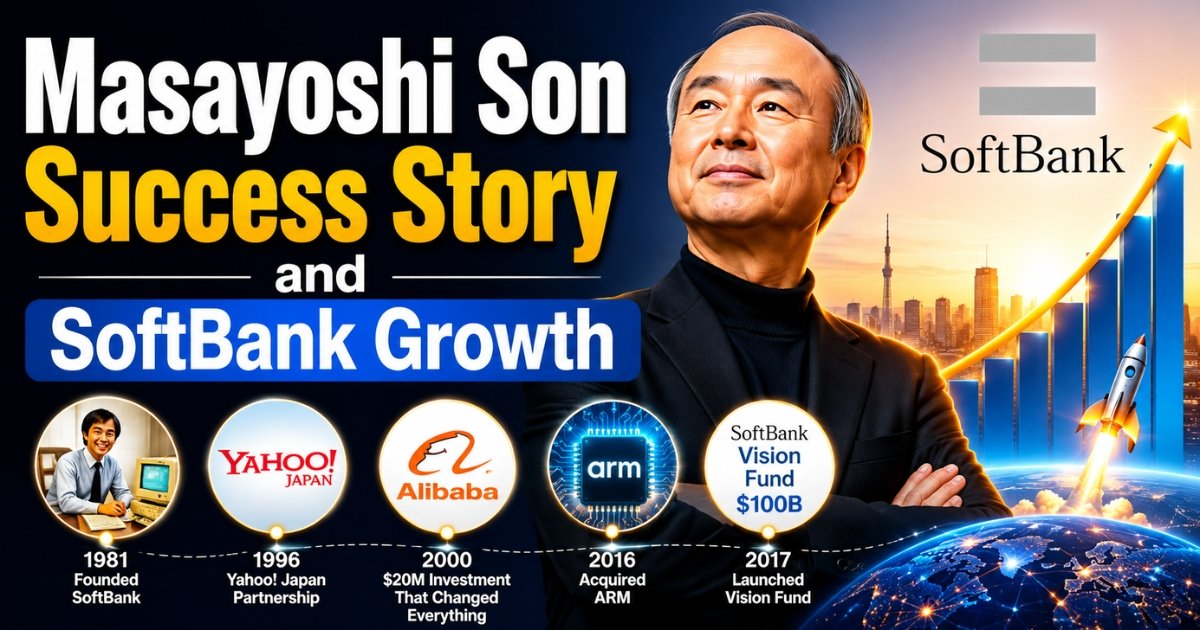
Masayoshi Son is a billionaire tech entrepreneur and investor who founded SoftBank Group in 1981. He is best known for transforming SoftBank from a software distributor into a global investment powerhouse, driven by a historic $20 million early investment in Alibaba and the creation of the $100 billion SoftBank Vision Fund, which heavily backed technology companies like Uber, DoorDash, and WeWork.
Risk is a concept most investors try to mitigate, manage, or avoid entirely. Masayoshi Son treats risk as a prerequisite for massive growth. Over the past four decades, the founder and CEO of SoftBank Group has built a reputation as the technology industry’s most aggressive backer, funding the infrastructure of the modern digital economy.
Understanding Masayoshi Son requires looking beyond his net worth. His career is a study in extreme conviction. He lost billions during the dot-com crash, only to rebound by orchestrating one of the most profitable investments in modern financial history. Later, he reshaped global venture capital by deploying unprecedented amounts of capital into unproven startups through the SoftBank Vision Fund.
This biography explores the life, strategy, and legacy of Masayoshi Son. You will learn how a student from a marginalized community in Japan built a global empire, the rationale behind his most controversial financial decisions, and how his 300-year vision for SoftBank Group continues to influence the artificial intelligence revolution.
What was Masayoshi Son’s early life and background?
Masayoshi Son was born on August 11, 1957, in Tosu, a city on the Japanese island of Kyushu. His family was of Korean descent (Zainichi Koreans), a group that historically faced significant discrimination in Japan. To assimilate, his family initially used the Japanese surname Yasumoto. Masayoshi Son later reclaimed his Korean surname, Son, a decision that reflected his growing self-reliance and determination to forge his own path.
Son’s father, Mitsunori, operated various businesses, including restaurants and pachinko parlors. Watching his father navigate the business world instilled an early entrepreneurial drive in Masayoshi Son. However, his ambitions quickly expanded beyond Japan.
At the age of 16, Masayoshi Son moved to the United States to finish high school. He subsequently enrolled at the University of California, Berkeley, where he majored in economics and computer science. The vibrant technological ecosystem of the San Francisco Bay Area in the late 1970s heavily influenced Masayoshi Son.
While at UC Berkeley, Masayoshi Son invented an electronic pocket translator. Recognizing the value of his intellectual property, he sold the patent to Sharp Corporation for approximately $1.7 million. He used this capital to import used arcade games like Space Invaders from Japan and lease them to local businesses in California. These early ventures demonstrated Masayoshi Son’s ability to identify emerging technology trends and monetize them rapidly.
How did Masayoshi Son found and build SoftBank Group?
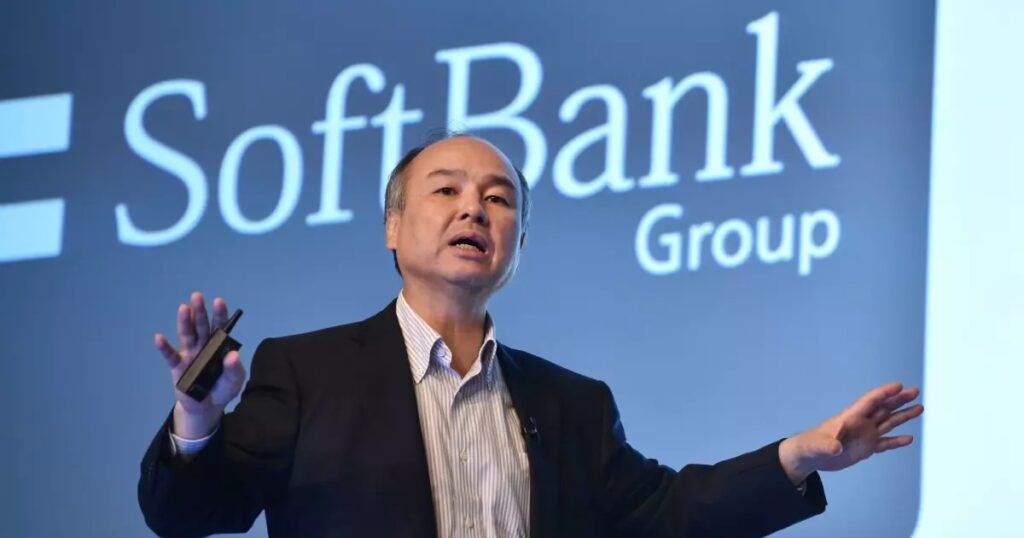
Upon graduating from UC Berkeley in 1980, Masayoshi Son returned to Japan. He took a year to research various business models before officially founding SoftBank in 1981.
Initially, SoftBank operated as a software distributor. The personal computer market was expanding rapidly, and Masayoshi Son positioned SoftBank as the crucial intermediary connecting software developers with computer retailers. Despite a slow start, SoftBank secured exclusive distribution rights with major electronics retailers, effectively capturing a dominant share of the Japanese software distribution market.
SoftBank quickly diversified. Masayoshi Son realized that controlling information about technology was just as valuable as selling the technology itself. SoftBank entered the publishing industry, launching magazines focused on computing and software. This move built brand authority and gave Masayoshi Son deep insights into consumer demand and technological shifts.
By the mid-1990s, Masayoshi Son shifted his focus back to the United States, targeting the emerging World Wide Web. He took SoftBank public in 1994, raising capital to fund a series of aggressive acquisitions and investments. SoftBank acquired the technology publisher Ziff Davis and the COMDEX trade show, giving the company unparalleled access to Silicon Valley’s top executives and upcoming trends.
How did the Yahoo! joint venture accelerate SoftBank’s growth?
In 1995, Masayoshi Son met Jerry Yang, the co-founder of Yahoo!. Recognizing the potential of the web portal, SoftBank invested $100 million for a 33% stake in Yahoo!. The following year, Masayoshi Son and Jerry Yang launched Yahoo! Japan as a joint venture.
Yahoo! Japan became the dominant search engine and web portal in the country, completely eclipsing competitors. This joint venture established SoftBank as a premier internet company in Japan and proved Masayoshi Son’s thesis that American technology models could be successfully localized for the Japanese market.
What are Masayoshi Son’s most impactful investments?
Masayoshi Son’s investment strategy relies on identifying foundational technological shifts—from the internet to mobile communications, and now artificial intelligence. He places massive, concentrated bets on the companies he believes will dominate those sectors.
How did the Alibaba investment change SoftBank Group?
The defining moment of Masayoshi Son’s career occurred in the year 2000. During a trip to China, he met Jack Ma, a former English teacher who had recently founded an e-commerce startup called Alibaba. Masayoshi Son was struck by Jack Ma’s charisma and vision for Chinese digital commerce.
Following a brief presentation, SoftBank invested $20 million in Alibaba. At the time, Alibaba had no revenue and a very basic website.
When Alibaba went public on the New York Stock Exchange in 2014, SoftBank’s initial $20 million stake was valued at roughly $60 billion. This return on investment cemented Masayoshi Son’s reputation as a visionary capital allocator. The Alibaba windfall provided SoftBank Group with the immense balance sheet necessary to pursue even larger acquisitions in the following decades.
What was the strategy behind acquiring Sprint and Vodafone Japan?
Masayoshi Son recognized early that mobile connectivity would succeed the desktop internet. In 2006, SoftBank Group acquired Vodafone’s struggling Japanese mobile unit for approximately $15 billion. Observers widely criticized the move, noting Vodafone Japan’s declining market share and poor network infrastructure.
Masayoshi Son rebranded the carrier to SoftBank Mobile and aggressively courted Apple. He secured the exclusive rights to sell the iPhone in Japan starting in 2008. This exclusivity deal triggered a massive influx of new subscribers, transforming SoftBank Mobile into a highly profitable telecommunications giant.
Attempting to replicate this success globally, SoftBank Group acquired a controlling stake in the American wireless carrier Sprint in 2013 for $21.6 billion. Masayoshi Son planned to merge Sprint with T-Mobile to challenge the dominance of AT&T and Verizon. While regulatory hurdles delayed the merger for years, the Sprint and T-Mobile merger finally closed in 2020, validating Masayoshi Son’s long-term telecommunications strategy.
Why did Masayoshi Son buy ARM Holdings?
In 2016, SoftBank Group announced the acquisition of ARM Holdings, a British semiconductor and software design company, for $32 billion. ARM does not manufacture chips; instead, it licenses its architecture to companies like Apple, Samsung, and Qualcomm. ARM designs are present in nearly every smartphone globally.
Masayoshi Son purchased ARM Holdings because he viewed the company as the critical infrastructure for the Internet of Things (IoT) and artificial intelligence. He believed that the proliferation of connected devices required highly efficient processors, positioning ARM at the center of the next technological paradigm.
What is the SoftBank Vision Fund and how does it operate?
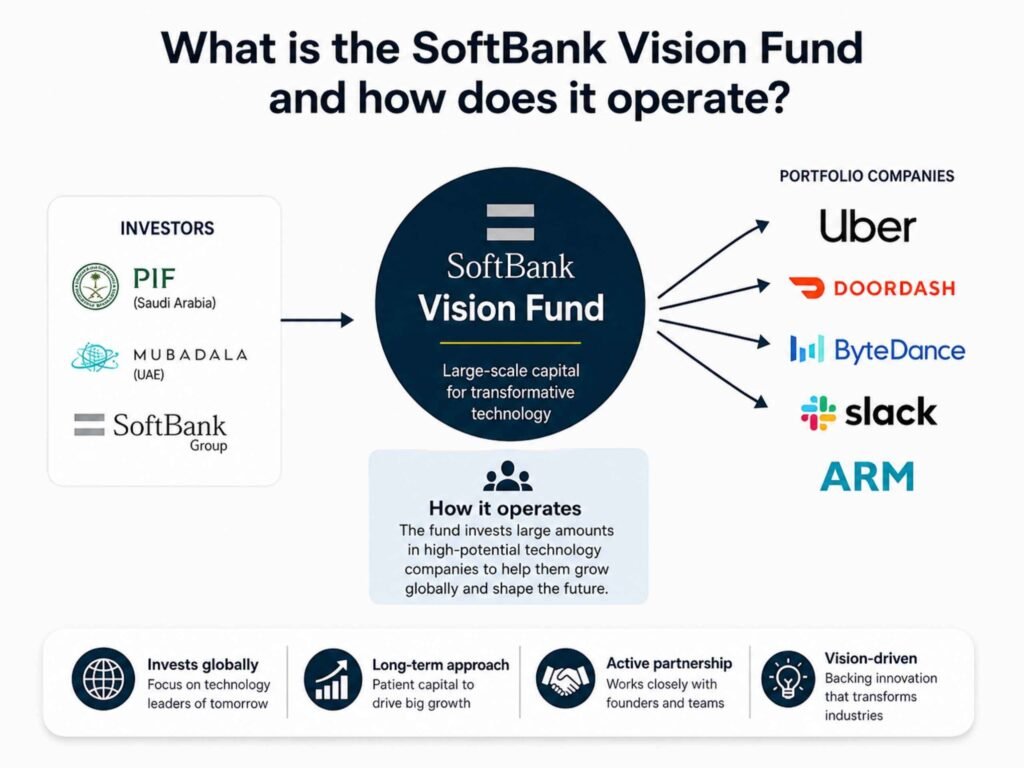
In 2017, Masayoshi Son radically disrupted global venture capital by launching the SoftBank Vision Fund. With nearly $100 billion in committed capital—heavily backed by the Public Investment Fund of Saudi Arabia and Abu Dhabi’s Mubadala Investment Company—the Vision Fund was the largest technology-focused investment fund in history.
The SoftBank Vision Fund operated on a strategy of overwhelming force. Masayoshi Son sought out market leaders in ride-sharing, artificial intelligence, robotics, and e-commerce. The fund would offer startup founders hundreds of millions, or even billions, of dollars. If a founder refused, Masayoshi Son often threatened to invest the same amount in their direct competitor.
This strategy forced companies to accept SoftBank’s capital to maintain their competitive edge. The Vision Fund heavily capitalized companies like Uber, ByteDance, DoorDash, and Slack, prioritizing rapid global expansion over near-term profitability.
What happened with the SoftBank investment in WeWork?
The SoftBank Vision Fund’s aggressive strategy encountered a severe setback with WeWork, a co-working space provider founded by Adam Neumann. Masayoshi Son invested billions into WeWork, artificially inflating the company’s private valuation to $47 billion.
When WeWork attempted an initial public offering (IPO) in 2019, public market investors scrutinized the company’s massive financial losses and problematic corporate governance. The IPO was canceled, and WeWork’s valuation plummeted. SoftBank Group was forced to orchestrate a multi-billion dollar bailout to prevent WeWork from descending into immediate bankruptcy.
Masayoshi Son publicly admitted that his judgment regarding Adam Neumann and WeWork was flawed. The WeWork crisis prompted a strategic shift within the SoftBank Vision Fund, forcing the firm to prioritize corporate governance and clear paths to profitability in its portfolio companies.
What is Masayoshi Son’s leadership style and business philosophy?
Masayoshi Son’s leadership style is characterized by extreme optimism, high risk tolerance, and a reliance on intuition. He frequently speaks about investing based on the “sparkle in the eyes” of founders, valuing ambition and vision as highly as financial metrics.
At the core of his philosophy is the “SoftBank Group 300-Year Plan.” Masayoshi Son believes that to build an enduring enterprise, a company must adapt to the information revolution rather than cling to specific products or services. He views SoftBank not as an operating company, but as a strategic holding company designed to partner with the foremost entrepreneurs of every era.
He is also a vocal proponent of the Singularity—the hypothetical future point where artificial intelligence surpasses human intelligence. Masayoshi Son actively aligns SoftBank Group’s portfolio to capitalize on this impending shift, heavily funding AI research, robotics, and autonomous systems.
The legacy and future of Masayoshi Son and SoftBank Group
Masayoshi Son’s legacy is defined by his willingness to finance the future. He has weathered multiple catastrophic financial downturns, including losing an estimated $70 billion of his personal net worth during the dot-com crash, only to rebuild his fortune and launch the most ambitious venture fund in history.
Looking forward, Masayoshi Son has positioned SoftBank Group at the nexus of the artificial intelligence boom. With the successful public listing of ARM Holdings in 2023, SoftBank secured massive capital reserves. Masayoshi Son is actively pivoting his organization from a broad technology investor into a highly specialized syndicate funding AI infrastructure, semiconductor manufacturing, and advanced robotics.
Whether his aggressive bets on artificial intelligence yield another Alibaba-level triumph or another WeWork-style collapse, Masayoshi Son remains one of the most consequential figures in modern capitalism. His decisions dictate how emerging technologies are developed, funded, and ultimately integrated into global society.
If you’re exploring more inspiring stories of innovation, leadership, and building long-term influence, these features on Jack Dorsey’s journey & leadership style and Reid Hoffman’s net worth and entrepreneurial success make great reads, while this profile on Diljit Dosanjh’s net worth and earnings offers an interesting look at success beyond the tech world.
Frequently Asked Questions (FAQ) about Masayoshi Son
What is Masayoshi Son’s current role?
Masayoshi Son serves as the Founder, Representative Director, Corporate Officer, Chairman, and Chief Executive Officer (CEO) of SoftBank Group Corp. He oversees the company’s global investment strategy, including the management of the SoftBank Vision Funds.
How did Masayoshi Son make his money?
Masayoshi Son made his initial fortune by building SoftBank into Japan’s top software distributor and acquiring major stakes in internet businesses like Yahoo! Japan. His wealth grew exponentially following a $20 million early investment in the Chinese e-commerce giant Alibaba, which eventually generated tens of billions of dollars in returns for SoftBank.
Why did Masayoshi Son start the SoftBank Vision Fund?
Masayoshi Son started the SoftBank Vision Fund in 2017 to aggressively invest in technologies driving the next stage of the information revolution, specifically artificial intelligence, robotics, and the Internet of Things (IoT). He believed traditional venture capital funds were too small to properly scale the massive global platforms of the future.
What was the biggest mistake Masayoshi Son made in business?
Masayoshi Son has publicly acknowledged that his massive, multi-billion dollar investment in WeWork was a significant mistake. He admitted to ignoring severe corporate governance issues and overvaluing the co-working real estate model because he was overly enamored with the founder, Adam Neumann.
What is Masayoshi Son’s view on artificial intelligence?
Masayoshi Son is a strong believer in artificial superintelligence (ASI). He predicts that within the coming decades, AI will surpass human cognitive capabilities, radically transforming every major industry. Consequently, he has oriented SoftBank Group’s entire investment pipeline toward semiconductor design, data infrastructure, and advanced AI models.
