
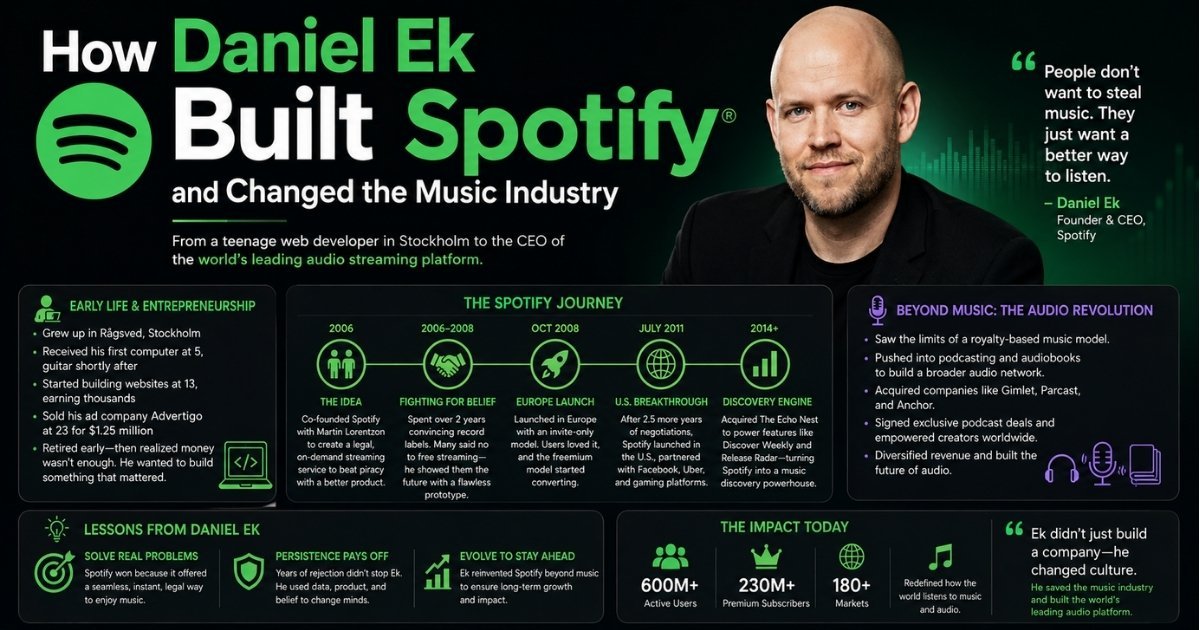
Daniel Ek achieved global success by founding Spotify in 2006 alongside Martin Lorentzon. Ek identified a middle ground between piracy and paid downloads, creating a legal streaming service that compensated artists while providing a seamless user experience. Today, Spotify dominates the audio streaming market, and Ek’s journey offers a masterclass in persistence and innovation.
The music industry looked vastly different two decades ago. Digital piracy ran rampant, record label revenues plummeted, and consumers frustrated by restrictive purchasing models flocked to illegal file-sharing sites. It seemed impossible to find a solution that satisfied both listeners and creators. Many companies tried to solve the piracy problem, but most failed to offer a user experience that could compete with the appeal of free music.
Enter Daniel Ek. The Swedish entrepreneur looked at the crumbling landscape of the music business and saw an opportunity. Ek understood that people did not want to steal music; they simply wanted a better, faster, and more accessible way to listen to their favorite artists. By combining the convenience of peer-to-peer networking with a legal, licensing-based framework, Ek built a platform that rescued a failing industry and completely revolutionized how humans consume audio.
Reading about the Daniel Ek success story provides deep insights into the mind of a visionary leader. Entrepreneurs and business professionals can learn a great deal from his methodical approach to problem-solving, his willingness to endure years of industry pushback, and his relentless focus on the end-user experience.
This comprehensive breakdown explores the timeline of Daniel Ek’s life. We will examine his early ventures, the complex negotiations required to launch Spotify, and the leadership strategies that helped him scale a small Swedish startup into a global technology powerhouse.
Early Life: How Did Daniel Ek’s Childhood Shape His Entrepreneurial Journey?
Daniel Ek grew up in Rågsved, a working-class suburb of Stockholm, Sweden. Born in 1983, Ek showed an early aptitude for both music and technology. He received his first computer at age five and a guitar shortly after. This dual interest in computers and music would later form the foundation of his greatest enterprise.
By the time Ek turned 13, he started his first business from his bedroom. He noticed that local businesses needed websites, but professional development agencies charged exorbitant fees. Ek began building websites for clients, initially charging $100 per project. He quickly scaled his operations, eventually charging upwards of $5,000 per website. To handle the increasing workload, Ek recruited his classmates, paying them with video games and computer parts.
By age 18, Ek managed a team of programmers and earned more money than his parents. He applied for an engineering role at Google but received a rejection because he lacked a college degree. Undeterred, Ek enrolled at the KTH Royal Institute of Technology in Stockholm. However, he dropped out after just eight weeks, realizing that traditional academia could not keep pace with his ambition.
Ek went on to work for several technology companies, including Tradera (which eBay later acquired) and Stardoll. He eventually founded Advertigo, an online advertising company. In 2006, Ek sold Advertigo to TradeDoubler for a reported $1.25 million. At just 23 years old, Daniel Ek achieved financial independence.
The Empty Retirement: What Inspired Daniel Ek to Create Spotify?
Following the sale of Advertigo, Ek decided to retire. He bought a luxury apartment in Stockholm, purchased a red Ferrari, and spent his days socializing at high-end clubs. Despite achieving the quintessential entrepreneurial dream, Ek quickly fell into a deep depression. He realized that money and material possessions did not provide lasting fulfillment. Ek wanted to work on a project of massive global significance.
During this period of soul-searching, Ek reconnected with Martin Lorentzon. Lorentzon was the co-founder of TradeDoubler, the company that purchased Ek’s advertising firm. The two men bonded over their shared disillusionment with the corporate world and their desire to build something meaningful. They spent hours sitting in Ek’s apartment, watching movies, and discussing potential business ideas.
The conversation continually drifted back to music. The early 2000s marked the peak of the Napster era. Napster and subsequent file-sharing platforms like Kazaa and LimeWire decimated the traditional music industry. CD sales collapsed. Apple’s iTunes offered a legal alternative by selling digital downloads for 99 cents a song, but Ek believed that model still introduced too much friction for the average listener.
Ek realized that the only way to beat piracy was to create a service that performed better than piracy. The service needed to offer instant access to the world’s music library, it needed to be legal, and it needed to compensate the rightsholders. With this bold vision in mind, Daniel Ek and Martin Lorentzon officially founded Spotify in Stockholm in 2006.
Founding Spotify: How Did Daniel Ek Overcome Early Music Industry Resistance?
Building the technology for Spotify proved difficult, but navigating the music industry’s legal landscape proved monumental. Ek wanted to offer an on-demand streaming service with a “freemium” model. Users could listen for free with advertisements or pay a monthly subscription fee for an ad-free experience.
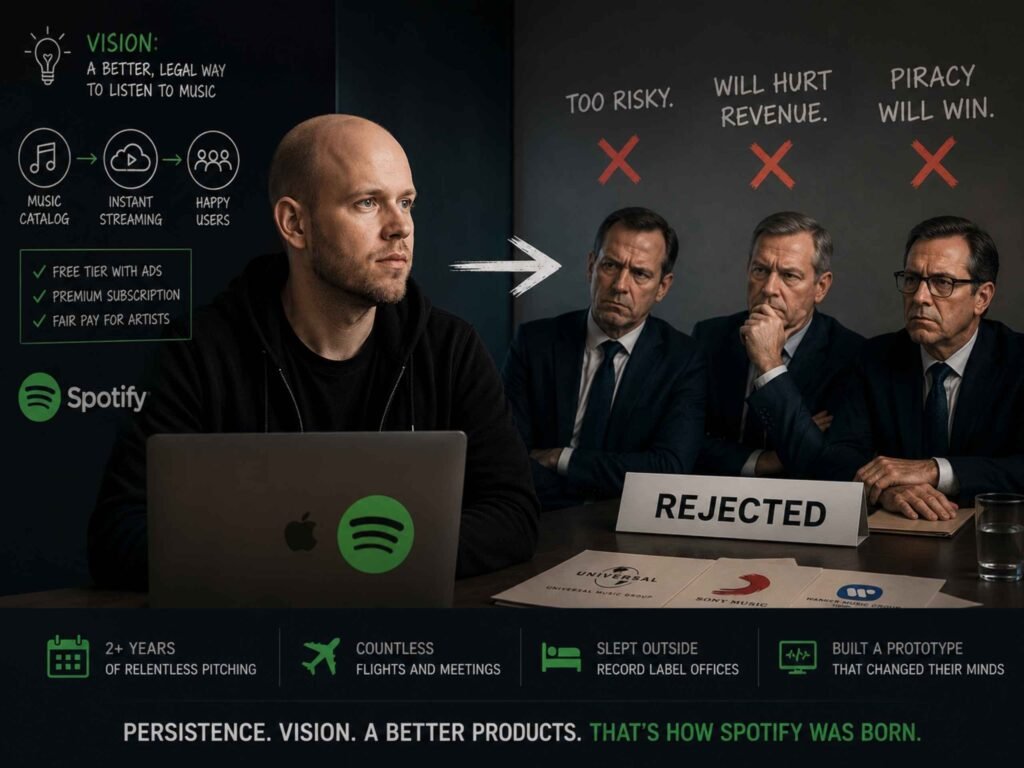
Record labels hated the idea. The music executives viewed free streaming as a continuation of the piracy they desperately fought to eliminate. They heavily favored the pay-per-download model established by Apple. Ek spent over two years flying across Europe, sleeping outside the offices of record executives, and relentlessly pitching his vision. He argued that a legal, free tier would funnel users away from pirate sites, eventually converting them into paying subscribers.
To prove his concept, Ek and his engineering team built a flawless prototype. The technical execution of Spotify set it apart from any prior attempt at streaming. The engineering team utilized a peer-to-peer networking protocol that allowed songs to play instantly upon clicking, eliminating the buffering times that plagued early streaming sites. When Ek finally convinced a few music executives to try the prototype, the instant playback felt like magic.
In October 2008, after securing licenses from the major European record labels, Spotify officially launched in several European countries. The service required an invite to join the free tier, generating massive hype and exclusivity. The strategy worked brilliantly. European users flocked to Spotify, and the conversion rate from free listeners to paying subscribers steadily climbed.
Global Expansion: What Strategies Helped Spotify Dominate the Streaming Market?
Success in Europe provided strong validation, but Daniel Ek knew that true global dominance required conquering the United States market. The American music labels remained highly skeptical of the freemium model. Apple, fiercely protective of its iTunes revenue, also allegedly pressured labels to resist Spotify’s entry into the US.
Ek refused to back down. He spent another two and a half years negotiating with American record executives. He leveraged the data from Spotify’s European success, demonstrating that the platform generated significant revenue and drastically reduced piracy rates in countries like Sweden and Norway. Finally, in July 2011, Spotify launched in the United States.
The US launch accelerated Spotify’s growth exponentially. Ek forged strategic partnerships to integrate Spotify into everyday life. A pivotal partnership with Facebook in 2011 allowed users to share their listening habits directly on their social feeds, creating a powerful viral marketing engine. Spotify later partnered with Uber, allowing passengers to control the music during their rides, and integrated heavily with gaming consoles like the PlayStation.
Ek also heavily prioritized algorithmic discovery. In 2014, Spotify acquired the music intelligence company The Echo Nest. This acquisition led to the creation of flagship features like “Discover Weekly” and “Release Radar.” By providing highly personalized music recommendations, Spotify transformed from a simple music catalog into an active music discovery engine. This personalization significantly increased user retention and solidified Spotify’s position against emerging competitors like Apple Music and Amazon Music.
Moving Beyond Music: Why Did Daniel Ek Push Spotify Into Podcasting?
By 2018, Spotify went public through a direct listing on the New York Stock Exchange, completely bypassing the traditional initial public offering (IPO) process. The direct listing reflected Ek’s unconventional thinking and his desire to democratize the financial markets for his employees and early investors.
Despite dominating the music streaming sector, Ek identified a structural flaw in the company’s business model. Every time a user streamed a song, Spotify paid a royalty fraction to the record labels. This variable cost structure meant that as Spotify grew, its payout costs grew proportionally, squeezing profit margins. Ek needed a new audio vertical with a fixed-cost structure. He found the answer in podcasting.
In 2019, Daniel Ek announced an ambitious strategy to transition Spotify from a music streaming company into the world’s leading audio network. Spotify spent heavily to acquire podcast production companies like Gimlet Media and Parcast. The company also purchased Anchor, a platform that democratized podcast creation by allowing anyone to record and distribute a show from their smartphone.
Ek’s aggressive push into podcasting culminated in massive exclusive licensing deals. By bringing prominent podcasters exclusively to the platform, Spotify successfully attracted millions of new users who sought non-music audio content. This strategic pivot diversified Spotify’s revenue streams, increased advertising opportunities, and reduced the company’s reliance on the major music labels.
Lessons Learned: What Can Entrepreneurs Learn from Daniel Ek’s Leadership?
The Daniel Ek success story highlights several core principles that aspiring founders can apply to their own ventures. Ek’s leadership style contrasts sharply with the loud, extroverted personas often associated with Silicon Valley CEOs. He leads with quiet conviction, a deep focus on product engineering, and a remarkable tolerance for long-term delays.
First, Ek emphasizes the importance of solving actual consumer pain points. He did not build Spotify to stroke his own ego; he built it because the user experience of acquiring digital music was fundamentally broken. By prioritizing a frictionless user experience—specifically the zero-latency playback—Spotify won the loyalty of millions.
Second, Ek demonstrates the power of extreme persistence. The music industry rejected his pitches for years. Instead of abandoning his vision, Ek systematically addressed their concerns with hard data and an undeniable prototype. Entrepreneurs must prepare for institutional resistance when attempting to disrupt established industries.
Third, Ek shows a willingness to cannibalize his own success to ensure future growth. When Ek pivoted Spotify toward podcasting and audiobooks, he risked alienating pure music fans. He understood that long-term survival required continuous evolution, even if those changes caused short-term friction.
The Future of Audio: Where Is Daniel Ek Taking Spotify Next?
Today, Spotify boasts hundreds of millions of active users and subscribers globally. The platform has expanded to include audiobooks, further cementing Ek’s vision of dominating the broader audio landscape. Ek continues to push the boundaries of machine learning and artificial intelligence, exploring how AI can generate personalized audio streams and even assist creators in producing new content.
Daniel Ek built a company that fundamentally changed culture. He saved the music industry from its own downward spiral and created a global ecosystem where artists can reach fans in every corner of the world. His journey from a teenage web developer in Stockholm to the CEO of a multi-billion dollar enterprise serves as a powerful testament to the impact of focused, relentless innovation.
For readers interested in entrepreneurial growth and investment success, this detailed look at Masayoshi Son SoftBank Group explores how bold decisions helped shape a global technology empire.
Entertainment and creator success can also be explored through this profile on Ado Net Worth and the journey of Kanna Hashimoto Net Worth, showing how talent and audience connection drive lasting recognition.
Frequently Asked Questions About Daniel Ek and Spotify
What is Daniel Ek’s net worth?
According to financial reports from 2024, Daniel_Ek’s net worth is estimated to be in the multi-billion dollar range, primarily tied to his substantial ownership stake in Spotify. His wealth fluctuates based on the company’s stock performance on the public market.
How did Daniel Ek start Spotify?
Daniel_Ek started Spotify in 2006 with co-founder Martin Lorentzon in Stockholm, Sweden. They sought to create a legal alternative to music piracy by offering an on-demand streaming service that compensated rightsholders through advertising revenue and premium subscription fees.
Does Daniel Ek still run Spotify?
Yes. Daniel_Ek continues to serve as the Chief Executive Officer (CEO) and Chairman of Spotify. He remains actively involved in shaping the company’s long-term product strategy and its expansion into new audio formats like podcasts and audiobooks.
Why did Spotify buy podcast companies?
Spotify acquired podcast companies to diversify its content offerings and improve profit margins. Unlike music, where Spotify pays royalties per stream, owned podcast content allows the company to generate higher advertising revenue without paying proportional licensing fees to record labels.
