
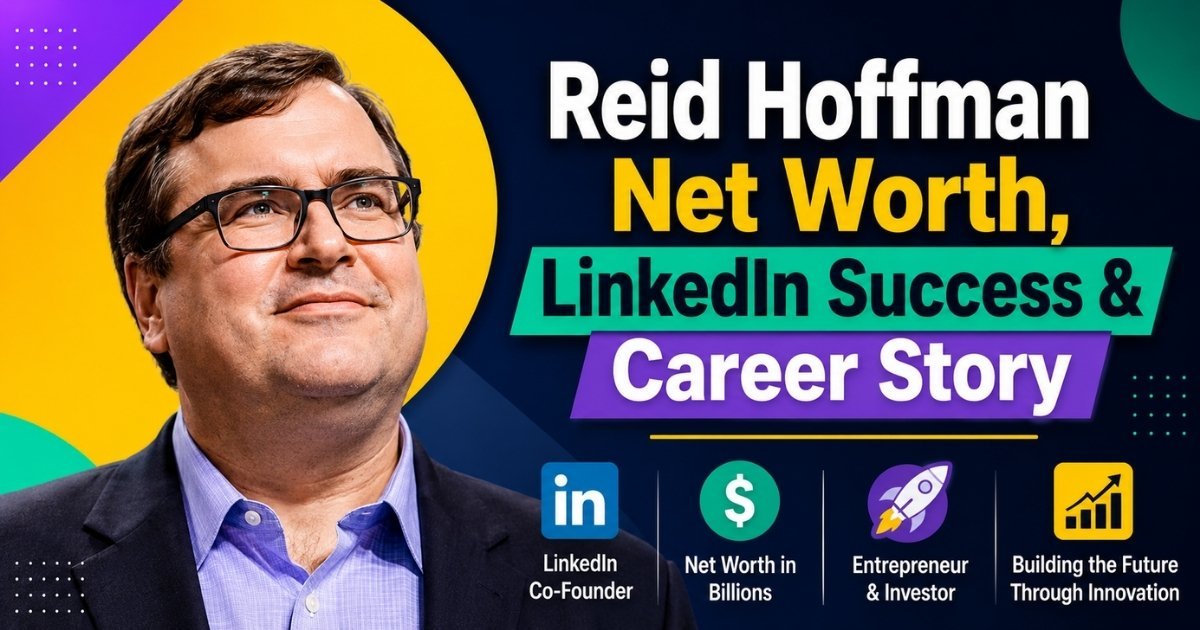
Reid Hoffman is a prominent entrepreneur, venture capitalist, and author best known as the co-founder of LinkedIn. His career began at Apple and Fujitsu before founding his first social networking site, SocialNet, in 1997. After serving as Executive Vice President at PayPal, Reid Hoffman launched LinkedIn in 2002, later joining Greylock Partners to invest in major tech companies like Airbnb and Facebook.
Reid Hoffman is rarely the loudest voice in the room, yet his fingerprints are visible on almost every major consumer internet company of the past two decades. Most professionals recognize his name instantly as the visionary who helped turn a digital resume repository into LinkedIn, the world’s premier professional networking platform.
But building LinkedIn is only one chapter in a sprawling career. Reid Hoffman has consistently positioned himself at the exact center of major technological shifts. He navigated the early days of online payments with PayPal, shaped the Web 2.0 social networking boom, and is now actively driving the rapid acceleration of artificial intelligence, further contributing to the story behind Reid Hoffman Net Worth and his long-term influence across the technology industry.
Understanding the career journey of Reid Hoffman provides a blueprint for modern entrepreneurship. His professional life demonstrates the immense value of cultivating strong networks, learning from early failures, and identifying the next massive wave of technological innovation before it breaks into the mainstream.
This comprehensive guide explores the specific milestones that define Reid Hoffman’s career. We will trace his path from academia to his early attempts at building social networks, his pivotal role in the PayPal Mafia, his monumental success with LinkedIn, and his current focus on artificial intelligence as a leading venture capitalist.
Early life and education: How did Reid Hoffman prepare for Silicon Valley?
Reid Hoffman was born in 1967 in Stanford, California, placing him geographically at the heart of the tech industry from day one. However, his early interests leaned far more toward academia than business. He attended The Putney School in Vermont, an environment that encouraged independent thinking and practical problem-solving.
When Reid Hoffman returned to the West Coast to attend Stanford University, he enrolled in the Symbolic Systems program. This interdisciplinary major combined computer science, philosophy, linguistics, and psychology. The curriculum forced students to think deeply about how humans interact with computers and process information. Reid Hoffman graduated from Stanford in 1990 and subsequently earned a Marshall Scholarship to study at the University of Oxford.
At Oxford, Reid Hoffman pursued a Master’s degree in Philosophy. He initially intended to become a public intellectual and a university professor. He believed that writing books and teaching would be the most effective way to influence society positively. However, he soon realized that the academic publishing cycle was slow and its reach was limited.
Reid Hoffman concluded that building software companies would allow him to create tools that could impact millions of lives simultaneously. This realization prompted his pivot from academia to the technology sector. He joined Apple Computer in 1994, working on eWorld, an early attempt at a social and networking service. When AOL acquired eWorld in 1996, Reid Hoffman spent a brief period at Fujitsu before deciding it was time to build his own company.
What was SocialNet and why did it fail?
In 1997, long before Facebook or MySpace existed, Reid Hoffman founded SocialNet. The platform was designed to match people online based on shared interests, ranging from dating and finding roommates to matching tennis partners. The core concept behind SocialNet was remarkably prescient. Reid Hoffman understood that the internet could facilitate real-world human connections.
Despite having the right idea, SocialNet struggled to gain massive traction. The timing was slightly too early for the broader consumer market to embrace online networking. Furthermore, the company relied on traditional, expensive marketing channels like print and radio advertising to acquire users. Reid Hoffman later reflected that the team did not fully understand the mechanics of viral growth or how to leverage the internet’s unique distribution capabilities.
SocialNet ultimately did not survive the dot-com crash. However, the experience provided Reid Hoffman with crucial insights. He learned that social networks require a highly focused use case to achieve initial adoption. He also recognized the importance of building products that inherently encourage users to invite their existing contacts, setting the stage for his future endeavors.
How did PayPal shape Reid Hoffman’s career trajectory?
While running SocialNet, Reid Hoffman reconnected with Peter Thiel, a friend from his undergraduate days at Stanford. Peter Thiel and Max Levchin were building Confinity, a company that would eventually merge with X.com (founded by Elon Musk) to become PayPal. In 2000, Peter Thiel convinced Reid Hoffman to leave SocialNet and join PayPal full-time.
Reid Hoffman joined PayPal as the Executive Vice President and Chief Operating Officer. In this role, he was responsible for managing all of PayPal’s external relationships. This included negotiating critical partnerships with Visa and MasterCard, managing regulatory challenges, and leading the company’s business development efforts.
The environment at PayPal was famously intense and highly analytical. The company was constantly under threat from established financial institutions, organized fraud rings, and aggressive competitors. Navigating these existential threats forged a remarkably tight-knit and resilient executive team. When eBay acquired PayPal for $1.5 billion in 2002, this group of early employees became highly wealthy and closely connected.
This group, which included Peter Thiel, Elon Musk, Max Levchin, and Reid Hoffman, later became known as the “PayPal Mafia.” The members of this informal network went on to found or fund a staggering number of successful technology companies, including YouTube, Yelp, Tesla, and Palantir. For Reid Hoffman, the PayPal experience solidified his reputation as an elite operator and provided the financial freedom to pursue his next massive idea.
How did Reid Hoffman build LinkedIn into a global powerhouse?
In December 2002, shortly after the eBay acquisition of PayPal, Reid Hoffman gathered a team of former colleagues from SocialNet and Fujitsu to launch a new venture. They founded LinkedIn in Reid Hoffman’s living room, officially launching the platform in May 2003.
Reid Hoffman applied the painful lessons he learned from SocialNet directly to LinkedIn. Instead of trying to connect people for dating, housing, and hobbies simultaneously, LinkedIn focused exclusively on professional networking. The platform provided a digital space for users to maintain their professional identities, connect with colleagues, and discover job opportunities.
Growth in the early days was painfully slow. On some days, the platform only registered a handful of new signups. However, Reid Hoffman and his team focused obsessively on building features that encouraged existing users to invite their professional contacts. They introduced the ability to upload email address books, which dramatically accelerated the platform’s viral growth loop.
Under Reid Hoffman’s leadership as CEO, LinkedIn steadily grew its user base and established a robust business model. Unlike other social networks that relied entirely on advertising, LinkedIn generated revenue through premium subscriptions and recruiting tools for enterprise companies. Reid Hoffman transitioned from CEO to Executive Chairman in 2009, bringing in Jeff Weiner to lead the company’s next phase of scale.
In 2016, Microsoft acquired LinkedIn for $26.2 billion. This transaction cemented Reid Hoffman’s status as a legendary founder and ensured that LinkedIn would remain a fundamental piece of the global professional infrastructure.
What is Reid Hoffman’s role at Greylock Partners?
Following his transition to Executive Chairman at LinkedIn, Reid Hoffman joined the venture capital firm Greylock Partners in 2009. His background as a successful founder and his extensive network made him a highly sought-after investor.
At Greylock Partners, Reid Hoffman focuses primarily on consumer internet, enterprise software, and artificial intelligence companies. He looks for founders who possess a deep understanding of human psychology and the mechanics of network effects. One of his most notable early investments was Facebook. Reid Hoffman famously arranged the initial meeting between Mark Zuckerberg and Peter Thiel, resulting in Peter Thiel’s crucial $500,000 angel investment. Reid Hoffman also invested his own capital in Facebook’s first financing round.
Reid Hoffman has led Greylock’s investments in several iconic companies, including Airbnb. He recognized early on that Airbnb was not just a housing platform, but a community built on trust. He has also served on the boards of companies like Aurora (autonomous vehicles), Coda, and Convoy, guiding founders through the complex challenges of hyper-growth.
How is Reid Hoffman influencing the future of artificial intelligence?
In recent years, Reid Hoffman has become one of the most vocal and active proponents of artificial intelligence. He views AI as a cognitive revolution that will augment human intelligence and reshape every industry on the planet.
Reid Hoffman was an early investor in OpenAI, the research laboratory responsible for creating ChatGPT. He recognized the profound potential of large language models long before they captured the public’s imagination. In 2022, Reid Hoffman co-founded Inflection AI alongside Mustafa Suleyman (co-founder of DeepMind) and Karén Simonyan. Inflection AI focused on creating personal AI assistants designed to be empathetic, conversational, and highly aligned with user values.
Beyond investing and founding companies, Reid Hoffman actively shapes the public discourse around AI. He co-authored the book “Impromptu: Amplifying Our Humanity Through AI,” using GPT-4 to generate portions of the text. He advocates for the responsible and ethical development of AI systems, emphasizing that technology should be designed to elevate human potential rather than replace human workers.
Looking ahead: The ongoing impact of Reid Hoffman
Reid Hoffman’s career demonstrates a remarkable ability to anticipate the future and build the infrastructure necessary to support it. From his early recognition of the internet’s social potential with SocialNet to the establishment of the modern professional identity with LinkedIn, he has consistently focused on building networks that connect people.
Today, as a partner at Greylock Partners and an active participant in the AI revolution, Reid Hoffman continues to fund and advise the next generation of visionary founders. His philosophy of the “startup of you”—treating one’s career as a constantly evolving, entrepreneurial venture—remains a guiding principle for professionals worldwide. As technology continues to evolve, Reid Hoffman’s influence will undoubtedly remain a driving force in shaping how we work, connect, and interact with the digital world.
If you’re interested in exploring more inspiring journeys of innovation, wealth, and entrepreneurship, these stories on Garrett Camp’s Uber Success Journey, Kevin Systrom Net Worth & Instagram Story, Top AI CEOs Net Worth Insights, and Elon Musk Net Worth & Business Empire offer valuable perspectives on how vision and execution create long-term success.
FAQs about Reid Hoffman net worth, career
What did Reid Hoffman study in college?
Reid Hoffman earned a Bachelor of Science degree in Symbolic Systems and Cognitive Science from Stanford University in 1990. He then attended the University of Oxford on a Marshall Scholarship, where he earned a Master of Studies in Philosophy in 1993.
Was Reid Hoffman part of the PayPal Mafia?
Yes, Reid Hoffman is a prominent member of the PayPal Mafia. He served as the Executive Vice President and Chief Operating Officer of PayPal, working closely with other notable tech figures like Peter Thiel, Elon Musk, and Max Levchin before eBay acquired the company in 2002.
How much did Microsoft pay to acquire LinkedIn?
Microsoft acquired LinkedIn for $26.2 billion in cash in December 2016. At the time, Reid Hoffman was the Executive Chairman of LinkedIn. Following the acquisition, Reid Hoffman joined Microsoft’s board of directors.
What companies does Reid Hoffman invest in?
As a partner at Greylock Partners, Reid Hoffman has invested in numerous successful technology companies. His notable investments include Airbnb, Aurora, Coda, Convoy, and Entrepreneur First. He was also an early angel investor in Facebook and Zynga.
What AI companies is Reid Hoffman involved with?
Reid Hoffman was an early investor in OpenAI and served on its board of directors. He also co-founded Inflection AI in 2022, a company focused on building personal and empathetic artificial intelligence assistants.
Explore more inspiring stories of success, fame, and wealth through these features on Ado, Kanna Hashimoto, Gautam Adani, and Mukesh Ambani.
