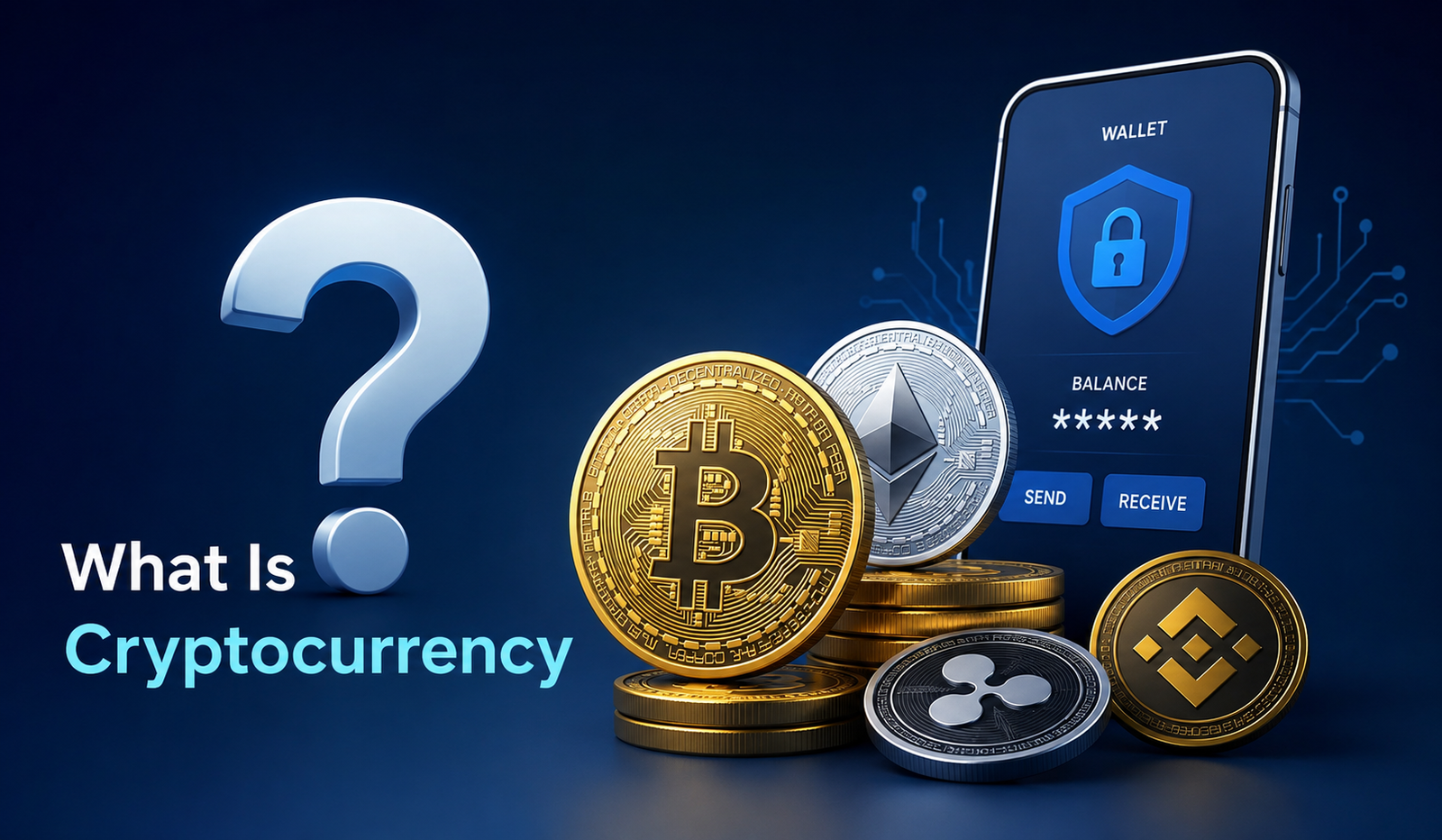
What Is Cryptocurrency and How Does It Work for Beginners?
Cryptocurrency is a form of digital or virtual currency that uses cryptography for security and operates on decentralized networks called blockchains. Unlike traditional currencies issued by governments, cryptocurrencies are not controlled by any central authority, making them borderless, transparent, and resistant to censorship.
Cryptocurrency has gone from a niche internet experiment to a global financial phenomenon in just over a decade. Millions of people around the world now buy, sell, hold, and transact with digital currencies like Bitcoin and Ethereum every day. Yet for many, the concept still feels abstract, technical, or even intimidating.
This guide cuts through the noise. Whether you’ve heard the term in passing or you’re seriously considering investing, this post will explain exactly what cryptocurrency is, how it works, why it matters, and what risks come with it. By the end, you’ll have a clear, grounded understanding of one of the most disruptive technologies of the 21st century.
No jargon. No hype. Just the facts.
What Exactly Is Cryptocurrency and How Does It Differ From Regular Money?
Cryptocurrency is a type of digital currency that exists only in electronic form. There are no physical coins or paper notes. Instead, ownership and transactions are recorded on a shared digital ledger called a blockchain.
The key difference between cryptocurrency and traditional money—like US dollars or Indian rupees—is who controls it. Traditional currencies are issued and regulated by central banks and governments. Cryptocurrency, on the other hand, operates on a decentralized network, meaning no single entity controls it. Transactions are verified by a distributed network of computers (called nodes) rather than a central authority like a bank.
This decentralization has two major implications. First, it makes cryptocurrency transactions difficult to censor or block. Second, it eliminates the need for intermediaries like banks when transferring money, especially across borders. According to the World Bank (2023), cross-border remittance fees average around 6%, a cost that blockchain-based transfers can drastically reduce.
How Does Blockchain Technology Power Cryptocurrency?
To understand cryptocurrency, you need a basic grasp of blockchain—the technology that makes it possible.
A blockchain is a chain of “blocks,” where each block contains a group of verified transactions. Once a block is added to the chain, it cannot be altered or deleted. This creates a permanent, tamper-resistant record of every transaction ever made on that network.
Here’s how a typical transaction works:
- User A wants to send cryptocurrency to User B.
- The transaction is broadcast to a network of computers (nodes).
- The nodes validate the transaction using consensus mechanisms (more on that shortly).
- The verified transaction is grouped with others into a block.
- The block is added to the existing chain—permanently.
This process happens without any bank or third party involved. The MIT Digital Currency Initiative describes blockchain as “a foundational technology that could reshape finance, supply chains, healthcare, and governance.”
There are two primary consensus mechanisms used to validate transactions:
- Proof of Work (PoW): Used by Bitcoin. Miners compete to solve complex mathematical puzzles. The winner adds the next block and earns a reward. This process consumes significant energy.
- Proof of Stake (PoS): Used by Ethereum (since its 2022 “Merge”). Validators are chosen based on how much cryptocurrency they “stake” as collateral. This method uses far less energy than PoW.

What Is Bitcoin and Why Was It the First Cryptocurrency to Matter?
Bitcoin (BTC) is the first and most well-known cryptocurrency. It was created in 2009 by an anonymous person or group using the pseudonym Satoshi Nakamoto, who published the now-famous Bitcoin whitepaper in October 2008.
Nakamoto’s goal was straightforward: create a peer-to-peer electronic cash system that allowed people to transact directly without a trusted third party like a bank or payment processor.
Bitcoin introduced several revolutionary concepts:
- A fixed supply of 21 million coins, making it deflationary by design.
- A public, permissionless ledger anyone can audit.
- A decentralized network that has operated continuously since January 2009.
As of 2024, Bitcoin’s market capitalization has exceeded $1 trillion at various points, making it one of the most valuable assets in the world by market cap. CoinMarketCap tracks real-time data for Bitcoin and thousands of other cryptocurrencies.
What Are the Most Popular Cryptocurrencies Beyond Bitcoin?
Bitcoin may have started the revolution, but it is far from the only player. The cryptocurrency market now includes thousands of digital assets, each with its own purpose, technology, and community.
Ethereum (ETH) is the second-largest cryptocurrency by market cap. Unlike Bitcoin, which is primarily a store of value, Ethereum is a programmable blockchain. Developers can build decentralized applications (dApps) and smart contracts on top of it. According to Ethereum.org, smart contracts are “programs stored on a blockchain that run when predetermined conditions are met”—eliminating the need for middlemen in agreements ranging from loans to insurance claims.
Solana (SOL) is a high-speed blockchain designed to process thousands of transactions per second at low cost. It has become a popular platform for NFTs and decentralized finance (DeFi) applications.
Stablecoins like USDT (Tether) and USDC are cryptocurrencies pegged to the US dollar. They aim to combine the speed and borderless nature of crypto with the price stability of fiat currency—making them popular for remittances and trading.
XRP, developed by Ripple Labs, is designed specifically for fast, low-cost international bank transfers. The Ripple network settles transactions in 3–5 seconds, compared to the 2–5 business days typical of traditional wire transfers.
What Are the Real-World Use Cases of Cryptocurrency in 2024?
Cryptocurrency is no longer just a speculative asset class. Its practical applications are expanding rapidly across industries.
Remittances and cross-border payments represent one of the most impactful use cases, particularly in developing economies. The World Bank reports that remittance flows to low- and middle-income countries reached $669 billion in 2023. Blockchain-based transfers can reduce fees and settlement times significantly.
Decentralized Finance (DeFi) allows users to lend, borrow, earn interest, and trade assets without banks or brokerages. Platforms like Aave and Uniswap operate entirely via smart contracts. According to DeFiLlama, total value locked in DeFi protocols has exceeded $100 billion at peak periods.
NFTs (Non-Fungible Tokens) use blockchain to prove ownership of unique digital assets—artwork, music, gaming items, and more. While the NFT market has been volatile, the underlying technology continues to find legitimate applications in digital ownership and creator monetization.
Supply chain transparency is another growing area. Companies like IBM have developed blockchain-based systems to track goods from origin to consumer, reducing fraud and improving accountability. IBM’s Food Trust network uses Hyperledger Fabric to trace food products across the supply chain.
What Are the Risks and Challenges of Investing in Cryptocurrency?
Cryptocurrency offers significant opportunity, but it comes with equally significant risks. Understanding these is essential before committing any capital.
Price volatility is the most obvious risk. Bitcoin has experienced drawdowns of more than 80% on multiple occasions throughout its history. Unlike stocks, which are tied to company earnings, cryptocurrency prices are heavily influenced by sentiment, regulatory news, and macroeconomic factors.
Regulatory uncertainty remains a major challenge globally. The US Securities and Exchange Commission (SEC) has pursued legal action against several major crypto exchanges, and regulatory frameworks continue to evolve. The Financial Action Task Force (FATF) has issued guidelines urging countries to regulate crypto to prevent money laundering and terrorist financing.
Security risks are real and consequential. Unlike a bank account, a cryptocurrency wallet that is lost or hacked typically cannot be recovered. According to Chainalysis (2023), approximately $3.8 billion was stolen from crypto platforms in 2022 alone—the highest annual figure on record.
Scams and fraud are rampant. Rug pulls, Ponzi schemes, and phishing attacks target both novice and experienced investors. Due diligence is non-negotiable.
How Can You Buy, Store, and Secure Cryptocurrency Safely?
Buying cryptocurrency is now accessible to almost anyone with a smartphone. Here’s a straightforward process for getting started safely.
Step 1 – Choose a reputable exchange. Platforms like Coinbase, Kraken, and Binance allow you to buy cryptocurrency using a bank account or credit card. Always verify that the exchange is licensed and regulated in your jurisdiction.
Step 2 – Complete identity verification. Most regulated exchanges require KYC (Know Your Customer) verification, which typically involves submitting a government-issued ID.
Step 3 – Start small. Financial advisors commonly recommend allocating no more than 1–5% of an investment portfolio to high-risk assets like cryptocurrency, especially for beginners.
Step 4 – Secure your assets. Keeping cryptocurrency on an exchange exposes it to platform hacks. A hardware wallet—a physical device that stores your private keys offline—is considered the safest storage method. Popular options include Ledger and Trezor.
Step 5 – Back up your seed phrase. Your seed phrase (a 12–24 word recovery phrase) is the master key to your wallet. Store it offline, in multiple secure locations. Never share it with anyone.
Is Cryptocurrency the Future of Money, or Just a Speculative Asset?
This question divides economists, technologists, and policymakers. The honest answer is: probably both, depending on the asset.
Bitcoin’s fixed supply and decentralized nature have led many to view it as “digital gold”—a store of value and hedge against inflation. Ethereum and its ecosystem of dApps suggest a programmable financial infrastructure that could eventually complement or compete with traditional finance.
Central banks are responding. As of 2024, over 130 countries are exploring Central Bank Digital Currencies (CBDCs)—government-issued digital currencies that borrow blockchain concepts without decentralization. The Atlantic Council’s CBDC tracker documents this global shift in real time.
The technology is clearly here to stay. But whether any specific cryptocurrency becomes widely adopted as a medium of exchange—rather than primarily a speculative investment—remains an open question.
Frequently Asked Questions About Cryptocurrency
What is cryptocurrency in simple terms?
Cryptocurrency is digital money that uses cryptography to secure transactions and operates on a decentralized network called a blockchain. No bank or government controls it.
Is cryptocurrency legal?
Legality varies by country. Cryptocurrency is legal in the United States, the European Union, the United Kingdom, and many other countries. Some countries, like China, have imposed significant restrictions. Always check your local regulations before buying.
Can you lose all your money in cryptocurrency?
Yes. Cryptocurrency prices can drop to near zero, especially for smaller, unestablished coins. Only invest what you can afford to lose entirely.
What is the difference between Bitcoin and Ethereum?
Bitcoin is primarily a store of value with a fixed supply of 21 million coins. Ethereum is a programmable blockchain platform that enables smart contracts and decentralized applications. Both serve different purposes within the crypto ecosystem.
How is cryptocurrency taxed?
In most countries, cryptocurrency is treated as a capital asset and taxed on gains. In the US, the IRS treats crypto as property, meaning gains are subject to capital gains tax. Consult a tax professional for advice specific to your situation.
What is the safest way to store cryptocurrency?
A hardware wallet—such as Ledger or Trezor—stored offline is widely considered the safest method. Always back up your seed phrase securely.
Start Your Crypto Journey with Confidence
Cryptocurrency represents a genuine shift in how value can be stored and transferred—but it demands respect, research, and realistic expectations. The technology is powerful, the opportunities are real, and so are the risks.
The smartest starting point is education. Read the Bitcoin whitepaper. Explore Ethereum’s official documentation. Follow credible sources like CoinDesk and The Block for news. And before investing a single dollar, understand what you’re buying and why.
The crypto space rewards those who take the time to understand it. That process starts here.
